

How to Choose a Large Cassava Starch Line Supplier in Ghana: Installation & Operator Training
If you are hunting for a large cassava starch line in Ghana, you have most likely been quoted by more than one seller already, and what keeps you up at night is probably not the number on the proforma invoice. It is the three assumptions that invoice quietly buries: that the line will actually reach the tonnage it promises once real cassava goes through it; that engineers will physically turn up in Ghana to install and commission it, not just mail a manual; and that your own operators will still run it steady the week the engineers fly home. Every serious "who can you recommend" enquiry is really asking those three questions, and a glossy catalogue answers none of them.
So rather than hand you a name to trust blindly, treat this as a checklist you can run against any shortlist, including ours — what "large" really means, whether a supplier can integrate and build a full line, whether installation suits a Ghana site, whether training is in the contract, and whether after-sales and spare parts are genuinely within reach.
What "Large" Means — and Why It Raises the Bar
Before comparing anyone, agree on the unit of measure. A large cassava starch line should be sized on fresh-root throughput — how many tonnes of cassava are fed in per day — not on a flattering "output" figure, because every downstream machine is chosen against the incoming root load. As an engineering rule of thumb, continuous wet feeding generally takes over from simple dry handling somewhere around 35–40 tonnes of roots per hour; state the supplier's own operating band separately, though, as a capability rather than an industry law. Jinrui Foodtech (Henan Jinrui) builds cassava starch lines spanning roughly 40 to 800 tonnes of fresh-root feed per day, and it has commissioned work right across that span — 80- and 96-tonnes-per-day starch plants in Nigeria, a 192-tonnes-per-day line in DR Congo and a 240-tonnes-per-day plant in Indonesia — so a "large" line is something it has actually delivered, not a figure borrowed from a datasheet.
Scale raises the bar for one blunt reason: a good single machine is not a good line. Starch yield is decided upstream — a rasper reaching around 96% cell-breakage releases far more free starch than a weak crusher — but that extra pulp must then be absorbed by centrifugal sieves and a hydrocyclone station sized on real slurry duty, not the rasper's nameplate. If those stages are undersized, the bottleneck just shifts downstream and the plant never hits its target yield. A supplier who has sized real lines explains how each stage matches the next instead of stacking the most powerful motors it can sell you.
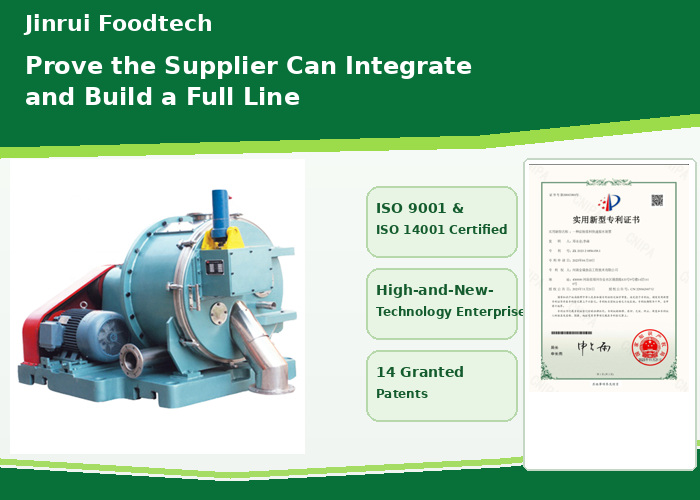 Jinrui Foodtech's intergate cassava starch line
Prove the Supplier Can Integrate and Build a Full Line
A seller that genuinely delivers large lines can walk you through the process flow, not just a product list: cleaning, cutting, rasping, centrifugal screening plus fine-residue screening, multi-stage hydrocyclone purification, peeler-centrifuge dewatering, flash drying, sieving and packing. Ask where each stage hands off to the next, who owns responsibility at each seam, and what is built in-house versus bought in — that distinction belongs in the equipment schedule, not a lump-sum price.
The goal is to replace vague claims with things you can check. Jinrui Foodtech is certified to ISO 9001 and ISO 14001, holds China's High-and-New-Technology Enterprise designation, and has been granted 14 patents on the very stages that decide yield and purity — the dry sieve and drum washer, the centrifugal sieve and its back-flush device, the hydrocyclone pulp-residue separation structure, the drying and rapid-dewatering units, the cutter and the crusher. A company that has designed, built and patented these stages, runs a certified factory and load-tests each line before shipment is far harder to fool with a borrowed spec sheet than a trader reselling someone else's equipment.
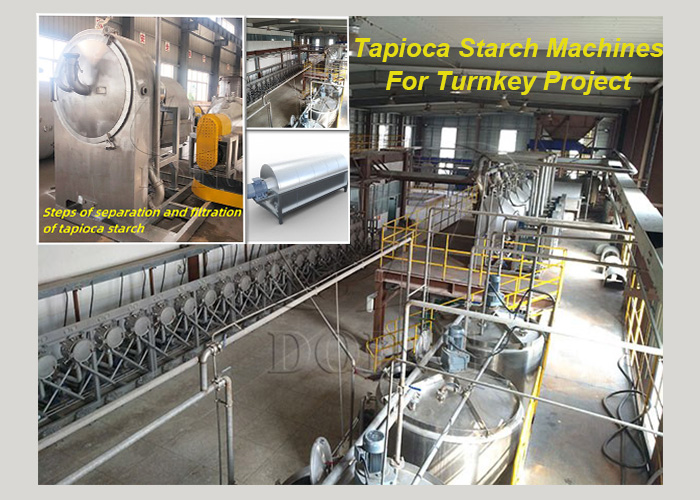 Cassava starch processing project
Confirm Installation and Commissioning That Suits a Ghana Site
This is where large lines actually fail, and rarely for glamorous reasons: foundations poured without the right drawings, water and drainage never tied in, a grid too weak to start the motors. Settle responsibility boundaries before the order — who builds foundations, platforms, pipelines and utility connections, who installs, wires and commissions — and insist that layout and foundation drawings arrive during manufacturing, so your Ghana site is prepared in parallel with fabrication rather than waiting on containers.
Then plan around Ghana's real conditions. Where the grid is unreliable, size standby generation against total installed power plus motor starting surge, not just running load; where water is scarce, ask that process-water recycling be designed in, since a full line can draw up to two tonnes of water per tonne of root. Relevance to Ghana should be testable, not assumed: Jinrui Foodtech counts Ghana among its top overseas markets — nine recorded equipment deliveries and eight signed contracts there — meets Ghana FDA food-grade export requirements, and keeps its nearest engineering base in neighbouring Nigeria, so mobilising a team to a Ghana site is a regional move rather than an intercontinental one.
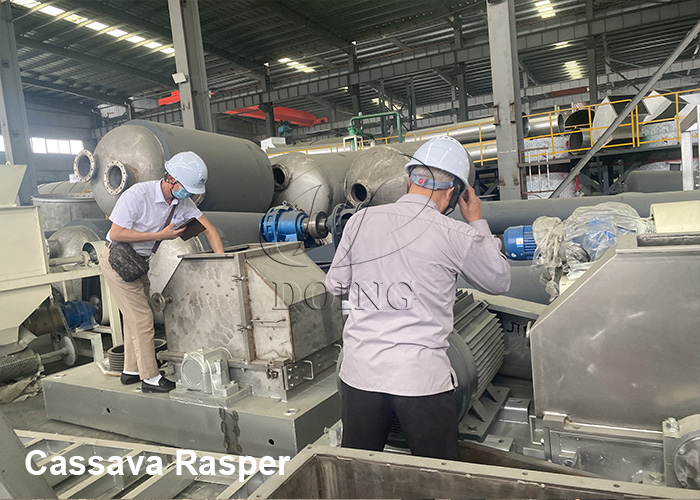 Cassava starch processing solution
Write Operator Training and Local Handover Into the Contract
Installation without training just swaps a foreign dependency for a monthly retainer. Spell the scope out in the contract: safe operation, parameter adjustment, daily maintenance and first-line fault diagnosis at each station. On a large line the continuous extraction stages — the hydrocyclone station and peeler centrifuge — are where operator skill directly drives starch purity and yield, so they deserve the deepest hands-on coverage, not a walkthrough.
Good handover leaves artefacts, not just a visit: an operation SOP, a maintenance manual and a parameter card your team can follow once the engineers are gone. Training works best running alongside commissioning, so operators learn by pushing the real line through its tuning, combining practice with written material so language never becomes the bottleneck. These are Jinrui's own delivered projects rather than generic promises: the 24-tonnes-per-day cassava starch plant it built in Nigeria was set up by a dedicated installation team with separate trainers on site, and government-tendered projects it completed in Guyana and the Central African Republic were likewise finished by engineers who installed, commissioned and then ran systematic operator training. On a prepared site, installation and training together typically run about a month.
Weigh After-Sales and Spare Parts Close to Ghana
Ask what happens after commissioning, in concrete terms. Fix the warranty basis — a standard one-year term starting when the line passes acceptance, not when it leaves the factory, with remote guidance and lifetime technical support beyond it. Then check how close support physically is: the same Nigerian subsidiary and its roughly 1,000 m² overseas parts warehouse in Ogun State, Nigeria — stocking fast-wear spares on African soil — can shorten the wait that would otherwise idle your plant while a single wear part is flown in. Ask for a first-stock list against your configuration, prioritising fast-wear items — rasper blades, sieve plates, hydrocyclone tubes, pump seals.
Frequently Asked Questions
How much fresh cassava will a large line consume, and how do I keep it supplied?
Size your feedstock before your machines. At a 94% extraction rate the process is roughly four tonnes of fresh roots per tonne of starch, so a line feeding 40 tonnes of roots an hour commits you to a large, steady daily supply. Fresh cassava deteriorates within about 48 hours of harvest, so build within reach of farms and secure supply through contract farmers or your own plantations — not spot purchases.
How does my cassava variety and starch content change the equipment?
Variety and dry-matter content drive the front end. Lower-starch or fibrous roots push more pulp through the rasper and screening stages and can pull recovery down, so those stages must be sized on your actual raw material. A supplier who asks your variety before quoting is usually the one thinking about your yield.
How should I plan power where Ghana's grid is unreliable?
Size standby generation on the whole line, not the biggest single motor. Add up installed power, then check the starting surge of the heaviest loads — the flash-dryer blower and the centrifuges in particular — because a generator matched to running load but not starting current will stall. Confirm your site voltage (415 V is common) so motors and controls are matched.
Which quotation line items do buyers most often miss?
The costs that surprise people later are the ones a low headline price hides: engineer travel, visa, airfare and per-diem for on-site installation; first-stock spare parts; laboratory instruments for testing starch at acceptance; and foundation or utility work filed under "client scope". Get these itemised in writing so competing quotes compare on the same terms.
What is the starting investment for a large cassava starch line?
A large starch line sits well above small garri or cassava-flour setups; depending on capacity and PLC automation, a complete line generally falls in the region of roughly USD 100,000 to several hundred thousand. Treat that as indicative only — a real number needs your throughput, configuration and automation level.
Discuss Your Large Cassava Starch Line Project in Ghana with Jinrui Foodtech
Choosing well comes down to a short chain of verifiable checks: size the line on fresh-root throughput, prove the supplier can integrate and manufacture a full large line, agree installation that fits your Ghana site, write training into the contract, and show that after-sales and spare parts are genuinely near you. Run any shortlist — including ours — through those five tests.
If you want a proposal you can verify, share your cassava variety and starch content, your daily fresh-root throughput target, the starch output and automation level you want, and your location in Ghana, and request a configuration and quotation spelling out the capacity calculation, the scope of on-site installation and commissioning, and the operator-training plan. We build that proposal from your inputs and a West Africa delivery record you can check line by line.