

How to Set Up a Combined Garri and Fufu Processing Plant
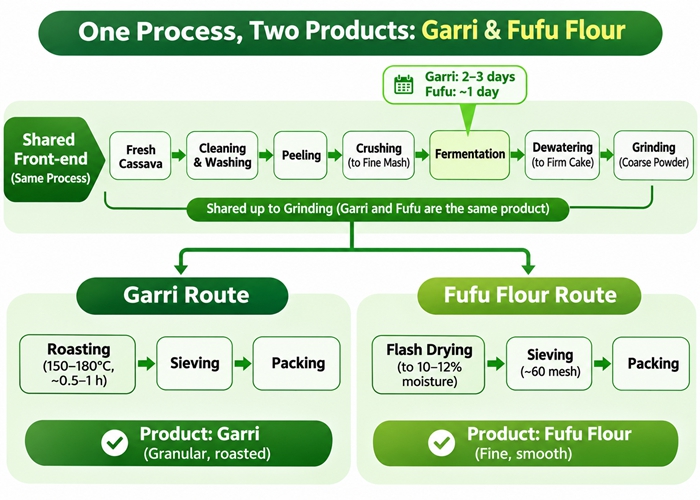
A combined garri and fufu processing plant is one cassava line that ends in two products. Cleaning, peeling, crushing, fermentation and cake grinding run once, on shared equipment; only the dewatering press forks early, because garri cake and fufu mash are pressed to different specifications. After that, the flow splits: garri goes to the roasting pan, fufu flour goes to the flash dryer. For a West African market where both are daily staples, that means one building, one raw-material intake and one team serving two product lines.
This guide covers how a garri and fufu production line works, the equipment each path needs, how to keep capacities matched, and the layout and utilities worth planning before civil works start. The FAQ at the end answers the questions buyers usually ask before committing.
One Process, Two Products: Where the Lines Converge and Split
The shared front-end
Everything up to fermentation is identical for both products. Fresh cassava is cleaned of stones and soil, then washed. Peeling matters more than it looks — most of the cyanogenic compounds sit in the peel.
The peeled roots are crushed into a fine mash and left to ferment, which builds the sour note both foods are known for and breaks down the remaining cyanide. The fermented mash is dewatered into a firm cake, and the cake is ground into a coarse powder.
At this point, garri and fufu are still the same product.
Fermentation: where sharing pays off
Garri ferments naturally for about two to three days. FAO’s guidance on cassava processing notes that around three days of sack fermentation removes 90–95% of the cyanogenic compounds, while the acids and esters that give garri its flavour develop. Fufu runs the same step faster in industrial practice — warm-water fermentation takes roughly a day.
The windows are close enough that one set of fermentation tanks can serve both lines. The schedules just need staggering.
 Garri & FuFu flour processing line
Where the paths divide
The garri route sends the ground cake straight to the roasting pan, where it is stirred continuously at 150–180°C for roughly half an hour to an hour. Roasting gelatinizes the starch and builds the granular texture and sour, crispy character garri is judged by. The finished granules are cooled, sieved and packed.
The fufu route skips roasting entirely. The ground cake goes into a flash dryer, which brings moisture down to 10–12%. The dried powder is sieved to about 60 mesh and packed — a fine, smooth flour for making fufu dough.
| Stage | Garri path | Fufu flour path |
|---|---|---|
| Cleaning → fermentation → grinding | Shared front-end | Shared front-end |
| Dewatering the fermented mash | Hydraulic press | Plate-frame filter press |
| Finishing | Roasting at 150–180°C, then sieving and packing | Flash drying to 10–12% moisture, 60-mesh sieving, packing |
Equipment for a Combined Garri and Fufu Line
The buying logic follows the process: purchase once for everything the two products share, and invest in dedicated machines only where the routes actually differ.
Shared equipment
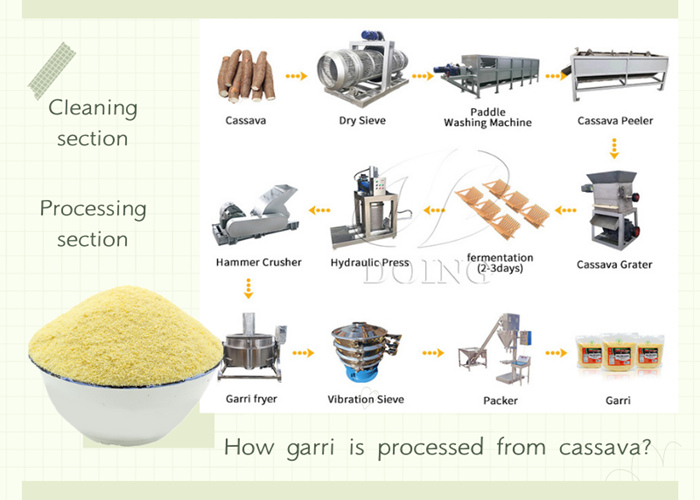
The front-end below handles both products from raw root to ground cake:
Dry sieve
Paddle washing machine
Cassava peeling machine
Crusher or grater
Fermentation tanks
Cake-grinding machine
Dewatering press — the one front-end machine you buy per product, not once for both: a hydraulic press on the garri path (roasting needs a coarse, crumbly cake) and a plate-frame filter press on the fufu path (the flash dryer expects a finer, evenly dewatered mash)
 Garri procesisng line
Product-specific equipment
From the split onward, each line carries only its own finishing machines:
Garri path: a garri fryer (from 100 kg/h semi-automatic units up to fully automatic production scale, heated by gas, diesel or electricity) plus a vibration sieve
Fufu path: a flash dryer and its sieving unit
Matching capacity stage by stage
Whatever the configuration, keep every stage rated for the same throughput. If the crusher takes in more than the press can handle, the bottleneck just moves downstream and the extra crushing capacity sits idle.
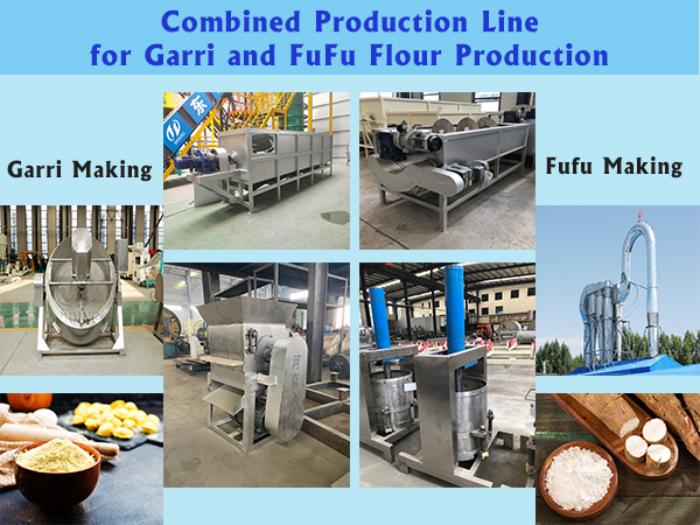
This stage-by-stage matching is exactly how Jinrui Foodtech (Henan Jinrui) configured a combined garri and cassava flour line for a Nigerian client — rated at 12 tonnes of raw cassava per day. The full equipment set shipped with CAD factory layout drawings, and engineers from the company’s Nigeria office installed the line and trained the operators on site. The same shared-front-end logic carries directly over to a garri–fufu plant.
On capacity: garri lines run from 1 to 50 tonnes per day of finished product, and a fufu section starts making economic sense from around 5 tonnes per day. Most combined plants are sized inside that band, scaled to budget and the demand mix in their trading area.
 Combined line for garri and cassava flour production
Factory Layout and Utilities for a Dual-Product Plant
Material flow
Two product streams in one building live or die by the flow. The workable pattern is linear: raw material in at one end, through the shared front-end in the middle, then out along two separate finishing legs to separate finished-goods storage.
Two rules keep it running. Place the roasting area and the drying area on opposite sides of the shared section, so the heat and steam of one path stay away from the other. And never let the flow double back on itself.
Factory size
The reference layouts Jinrui Foodtech works with for single garri lines give a starting point:
1–3 TPD (finished product): roughly 6 × 18 m, with about 6 m of headroom
2 TPH input: planned around 12 × 60 m
4 TPH input: around 12–15 × 60 m
A combined plant needs somewhat more than a single-product line — the flash dryer and the second finishing zone add floor. But because the front-end is shared, the increment is modest next to building two independent factories. The exact footprint depends on your capacity and product mix, so confirm it with layout drawings before the civil works are fixed.
Utilities to plan alongside the building
Electrical power. Add up the connected load across all equipment. Where the grid is unstable — common across many cassava-growing regions — size a backup generator for the critical machines.
Water. Washing consumes roughly 1 tonne of water per tonne of raw cassava. A settling and recirculation loop cuts the net figure considerably.
Drainage. The washing and dewatering zones need floor falls and proper wastewater handling from day one. Retrofitting drainage is far more painful than pouring it in.
Fuel for roasting. Garri fryers run on diesel, LPG or electricity. As a specification reference, roasting a 100 kg batch takes about 3 litres of diesel per hour, or roughly 2.5 litres of LPG — with 1 litre of LPG carrying about 1.12–1.2 times the heat value of diesel.
FAQ: Planning a Combined Garri and Fufu Plant
Which product should the first phase focus on — garri or fufu?
Follow your market, not the equipment. Garri is the larger-volume staple — Nigeria alone is estimated to consume over ten million tonnes a year — so where garri trading is dense, starting with the roasting path usually pays back sooner. Where urban, dough-style demand is stronger, the fufu path leads. The practical answer is to design the shared front-end for both from the start and install one finishing leg first. Adding the second later is then an extension, not a rebuild.
Can the same plant make a third product, like attieke?
Yes, and that is one of the quiet advantages of this design. Attieke runs on the same 1–50 TPD band as garri and reuses the same front-end. What it adds is a pelleting machine that shapes the fermented mash into standard grains before a drying room finishes them. For a plant already built around shared fermentation and dewatering, attieke is closer to a new mould than a new factory.
Should a first combined plant be semi-automatic or fully automatic?
Decide it by labour and consistency, not by prestige. A semi-automatic line has the lower entry cost and suits a first plant still proving its market. A fully automatic line with PLC control costs more upfront but runs continuously with fewer operators and holds product parameters steady — which matters in a combined plant, where operators switch between garri and fufu settings. Many buyers start semi-automatic on the roasting path and automate as volume grows.
What determines the investment for a combined line?
Four things, in rough order of impact: capacity, the level of automation, the materials used on product-contact surfaces, and whether you buy single machines or a turnkey line. The shared front-end is what makes the combined approach attractive financially — one set of cleaning, fermentation and grinding equipment serving two products costs considerably less than two independent lines. For a figure tied to your own capacity and configuration, a quotation from your equipment supplier is the honest source; published ballparks for a cassava processing plant in Africa age fast.
What do installation and after-sales look like for buyers in West Africa?
Stronger than the industry’s reputation, if you choose a supplier with local presence. Jinrui Foodtech has maintained a branch office in Nigeria since 2019 and runs a 1,000-square-metre overseas warehouse in Ogun State stocking spare parts that cover the whole garri process. Engineers are available for on-site installation, commissioning and operator training — the same team that commissioned Jinrui Foodtech’s 12 TPD combined line in Nigeria. Ask any supplier you evaluate the same three questions: where the spares sit, who installs, and who answers the phone in year three.
Discuss Your Combined Garri and Fufu Processing Plant with Jinrui Foodtech
A combined garri and fufu plant rewards early clarity: know where the two processes split, buy the shared front-end once, keep the stage capacities matched, and lay the building out in one direction with the two finishing legs apart. Get those four right and the plant serves two markets without doubling its cost.
If you are ready to set up a garri-fufu plant, contact Jinrui Foodtech with your target capacity, your product mix and your site dimensions — the team will come back with a matched configuration, factory layout drawings and a quotation.