

Centrifugal Sieve vs Rotary Screen for Cassava Starch Processing: Which Is Better?
For most commercial cassava starch lines, a multi-stage centrifugal sieve is the better choice — it runs continuously, washes the fiber repeatedly, and recovers starch that a single screening pass leaves behind. A rotary screen is not obsolete: it separates starch milk from fiber perfectly well in simpler, lower-throughput arrangements. What separates the two in practice is throughput, how many washing stages the fiber gets, and how much starch is still in the pulp when it leaves the section.
Both machines sit in the same position in the flow: after rasping, where starch granules have just been released into a mixture of water and fibrous pulp. Both exist to do one thing — get the starch-rich liquid out and leave the fiber behind. What follows compares how they do it, what each one costs you in performance, and how to choose between them.
1. How Do Centrifugal Sieves and Rotary Screens Work in Cassava Starch Processing?
Same job, different mechanics. A centrifugal sieve throws slurry against a spinning basket; a rotary screen carries pulp along a rotating surface. Everything else follows from that difference.
How a Centrifugal Sieve Separates Starch Milk and Fiber
Slurry enters a spinning basket. Centrifugal action forces the starch milk through the screen while the fibrous pulp is held back and discharged at the other end. Wash water does the rest — it releases starch still clinging to the fiber and carries it through the mesh. On an industrial line, several units run in series, so the fiber is washed again and again before it leaves the extraction section.
Keeping the mesh open is what limits how long a train can be — once it blinds over, extra stages add nothing. A typical cassava line runs four to five stages. That is not redundancy for its own sake: each stage recovers starch the previous one could not reach.
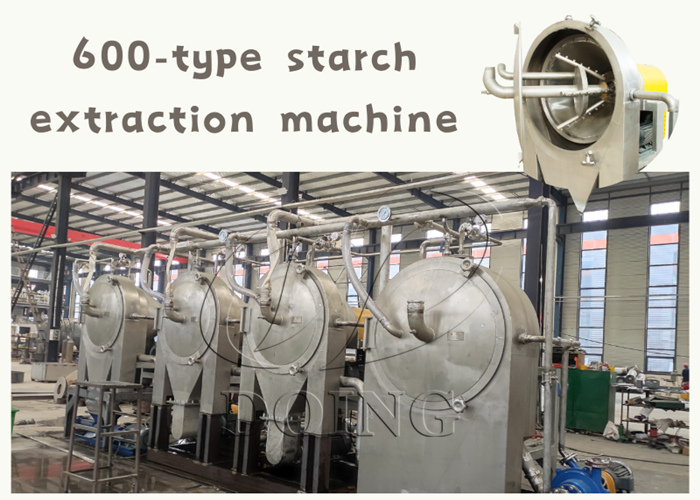 Centrifugal sieve
How a Rotary Screen Separates Starch Milk and Fiber
A rotary screen does the same job with a rotating surface, usually a drum or a cone. Pulp travels along it toward the discharge end, water sprays over it, and starch milk drains through the screen underneath. There is no centrifugal basket involved — movement and wash water do the work.
FAO’s Cassava Processing – Cassava Flour and Starch describes one such design in detail: a hardwood cone at least 3 m long, turning at roughly 50 rpm, with water sprayed onto the pulp at about 6 atmospheres through openings in a hollow shaft. A more elaborate version adds two sets of brushes — one to convey the fiber, one to keep the mesh clear. Read those figures as a description of a specific historical design, not as the specification of every rotary screen on the market today.
Source: FAO – Cassava Processing: Cassava Flour and Starch | www.fao.org/4/x5032e/x5032e02.htm
2. Centrifugal Sieve vs Rotary Screen: Key Performance Differences
Speed is the wrong thing to compare. A sieve turning at 1,120 rpm and a cone at 50 rpm are both fast enough; the difference is how many times the fiber gets washed before it leaves the section, and how much material the arrangement moves while doing it. The table below sets the two side by side.
| Comparison factor | Centrifugal sieve | Rotary screen |
|---|---|---|
| Separation method | Centrifugal action combined with screening and washing | Rotating screening surface combined with water washing |
| Fiber separation | Supports repeated separation through multi-stage configurations | Depends on screen design and washing arrangement |
| Starch recovery | Multi-stage washing can recover starch remaining in pulp | May need additional washing or screening stages |
| Processing capacity | Industrial models for continuous, high-throughput applications | Depends on drum dimensions, screen area and feed conditions |
| Washing arrangement | Integrated multi-stage washing systems | Water spraying and mechanical movement |
| Maintenance | Screen, flushing system, rotating components and alignment | Screen cleaning, brushes if fitted and rotating parts |
| Selection | Commercial lines needing integrated multi-stage extraction | Simpler arrangements that meet performance requirements |
Note: this compares design principles and typical configurations, not a controlled test of two specific machines.
Fiber Separation and Starch Recovery
Holding pulp back on a screen is the easy part. After rasping, a good share of the starch is still locked into the fiber, and every kilogram that leaves with the residue is starch you already paid to grow, harvest and rasp.
Multi-stage centrifugal screening attacks that problem by washing the fiber over and over — each stage gives the residue another chance to release starch. A rotary screen can wash fiber too, and FAO documents it doing exactly that, but how much it recovers depends on screen area, water distribution, feed consistency and whether extra stages follow it. Neither machine’s rpm tells you much about recovery on its own. Bad rasping leaves starch sealed inside unbroken cells; too little wash water leaves released starch in the residue. Two different faults with two different fixes.
Which is why the only meaningful figure is residual starch in the discharged fiber, measured under comparable conditions. Any extraction percentage quoted without that measurement is an estimate, not a result.
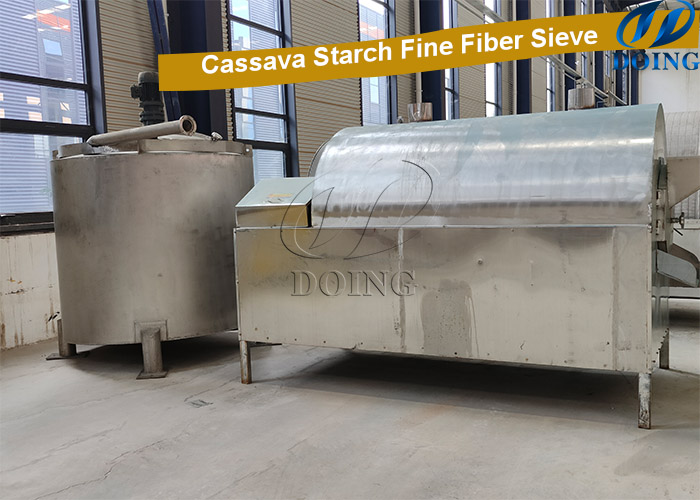 Rotary screen
Processing Capacity and Continuous Operation
Capacity is where the two types stop being comparable. Jinrui Foodtech’s LSW series includes four models spanning 4 to 55 t/h. The figures below are manufacturer’s rated specifications and should be checked against the actual feed characteristics and proposed line configuration.
| Model | Rated capacity | Screen basket diameter | Rotational speed | Motor power |
|---|---|---|---|---|
| LSW60 | 4–10 t/h | 600 mm | 1,120 rpm | 15 kW |
| LSW85 | 10–25 t/h | 850 mm | 1,120 rpm | 22 kW |
| LSW100 | 20–40 t/h | 1,000 mm | 1,050 rpm | 37 kW |
| LSW120 | 30–55 t/h | 1,200 mm | 1,050 rpm | 45 kW |
FAO’s 50 rpm cone carries no throughput rating, so there is nothing to line these figures up against.
One number is missing from most datasheets, including this one: what the t/h actually refers to. For the LSW series it is wet pulp throughput — not fresh root intake — and the gap between the two bases is wide enough to change the model you pick. Size from the slurry your rasping section actually delivers.
Capacity also has to line up with the rest of the plant. The screening section must match the rasper upstream and the purification equipment downstream; a high-capacity sieve fed by a starved rasper changes nothing.
Water Consumption, Maintenance, and Investment
Water is where brochures get quiet. Consumption depends on how many washing stages you run, how thin the slurry is, how the water is distributed, and whether any of it is recovered and reused. A multi-stage centrifugal system is built to integrate washing; a rotary screen typically sprays and brushes. No one can tell you which uses less water per tonne of starch without measured data from your own feed.
Cost works the same way — price the system, not the machine. Pumps, piping, controls, the washing arrangement, and maintenance over the first few years all belong in the comparison. Centrifugal sieves need attention to the rotating assembly, screen condition and flushing components. Rotary screens need screen cleaning, inspection of rotating parts, and brushes where fitted, which are consumables. A sieve quoted at half the price can cost more once the rest of the package is added.
3. Which Screening Equipment Should You Choose for Your Cassava Starch Plant?
Match the machine to the actual problem. Factory size on its own is a poor guide: a 20 t/h plant replacing an old rotary screen and a new 20 t/h plant starting from nothing need different answers. The table below maps common situations to a starting direction.
| Factory requirement | Recommended direction | Main consideration |
|---|---|---|
| New commercial starch plant | Prioritize multi-stage centrifugal sieves | Integrated throughput and repeated washing |
| Smaller operation, simple extraction | Evaluate a rotary screen | Confirm capacity and starch losses |
| Existing rotary screen with starch losses | Assess centrifugal sieve upgrade | Verify loss source before replacement |
| Existing centrifugal sieves with poor recovery | Diagnose current process first | Check rasping, screens and washing |
Small-Scale Production: Evaluate Whether a Rotary Screen Meets the Required Performance
A rotary screen for starch recovery is a legitimate choice when throughput is modest and the machine can reach acceptable fiber separation without a long train of stages. FAO records rotating screens in factories of medium capacity, not just village mills, so “simple” does not mean “artisanal”. Before choosing one for its mechanical simplicity, ask for three numbers: processing capacity on cassava pulp, the washing arrangement, and residual starch in the discharged fiber.
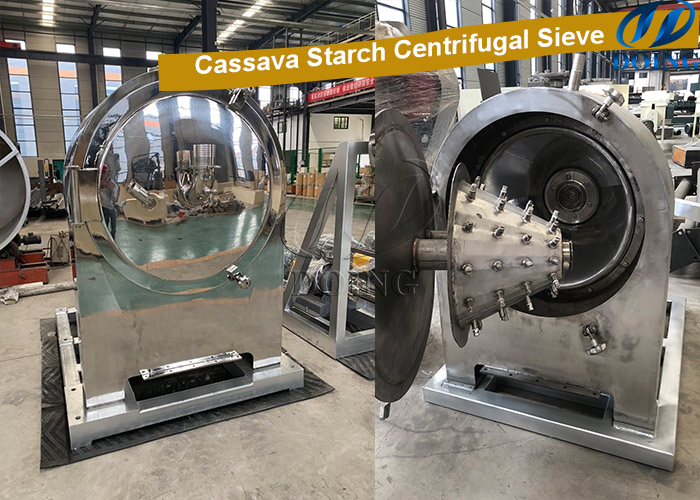 Jinrui Foodtech's cassava starch machine
Commercial Production: Prioritize Integrated Multi-Stage Screening
For a new plant built around continuous operation, multi-stage centrifugal screening is the stronger starting point: industrial throughput plus repeated washing in one section. The value is in the repetition, not in the hardware count. Size the number of stages from the material balance and the target recovery — five stages on a line that needs three buys water bills, not starch.
Existing Factory Upgrades: Identify the Source of Starch Loss Before Replacing Equipment
Losing starch in the discharged pulp does not automatically mean the screen is at fault. There are two distinct failures, and only one of them is a screening problem. Case one: starch sealed inside cells the rasper never opened — the fix is upstream, at the rasping stage. Case two: starch already released but washed out with the residue — that one is screening. Test both before buying. Replacing a rotary screen to cure a rasping problem will not fix the loss.
4. Jinrui Centrifugal Sieve Solutions for Cassava Starch Processing
Jinrui Foodtech builds the LSW60, LSW85, LSW100 and LSW120. Each is a horizontal centrifugal sieve for starch recovery, with stainless-steel material-contact parts, dynamically balanced screen baskets, and front- and back-flushing that keeps the mesh from blinding. Model choice follows your capacity and slurry; the number of stages follows your extraction target.
In a cassava line these units sit between the rasper and the purification section: fiber out, starch milk on. What happens after that — hydrocyclone washing, separation, dewatering — is a different job for different equipment. That is why sieve selection belongs to process design, not to a purchase order.
Frequently Asked Questions
Can a centrifugal sieve replace an existing rotary screen without modifying the processing line?
Not necessarily. A drop-in replacement assumes the same slurry feed, the same pump curve, the same discharge height and enough floor space — assumptions that often fail. Send the existing layout and operating conditions first. A model quoted before those details are known is a guess.
What screen mesh size is suitable for cassava starch fiber separation?
There is no single mesh size, because mesh is stage-specific. The first stage only has to hold back coarse pulp; the last stage decides how much fine fiber reaches the hydrocyclones. Ask for the mesh used at each stage of the train, not one number for the machine, and never copy a figure from a different screening application.
How can a factory measure starch losses in discharged cassava pulp?
Sample the discharged fiber during steady operation, not straight after a start-up. Measure residual starch by a laboratory method, and record material flow and moisture at the same moment so two tests can be compared. Then test again after the change. Squeezing the pulp in your hand tells you nothing about recovery.
What information should buyers provide when selecting a cassava starch centrifugal sieve?
Four things decide the answer: planned fresh cassava throughput, slurry flow data from the existing or intended rasper, the current screening arrangement (or a drawing of the space), and the starch-loss symptom you are trying to fix. For an upgrade, add photographs of the installation area and the available power and water.
Can a centrifugal sieve remove proteins and dissolved impurities from cassava starch milk?
No. A centrifugal sieve removes insoluble fiber; protein and soluble impurities leave in the purification section, typically hydrocyclone washing and separation. Expecting a sieve to improve protein removal is expecting it to do a job it was never designed for — the fix is downstream, not at the screen.
Choosing the Right Cassava Starch Screening System
For continuous commercial production with repeated recovery from fiber, multi-stage centrifugal screening is the stronger choice. Rotary screens remain a real option wherever their capacity, washing arrangement and separation performance meet the requirement. Decide on measured conditions and measured losses — not on rpm, and not on the price of the machine alone.
If you are planning a new cassava starch plant or upgrading an existing screening section, contact Jinrui Foodtech with your raw material processing capacity, current equipment configuration, factory location, and target starch requirements. Our team can help assess suitable centrifugal sieve models and develop a screening configuration for your production needs.