

How to Choose a Cassava Starch Production Line Manufacturer for Your Project
Choosing a cassava starch production line manufacturer is not mainly a price comparison. The real test is whether the supplier can match the process to your raw cassava, define capacity correctly, integrate the equipment, and take responsibility when the plant is installed and commissioned.
From an engineering point of view, five factors should be compared first: complete-line capability, capacity and raw-material assumptions, relevant project experience, equipment integration, and post-delivery support. Only after these points are clear does the commercial offer become meaningful.
1. Complete Cassava Starch Production Line Capability
A supplier that can manufacture one good machine is not automatically capable of delivering a complete cassava starch production line. The important question is whether the supplier can connect each processing stage into one workable system and clearly define its responsibility.
Start with the process flow rather than the equipment catalogue. A typical cassava starch line needs coordinated stages for washing, cutting, rasping, fiber separation, starch extraction and refining, concentration, dewatering, drying, sieving and packaging. The supplier should show how each stage is connected and which equipment is included.
Manufacturing scope is another useful check. If the supplier produces the core machines itself, it has more direct control over equipment matching, fabrication and technical changes. Jinrui Foodtech (Henan Jinrui) manufactures the core equipment — washing, cutting, rasping, centrifugal sieving, hydrocyclone stations, peeler centrifuges and flash dryers — in its own 40,000 m² factory, established in 2011. Sifters are sourced externally, and this distinction is stated in the equipment scope rather than hidden in the quotation.
A complete line means more than a complete equipment list. It means one supplier can define the process relationship, equipment scope and responsibility from raw cassava to finished starch.
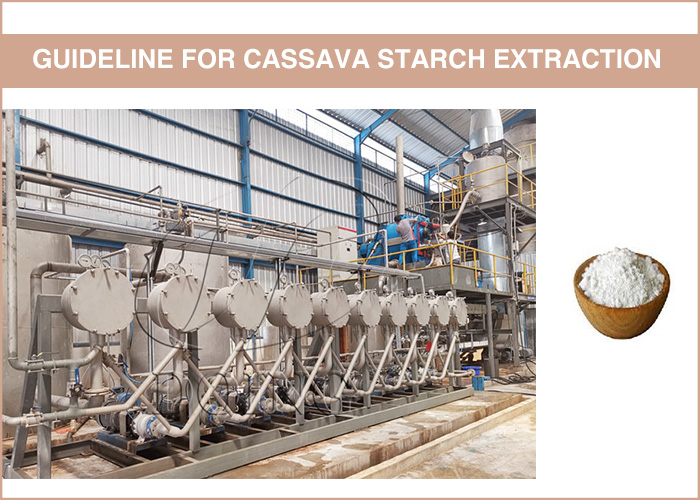 Cassava starch processing equipment
2. Capacity and Raw Material Configuration
One of the easiest ways to compare the wrong quotations is to compare capacity figures without checking what they actually represent. “100 TPD” is not meaningful until the supplier states whether it refers to fresh cassava input, finished starch output, or another operating basis.
For a fresh-cassava starch project, the quotation should clearly state the daily fresh-root input capacity and the operating hours used to calculate it. Jinrui Foodtech (Henan Jinrui) currently covers lines from 40–800 TPD of fresh cassava input, but the equipment configuration is not simply scaled by multiplying machine size. Raw-material conditions and the required process capacity affect the selection of washing, rasping, separation, refining, dewatering and drying equipment.
Raw material is equally important. Cassava variety, starch content, moisture, fiber level, soil contamination and seasonal variation can all affect process performance. Two factories with the same nominal fresh-cassava capacity may therefore require different configurations.
The practical test is simple: ask the manufacturer to put the capacity basis and raw-material assumptions directly into the technical proposal. The calculation should be traceable rather than presented as a single headline number.
A capacity number is only useful when its input basis, operating assumptions and raw-material conditions are clearly defined.
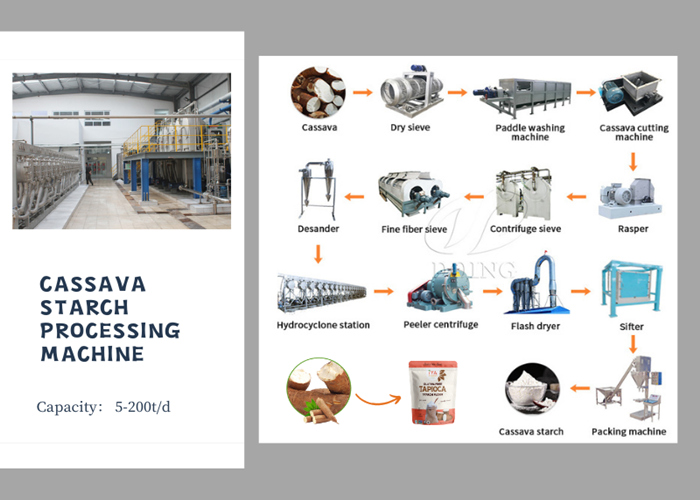 Cassava starch processing plant
3. Relevant Cassava Starch Project Experience
A project becomes useful evidence when it shows how the manufacturer handled conditions similar to yours. The country name alone is not enough; the useful information is the capacity, raw-material situation and engineering decisions behind a cassava starch production line.
A good example is our Oyo, Nigeria — 40 TPD fresh cassava project. The project required a complete process covering raw-cassava cleaning and washing, cutting, crushing, fiber separation, de-sanding, starch concentration and refining, dewatering, drying, sieving and packaging. Because the project was handled during COVID restrictions, a local technician was involved, while our team provided equipment-layout, foundation, platform and pipe-network drawings together with online installation guidance.
Other projects show different selection conditions:
| Project | Capacity (fresh cassava) | Key project condition |
| Ghana cassava starch project | 20 TPD fresh cassava | Medium-scale production requirement and corresponding line configuration |
| Ogun, Nigeria cassava starch project | 80 TPD fresh cassava | Downstream demand and plant location influenced the project planning |
| Indonesia tapioca starch project | 240 TPD fresh cassava | Complex terrain required factory layout and drainage planning around the site |
| Pekanbaru, Indonesia tapioca starch project | 400 TPD fresh cassava | Large cassava farmland supported the decision to move from raw-cassava sales into starch processing |
The configurations above changed with local demand, raw-material supply, site conditions and installation arrangements — which is exactly what relevant experience should demonstrate.
Relevant experience is not the number of project pins on a map. It is evidence that the manufacturer has made comparable engineering decisions before.
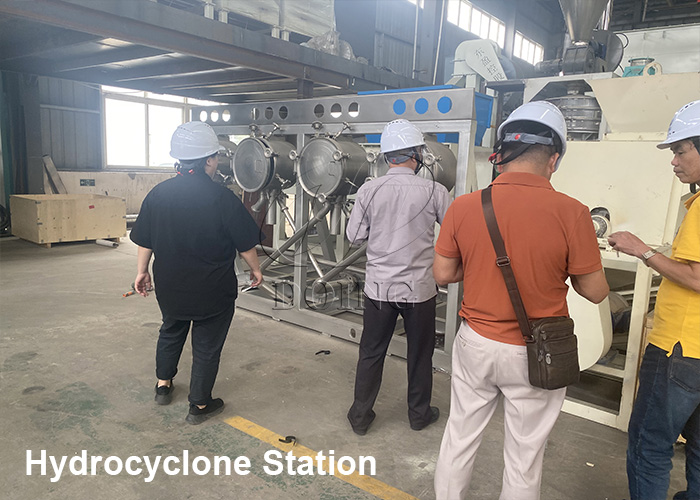 Cassava starch processing machine
4. Process and Equipment Integration Capability
A starch line can contain correctly selected machines and still perform poorly if the machines are not matched as one process. The integration point is where a supplier's engineering ability becomes visible.
The first check is capacity matching between connected stages. A high-capacity rasper, for example, does not help if the downstream extraction or separation stage becomes the bottleneck. Material transfer, pump selection and pipeline sizing also need to follow the actual process flow. Water circulation should be considered as a connected system, including the relationship between process-water demand, pumping and control.
In our cassava starch equipment range, this matching is built in. Jinrui Foodtech's rasper achieves a disruption rate above 95%, which releases more free starch but also sends more fiber into separation — so our centrifugal sieves and hydrocyclone stations, spanning roughly 4–55 TPH depending on model, are selected to handle the resulting slurry load rather than the rasper's nominal capacity alone. At the dewatering stage, the peeler centrifuge brings refined starch to around 38% moisture before drying; the lower this figure, the smaller the drying load and the fuel needed to reach final moisture below 12%.
The weakest stage can define the performance of the whole line. Equipment selection and process integration should therefore be evaluated together.
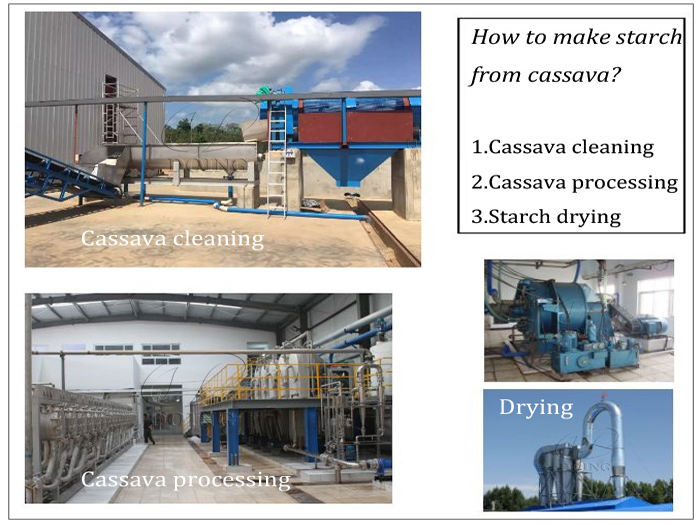 Cassava starch processing units
5. Turnkey Project Support and After-Sales Service
Project problems often emerge after equipment ships — not before. A technically correct equipment package can still face delays if installation responsibility, commissioning, training and spare-parts support are unclear.
Before signing, define who is responsible for site preparation and installation, who performs commissioning, and what operator training is included. These responsibilities should be written into the project scope before equipment production begins.
For a Jinrui Foodtech project, support follows the project timeline:
Equipment manufacturing (2–3 months): Drawings and technical documents are provided so site preparation can proceed in parallel with production.
Installation and commissioning (20–30 days): A commissioning and service team of 20+ engineers can be dispatched to the customer's site for installation guidance and commissioning according to project requirements.
After commissioning: One year of after-sales support is provided, with spare parts available through the overseas support system, including the Nigeria spare-parts warehouse.
Evaluate a cassava starch production line manufacturer not only on what it ships, but also on what happens when the equipment arrives at your factory.
6. How to Compare Cassava Starch Production Line Manufacturers
The easiest way to compare manufacturers is to score evidence rather than brochures or headline prices. Ask every supplier for the same information, put the answers into one comparison sheet, and check where assumptions differ.
| Evaluation criterion | What to ask the supplier | Evidence to request | Suggested score |
| Complete line capability | Can you supply and integrate the complete process? | Process flow + equipment list + responsibility scope | 1–5 |
| Capacity definition | What does the quoted capacity represent? | Fresh-root input/output calculation | 1–5 |
| Raw material configuration | What raw-material assumptions are used? | Starch content, moisture and recovery assumptions | 1–5 |
| Project relevance | Have you handled similar projects? | Comparable project cases | 1–5 |
| Process integration | How are connected stages matched? | Process parameters + equipment matching logic | 1–5 |
| Manufacturing scope | Which equipment is manufactured in-house? | Manufacturing scope/equipment list | 1–5 |
| Installation | Who installs and commissions the plant? | Written scope of responsibility | 1–5 |
| Training | What training is provided? | Training plan/documentation | 1–5 |
| Spare parts | What parts should be stocked locally? | Recommended spare-parts list | 1–5 |
| After-sales support | How are technical problems handled after commissioning? | Support procedure + response terms | 1–5 |
Do not give the highest score to the supplier with the longest equipment list. Give it to the supplier whose assumptions, technical scope, project evidence and responsibilities can be verified.
Compare evidence before price. A lower quotation is not necessarily the lower-cost project if capacity assumptions, integration or commissioning responsibilities are unclear.
FAQ
What documents should I request before comparing cassava starch equipment quotations?
Request the process flow, equipment list, capacity basis, raw-material assumptions, utility requirements and installation scope. Compare these items line by line across suppliers before comparing prices.
Which quotation assumptions should be confirmed in writing?
Confirm fresh-cassava capacity, operating hours, raw-material conditions, utility requirements and equipment scope. Any assumption that affects capacity, performance or cost should appear in the technical proposal or contract rather than remain only in verbal discussions.
How should I verify a manufacturer's project references?
Ask whether the referenced project has comparable capacity, raw-material conditions or site requirements. More importantly, ask what engineering decision the supplier made for that project and whether the same conditions apply to your own plant.
What should I confirm about commissioning before signing?
Confirm who supervises installation, who performs commissioning, what operator training is included and what technical documents are provided. These responsibilities should be clearly defined in the contract before equipment production begins.
What spare parts should I prepare before commissioning?
Ask for a recommended initial spare-parts list based on the actual equipment configuration. Prioritize wear parts and components with longer replacement lead times, and confirm how spare parts can be supplied after commissioning.
Ready to Compare Your Cassava Starch Project?
If you are planning a cassava starch project, send Jinrui Foodtech your cassava variety, estimated starch content, daily fresh-cassava supply and target capacity. We can prepare a technical proposal and quotation with the capacity calculation basis clearly stated, so you can compare the equipment scope and assumptions before making a purchasing decision.