

Should I Choose a Semi-Automatic or Fully Automatic Cassava Flour Processing Line?
There is no universally better option — only the one that fits your current output, market, and budget. This article first shows you exactly what differs between the two, then walks through the key factors that should determine which direction you go, so you can make a grounded choice rather than being swayed by price tags or sales pitches.
1. What the Two Options Actually Look Like
Before getting into decision factors, here is a side-by-side view of how the two configurations differ on the ground.
| Dimension | Semi-Automatic Line | Fully Automatic Line |
| Cassava input | 5–40 TPD | 40+ TPD |
| Labor involvement | Multiple stages require manual operation | Operator runs the whole line via PLC; no other manual work |
| Power demand | Three-phase supply required; smaller total load | Three-phase supply required; larger total load |
| Floor space | Smaller footprint, flexible layout | Larger; requires space for the full line |
| Typical market | Local wholesale, food processors | Export, chains, large buyers |
| Maintenance | Single machines, relatively simple | Full line linkage, higher complexity |
Project reference: Jinrui Foodtech supplied a 5 TPD semi-automatic cassava flour processing line to the Guyana Ministry of Agriculture, awarded through an open public tender. The line processes 20–25 tons of fresh cassava per day to produce 5 tons of finished cassava flour — the kind of configuration common for government and NGO-backed food security projects in the 5–40 TPD range.
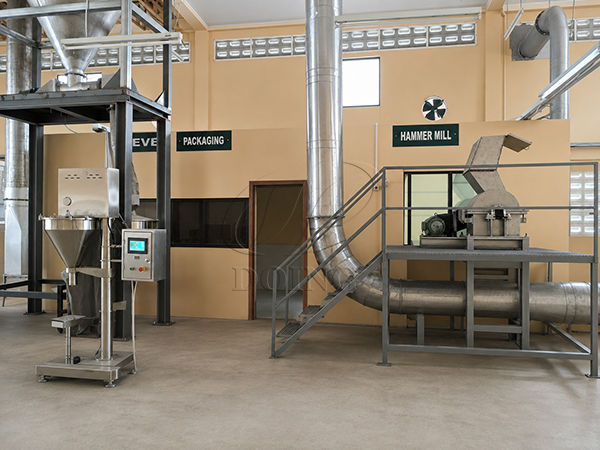 Guyana semi-automatic cassava flour line
2. Six Key Factors That Should Drive Your Choice
Factor 1 — Your target daily output
Cassava input volume is the dividing line. Semi-automatic lines run efficiently in the 5–40 TPD range; above 40 TPD, the manual steps in a semi-automatic setup become the production bottleneck, and the unit cost advantage of full automation starts to show. If your target output falls within 5–40 TPD, a semi-automatic line covers most needs. If you are aiming above 40 TPD, a fully automatic line is the more rational starting point.
Factor 2 — Who you are selling to
Your buyer determines how much consistency you need. Local and regional wholesale buyers have relatively flexible requirements — a well-run semi-automatic line usually meets their standards. If your buyers are exporters, supermarket chains, or food manufacturers, they typically require specific moisture content, microbial limits, and batch-to-batch consistency. Match your line choice to the buyer tier you are targeting: the higher the consistency requirement, the stronger the case for full automation — and at the top tier, only a fully automatic line delivers that level of consistency reliably.
Factor 3 — Power supply reliability
Both configurations need stable three-phase power. In areas with unreliable grid supply, resolve the power question before choosing a line type. Running a fully automatic connected line under unstable power conditions causes more equipment wear from frequent starts and stops than a semi-automatic setup with individual machines.
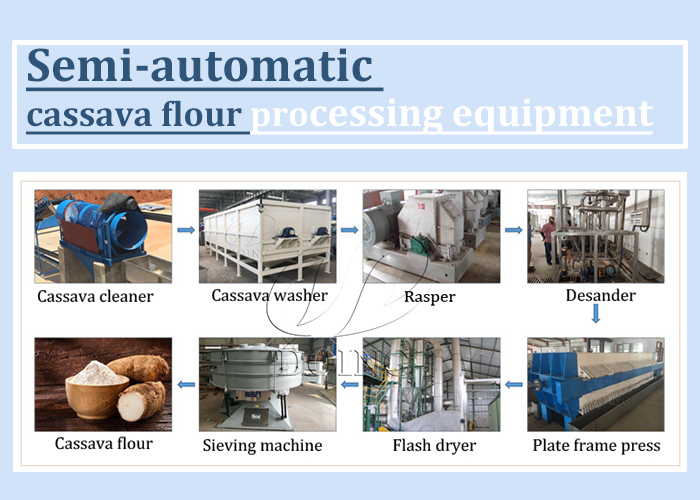 Semi-automatic Tapioca flour processing equipment
Factor 4 — Your available capital and cash flow
Fully automatic lines cost significantly more upfront than semi-automatic lines, but save more on labor over time. When evaluating, look beyond the purchase price — calculate the payback period and what your cash flow can realistically sustain. If cash is tight or the market is still unproven, a semi-automatic line with phased expansion carries less risk.
Factor 5 — Whether this is a new plant or an upgrade
A new plant can be built around a fully automatic line from the start: site layout, power supply, and utilities all planned for the target configuration. An existing plant adding automation needs to account for interface compatibility between new and existing equipment, and for the cost of site modifications — a cost that is easy to overlook and that can push actual spend well beyond the equipment budget.
Factor 6 — Your team’s technical capacity
Fully automatic lines need operators who can read equipment parameters and diagnose basic faults. If your team does not have anyone with this capacity, frequent unplanned downtime and repair costs will cancel out the gains from automation. The good news is that this capability gap can be closed — with the right training and support. Jinrui Foodtech provides systematic operator training and after-sales technical support alongside equipment delivery — helping your team get up to speed quickly and turning your automation investment into stable output.
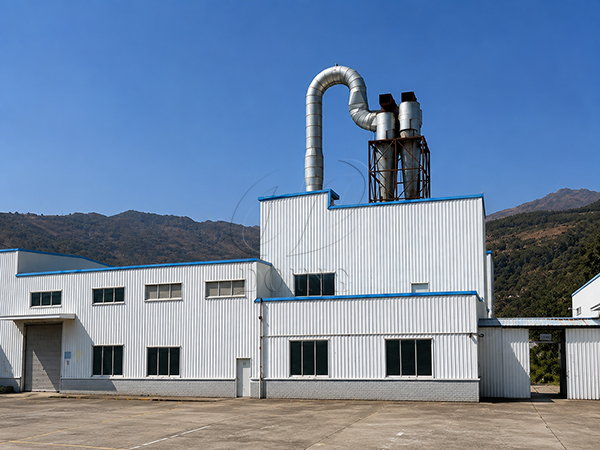 Cassava flour production facility in Ghana
3. A Decision Framework That Maps Your Situation to the Right Choice
Use the table below to locate your current situation and find the direction that fits.
| Your situation | Recommended direction |
| New plant, targeting 5–20 TPD, limited budget | Start with semi-automatic; plan for expansion |
| New plant, targeting 20–40 TPD, stable market | Semi-automatic, higher specification |
| New plant, targeting 40+ TPD, large buyer or export contract | Fully automatic |
| Existing semi-automatic plant, running near capacity, rising labor costs | Evaluate upgrade timing and site conditions |
| Area with unreliable power supply | Resolve power first; reassess line type after |
4. Frequently Asked Questions
What is the one question you should answer before choosing either option?
Ask first: how many tons of fresh cassava can I reliably source every day, across wet and dry seasons? Most buyers jump to “which machine” before answering this — and end up with the wrong line. The 5–40 TPD (semi-auto) and 40+ TPD (full-auto) ranges sort you into the right category once you have the real number.
What hidden costs do most buyers forget when comparing the two options?
Two costs get overlooked. Site prep for a full-auto line — electrical upgrades, foundation work, drainage — routinely adds 15–30% to project cost and is rarely budgeted separately. Full-auto lines also need a spare parts inventory: one machine down means the whole line stops, and waiting for international shipping on critical parts (belts, seals, sensors) costs far more than having them on hand.
Can I upgrade from semi-automatic to fully automatic later without replacing everything?
Yes — if you plan for it at purchase. Three must-haves: standard interfaces so new equipment connects without custom work; electrical and spatial headroom at your site; a supplier who offers add-on modules, not just full-line packages. Jinrui Foodtech designs modular interfaces, supporting phased expansion without replacing the original line. Upgrade when the current line runs near capacity most days, labor costs rise, or buyers need volume you cannot supply.
What power infrastructure do you need in place before the machines arrive?
Four checks: confirm three-phase supply at the correct voltage (380 V or 415 V — single-phase will not run full-auto lines); calculate total connected load and ensure transformer headroom of at least 20%; size a backup generator at 1.3–1.5× total load before ordering; run a dedicated feed line to the processing floor. Utility upgrades can take weeks to months — start early.
What quality certifications or standards do export buyers typically require for cassava flour?
Three frameworks come up most often. Codex Alimentarius sets moisture (max 12–14%) and microbial limits. EU and US FDA require microbiological compliance — achievable with a well-run semi-auto line if drying and packaging are controlled. Many buyers request a Certificate of Analysis (COA) per batch, requiring consistent documented output. Confirm the specific import regulations for your target country before finalizing your equipment.
6. Find the Configuration That Fits Where You Actually Are
The right choice is the one that matches your daily output, your target market, and your capital situation today — not the most advanced option on paper. Once you know your reliable daily cassava supply, which buyer tier you are targeting, and what your budget looks like, the choice narrows quickly.
Send Jinrui Foodtech your target daily output, your buyer profile, and your budget range, and get a configuration recommendation built for your actual situation.