

How to Choose a 20TPD Cassava Starch Equipment Manufacturer in West Africa
Planning a 20-tonne-a-day cassava starch plant in West Africa? The instinct is to start by comparing equipment prices. But a price tag says almost nothing about how much starch you will actually recover, how the line behaves when power is unstable or roots come in muddy, or what happens after the equipment ships. Those are the differences that decide whether your investment runs smoothly or turns into a long list of stoppages.
This guide is a decision framework rather than a brochure tour. Work through the checklist once with every candidate, and the final choice will rest on verified numbers, real operating conditions and a support plan — not on whoever quoted the lowest price or showed the most impressive catalogue.
Clarify the 20 TPD capacity basis before comparing quotes
“20 TPD” means nothing until the supplier states what it represents. It can refer to fresh cassava input, finished starch output, or a different operating basis entirely — and comparing two quotations that use different bases is the fastest way to pick the wrong equipment.
For your project, the basis is 20 tonnes of fresh cassava per day. Ask every supplier to confirm this in writing and to state the operating hours used to calculate it. At 8 hours per day, 20 tonnes/day corresponds to roughly 2.5 t/h of fresh-cassava input — a clear figure the equipment configuration should be built around. If the supplier quotes finished-starch output instead, or does not state the hours, treat the quotation as unverified and ask again.
Table 1 — Capacity basis quick check
What the quotation says | What it means | Why it matters |
|---|---|---|
Fresh-cassava input, 20 TPD | The line is sized for 20 tonnes of roots/day | Directly matches your project |
Finished-starch output, 20 TPD | The line handles roughly 4× that in roots (≈80 TPD input at a 4:1 ratio) | Different scale, different equipment |
20 TPD, hours not stated | Operating basis unclear | Cannot be compared reliably |
A capacity number is only useful when its input basis, operating hours and raw-material assumptions are all defined.
Match the complete line to your 20 TPD fresh-cassava input
Once the basis is clear, the next step is to confirm the supplier can deliver a complete, connected process rather than a list of individual machines. A typical cassava starch line at this scale needs coordinated stages:
Washing — dry sieving removes stones, soil and weeds; counter-current paddle washing follows, so two-stage cleaning protects the skin and the starch.
Pre-cutting and rasping — a cutting machine reduces roots into uniform pieces, then a rasper grinds the mash finely to release bound starch.
Fibre separation — multi-stage centrifugal sieves separate the starch milk from the pulp.
Refining — a hydrocyclone station concentrates, recovers and refines the starch to a clean starch milk.
Dewatering — a peeler centrifuge brings the refined starch to a low moisture level before drying.
Drying, sieving and packaging — flash drying reaches the final moisture target, followed by screening and automatic packing.
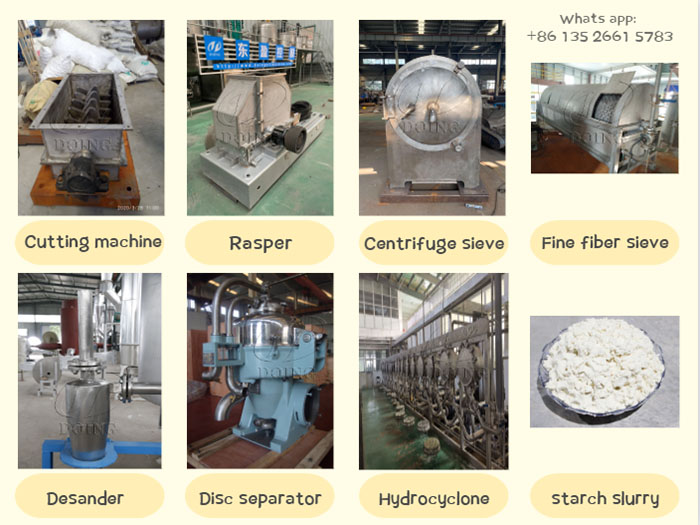 Cassava starch making line
The test is whether the supplier shows how each stage is connected — which machines are included, how material and water flow between them, and who takes responsibility for the whole line from roots to finished starch. This is where a manufacturer's design depth shows. Jinrui Foodtech (Henan Jinrui) designs and builds complete cassava starch lines with a fresh-cassava feed capacity of 2–40 t/h — at 8 hours of operation that is 16–320 tonnes/day, and at 20 hours it is 40–800 tonnes/day — so a 20-tonnes-per-day project sits squarely within a proven capability rather than at its edge.
Benchmark recovery and purity as the deciding metrics
The equipment that matters most is the machinery that decides how much starch you recover and how clean that starch is. These are measurable, and they are the figures that separate good suppliers from weak ones:
Rasping (crushing) rate — a high-speed rasper releases bound starch effectively; expect a disruption rate above 94%, versus roughly 80% for a hammer crusher. Better rasping means more starch recovered from the same roots.
Starch extraction rate — a well-configured line reaches around 94%, i.e. about 4 tonnes of fresh cassava producing 1 tonne of starch. Recovery directly shapes your profit per tonne.
Refining purity — an 18-stage hydrocyclone station is the standard configuration for food-grade output, reaching separation purity around 99.5% and producing a concentrated starch milk at about 23 Baumé. It removes fibre, protein, gum and small particles that would otherwise darken the starch or raise its ash.
Dewatering and drying — a peeler centrifuge takes the refined starch to around 36.5–38% moisture, and the flash dryer brings the final product to about 12–14%, meeting food-grade standards.
For food-grade output — in this project, refined with an 18-stage hydrocyclone station — ask every supplier for these figures in the technical proposal rather than as marketing claims. Jinrui Foodtech builds its cassava starch lines around a rasper with a disruption rate above 96%, an 18-stage hydrocyclone station reaching about 99.5% separation purity, and a peeler centrifuge that brings refined starch to 36.5–38% before flash drying — figures we can show, not just state.
Table 2 — Deciding metrics at a glance
Stage | Metric to ask for | Food-grade benchmark |
|---|---|---|
Rasping | Crushing / disruption rate | > 94% |
Whole line | Starch extraction rate | ~94% (4 t fresh cassava → 1 t starch) |
Refining | Separation purity / starch milk | ~99.5% / ~23°Bé (18-stage hydrocyclone) |
Dewatering | Moisture after centrifuge | 36.5–38% |
Drying | Final moisture | 12–14% |
Adapt the equipment to West Africa's power and raw material
West Africa changes the specification in ways a generic quotation will not show. Two realities matter most.
Unreliable power
Many sites face unstable grid supply. A supplier should offer low-power configurations or diesel-driven options where needed, and an electrical design that matches your local voltage and frequency. Confirm which equipment can run on diesel or a lower-power setup, and how the line copes with brief outages without damaging sensitive machines.
Raw-material conditions
Fresh cassava starts deteriorating quickly — it is best processed within about three days of harvest, and ideally within 48 hours. West African roots can also be high in fibre and carry significant soil, especially in the rainy season. The line should therefore include robust two-stage cleaning and de-sanding, with clog-resistant screens and piping. This is also where water use matters: processing 1 tonne of cassava typically requires about 2 tonnes of water (roughly 30% cleaning water and 70% cell-liquid water), so a counter-current system that recycles process water cuts both water bills and discharge.
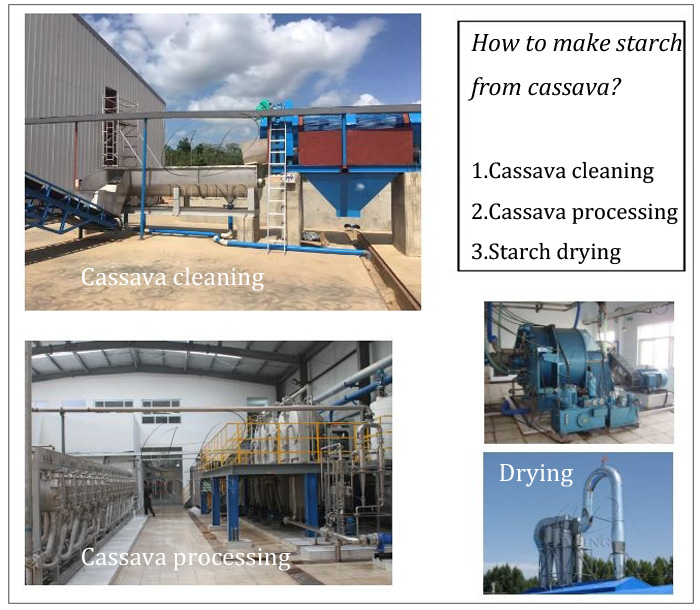 Cassava starch processing plant
Secure local parts, commissioning and training support
Project problems usually surface after the equipment ships, not before. For a plant in West Africa, confirm in the project scope who installs and commissions the line, what operator training is included, and how spare parts and technical support are delivered after commissioning. Remote video support is useful, but a local presence matters far more. Jinrui Foodtech runs a Nigeria branch and a 1,000 m² spare-parts warehouse in Ogun State, backed by an overseas installation and commissioning team of more than a dozen engineers who handle on-site installation guidance, commissioning and operator training. That is the difference between a supplier that answers from a distant call centre and one that answers from a warehouse a few hours away — which is what keeps your line running when it counts.
Validate the candidate with similar West African projects
Project references are only evidence if they show the same kind of engineering decisions your plant needs. A project in a different region, or at a very different scale, tells you less than one that matches your conditions. Ask whether the supplier has built cassava starch plants in West Africa at a comparable fresh-cassava input, and what decisions it made there — capacity sizing, raw-material handling, water circulation, installation in local conditions. Jinrui Foodtech has delivered 20 TPD and 24 TPD cassava starch plants in Nigeria and a larger cassava processing project in the DRC — projects whose configuration was decided around local demand, raw-material supply and site conditions rather than copied from a catalogue.
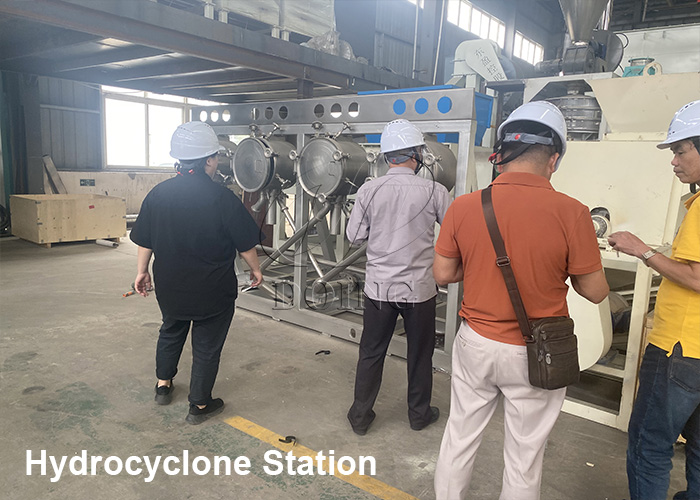 Cassava starch processing machine
Compare the shortlist on one scorecard, then weigh price vs long-term cost
With the shortlist defined, stop comparing brochures and start comparing evidence. Put every supplier through the same questions and score the answers on one sheet:
Table 3 — Shortlist scorecard
Criterion | What to ask | Evidence to request |
|---|---|---|
Capacity basis | What does 20 TPD represent? | Fresh-root input + operating hours in the proposal |
Complete-line scope | Can you supply and integrate the full line? | Process flow + equipment list + responsibility scope |
Recovery & purity | What extraction and purity figures? | Rasper rate, recovery %, hydrocyclone stages |
West-Africa adaptation | How do you handle power and raw material? | Diesel/low-power options, cleaning & de-sanding design |
Local support | Where are parts and engineers? | Spare-parts warehouse, commissioning & training plan |
Project relevance | Similar West African projects? | Comparable cases with their engineering decisions |
When scores are close, weigh the long-term cost rather than the headline price. A lower quotation is not necessarily the cheaper project: a higher recovery rate adds tonnes of starch per season, lower dewatering moisture cuts drying fuel, water recycling reduces both water bills and discharge treatment, and a local spare-parts presence shortens downtime. Price should be the last point of comparison, after assumptions and scope are verified.
FAQ
How much does a 20TPD cassava starch plant cost, and how fast does it pay back?
Total investment depends on equipment configuration, the scope of auxiliaries (piping, platforms, electrical work) and site preparation. Profitability is driven mainly by the starch extraction rate and local raw-material and labour costs — in one documented West African project, a tonne of cassava starch carried a margin in the range of USD 150–200. Request a budgeted technical proposal to calculate payback for your specific input cost and selling price, rather than relying on a generic figure.
Can I start with a smaller line and expand to 20TPD later?
Yes, if the supplier designs for expansion from the start. Ask for a modular configuration that lets you install core stages first and add capacity in phases, with space and interfaces reserved for future stages. This reduces the initial investment while keeping a clear path to the full 20 TPD line.
What water and utilities should I plan for a 20 TPD line?
Processing 1 tonne of cassava typically uses about 2 tonnes of water, so a 20 TPD line needs a reliable water supply and a circulation design that recycles process water back to the washing stage. Electrical load depends on configuration, but expect the drying and rasping stages to be the largest consumers; confirm the total installed power and how the supplier reduces it.
Which certifications should a manufacturer hold for export to West Africa?
Ask for ISO quality-management certification and, depending on the destination, food-safety and product registrations such as NAFDAC in Nigeria, FDA in Ghana or SONCAP where applicable. Confirm the electrical design meets your local voltage and any required certification for the target market.
What spare parts should I stock locally before commissioning?
Request a recommended initial spare-parts list based on the actual configuration, and prioritise wear parts such as rasper blades (which wear within a few days of continuous operation), sieve screens and pump mechanical seals. Confirm whether the supplier can supply these through a West African warehouse so replacements do not depend on international shipping lead times.
Put This Checklist to Work
Choosing a cassava starch equipment manufacturer stops feeling like a gamble once you can score the candidates against the same evidence. If a 20-tonne-a-day starch plant is on your agenda, send Jinrui Foodtech your cassava variety, expected starch content and daily fresh-cassava supply — you will get back a technical proposal with the capacity basis spelled out, so you can set it beside the other quotations and compare like for like.