

Gas-Fired vs Diesel-Fired Fryer for Garri Processing in West Africa: Which Is More Practical?
For garri processing in West Africa, a gas-fired (LPG) fryer is generally more practical than a diesel-fired one. Based on 2026 Nigeria prices, gas saves approximately $5.40 per ton of garri compared to diesel — while also delivering finer temperature control, cleaner emissions, and simpler maintenance.
This guide breaks down the real fuel costs in Nigeria and Ghana, compares product quality and operational practicality, and explains why most West African processors are switching to gas.
Fuel Cost Comparison: LPG vs Diesel Per Ton of Garri
The fuel cost difference between gas-fired and diesel-fired garri fryers is a primary driver for processors considering a switch. Based on industry benchmarks, a typical 100 kg batch requires approximately 2.5 kg of LPG or 3 litres of diesel. Scaling to one ton of finished garri, consumption rises to roughly 25 kg of LPG or 30 litres of diesel.
One kilogram of LPG provides thermal energy equivalent to approximately 1.12–1.2 litres of diesel (industry estimate), meaning the two fuels are relatively close in energy content — the cost advantage depends largely on local market prices. Nigeria diesel prices hovered around $1.18 per litre in 2026, while LPG prices were approximately $1.20 per kilogram (GlobalPetrolPrices / NBS, 2026).
Using these baseline prices, the fuel cost per ton of garri works out to approximately $35.40 for diesel (30 L × $1.18) versus $30.00 for LPG (25 kg × $1.20), representing a saving of roughly $5.40 per ton — or about 15% — when using gas. When LPG prices spike, the gap narrows considerably — against the Nigeria diesel baseline, the break-even point is about $1.42/kg — so the contract price you can secure for LPG at your site decides the answer.
In Ghana, using NPA June 2026 minimum prices (Diesel: GHS 15.49/L ≈ $1.07/L; LPG: GHS 13.48/kg ≈ $0.93/kg), the calculation yields diesel at $32.10/ton versus LPG at $23.25/ton — a saving of approximately $8.85/ton (27.6%) with gas.
| Parameter | LPG (Gas) | Diesel |
|---|---|---|
| Consumption per ton of garri | 25 kg | 30 L |
| Unit price (Nigeria baseline) | ~$1.20/kg | ~$1.18/L |
| Cost per ton | $30.00 | $35.40 |
| Savings with gas | — | ~$5.40/ton (15%) |
| Break-even LPG price vs diesel (Nigeria baseline) | ≈$1.42/kg | $1.18/L (baseline) |
Jinrui Foodtech (Henan Jinrui) offers all three heating options — gas, diesel and electric — across its garri fryer range and helps processors calculate operating costs under their specific local energy prices before purchase, ensuring the chosen configuration makes economic sense for their market.
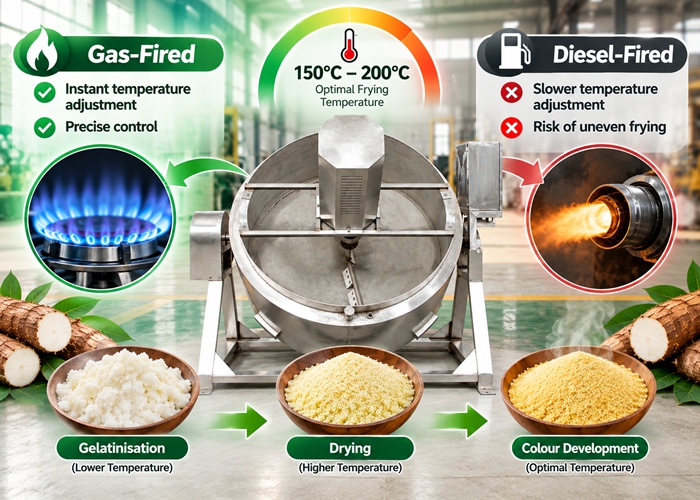 Gas VS Diesel garri fryer
Temperature Control and Garri Quality
The quality of finished garri depends heavily on precise temperature management during frying. Cassava mash must undergo a carefully controlled sequence: initial gelatinisation at lower temperatures, followed by progressive drying and colour development at higher heat. The optimal frying temperature range sits between 150°C and 200°C.
Gas-fired fryers offer a distinct advantage in temperature control. The flame from an LPG burner can be adjusted almost instantaneously — operators can switch between high, medium and low heat settings within seconds. This responsiveness is critical for managing the two-phase garri frying process (commonly referred to as garrification), which requires alternating between cooking and drying phases. Consistent heat output ensures uniform colour development and moisture reduction across each batch.
Diesel-fired fryers suffer from inherent lag in burner response. Adjusting heat output takes longer, increasing the risk of uneven frying — some portions remain undercooked while others become overdone. Additionally, diesel combustion can deposit soot on interior surfaces, gradually impairing heat transfer and potentially affecting product cleanliness. If burner maintenance is delayed, odour carryover from incomplete combustion becomes another quality concern.
Jinrui Foodtech designs its garri fryer with a stainless steel frying chamber and a precision gas burner engineered for optimal temperature control across the full range of garri frying operations.
Maintenance, Durability and Operational Practicality
Beyond fuel cost and product quality, day-to-day maintenance demands differ significantly between gas-fired and diesel-fired fryers — a factor that accumulates considerable cost over equipment lifespan.
Gas-fired (LPG) — lower maintenance burden:
No fuel pumps, complex filters or precision injectors to clog or wear out
Combustion chamber stays clean — no corrosive residue buildup
Annual maintenance typically limited to nozzle inspection and occasional gasket replacement
Lower long-term maintenance cost
Diesel-fired — higher maintenance burden:
Fuel injectors, high-pressure pumps and delicate filtration systems require regular cleaning and part replacement
Nozzle clogging and injector wear are common in West Africa's high-humidity environment with variable fuel quality
Replacement parts often need to be imported, driving up both cost and downtime
Higher long-term maintenance cost
Many West African processors already depend on diesel generators for machinery power due to unreliable grid electricity. Using diesel for both generation and frying creates a single-point fuel dependency — when diesel prices spike or supplies are disrupted, both power and cooking capabilities are affected simultaneously. The emerging best-practice configuration across West Africa pairs a generator (for the stirring motor) with an LPG-fired fryer, effectively decoupling cooking fuel costs from power generation costs.
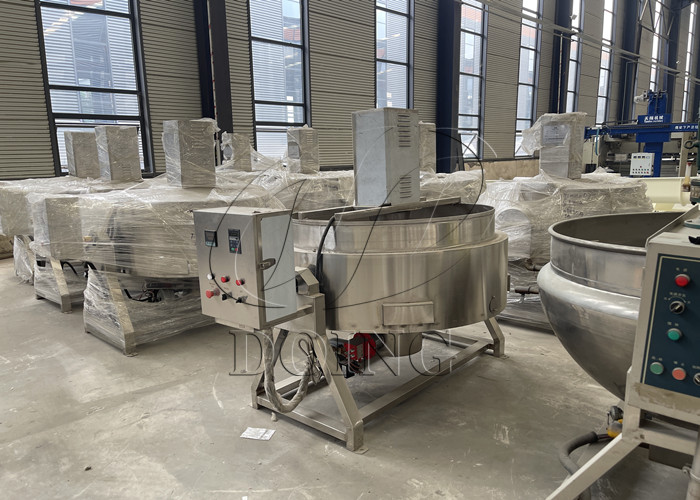 Garri fryer
Environmental and Food Safety Considerations
Fuel choice has direct implications for food safety and worker health in garri processing environments:
Gas-fired fryers:
Clean combustion — no particulate emissions, no sulfur compounds
Complies with food safety standards for commercial processing environments
Significantly lower indoor air pollution — important for worker health in enclosed spaces
Diesel-fired fryers:
Combustion emits nitrogen oxides (NOx), sulfur oxides (SOx) and particulate matter
Poorly maintained burners can produce visible black smoke — a direct food safety concern and workplace health hazard
As West African nations increasingly adopt environmental regulations for formal processing zones, equipment emitting visible pollutants may face future restrictions, making gas-fired technology a more future-proof investment.
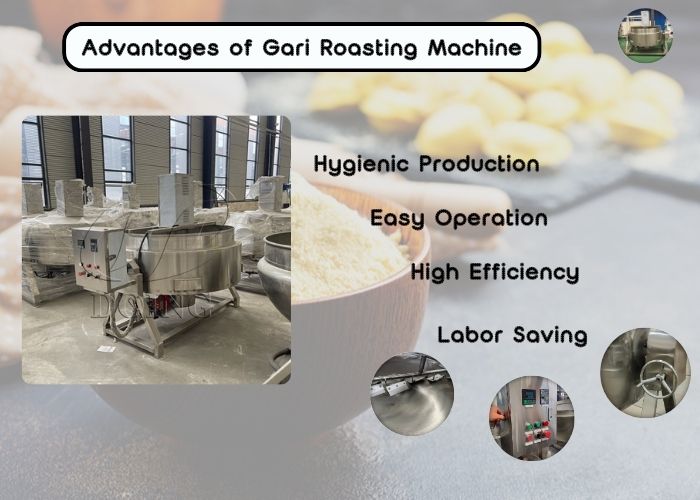 Jinrui Foodtech's garri fryer
How to Choose the Right Fryer for Your Operation
Choosing between gas and diesel comes down to your local fuel availability, production priorities and operational context. Here is a practical decision framework:
Choose gas-fired if:
LPG supply is reliable and reasonably priced in your area
You prioritise product quality consistency and food safety
Your production scale is small to medium (100–500 kg/hour)
You want lower ongoing maintenance costs and cleaner working conditions
You are concerned about future environmental compliance
Choose diesel-fired if:
LPG infrastructure is limited or unreliable in your location
You already have a robust diesel supply chain and storage capacity
You operate in a remote area where gas delivery is impractical
Your production scale is large and gas supply stability is uncertain
Material quality: Regardless of fuel type, ensure all food-contact surfaces are 304-grade stainless steel — the industry standard for food safety and corrosion resistance.
After-sales support: Spare parts availability and local service coverage matter significantly in West African operating conditions. Jinrui Foodtech maintains a parts warehouse in Nigeria to support after-sales service for West African customers.
Frequently Asked Questions
Is LPG really cheaper than diesel for garri frying, or does it depend on location?
LPG is often cheaper, but the result depends on local prices and actual consumption. Estimate gas cost using your local LPG price per kilogram multiplied by about 25 kg per ton of garri, and diesel cost using the diesel price per litre multiplied by about 30 litres per ton. The difference is the estimated saving with gas. These consumption figures are benchmarks, so confirm them against your fryer and recalculate when prices change — against the Nigeria diesel baseline, LPG above about $1.42/kg loses its cost advantage.
Can I convert my existing diesel fryer to run on gas?
Converting an existing diesel fryer to gas may be possible, but it depends on the burner design, fryer construction and whether a compatible gas burner can be safely installed. Because gas and diesel systems have different nozzle and air-fuel requirements, have the manufacturer or a qualified technician assess the equipment before making changes; a factory-configured fryer may be the more reliable and cost-effective option.
How do I check garri quality per batch to ensure consistency?
Check each batch for moisture content, colour uniformity and texture. Well-dried garri sits around 12–14% moisture: above that range, storage life shortens and mould risk rises; below it, you are giving away yield. Garri should have an even colour without burnt spots and a crisp texture without hard, undercooked cores. Record the results batch by batch; consistent temperature control can make these targets easier to maintain.
What is the typical payback period for upgrading to an automatic gas-fired garri fryer?
A payback period cannot be guaranteed and depends on the fryer price, daily output, operating hours, local fuel prices, labour savings, product yield and selling price. Work it out from your own numbers: divide the price difference between the two configurations by your annual fuel saving — the per-ton figures in this guide multiplied by your tonnage. Ask each supplier to run this calculation on your data and to show every assumption behind any payback figure they quote.
Get a Customised Fuel Cost Analysis for Your Garri Processing Project
Overall, an LPG-fired fryer is usually the more practical option when LPG is reliably available at a competitive price; diesel remains worth considering where gas supply is uncertain. Compare local fuel costs, maintenance access and the quality requirements of your product before deciding.
Ready to buy a garri fryer? Tell Jinrui Foodtech your daily capacity and which fuel is available at your site — we'll send a quote with a per-ton operating-cost comparison based on your local prices.