

Why Your Cassava Starch Has Impurities - and How to Fix It
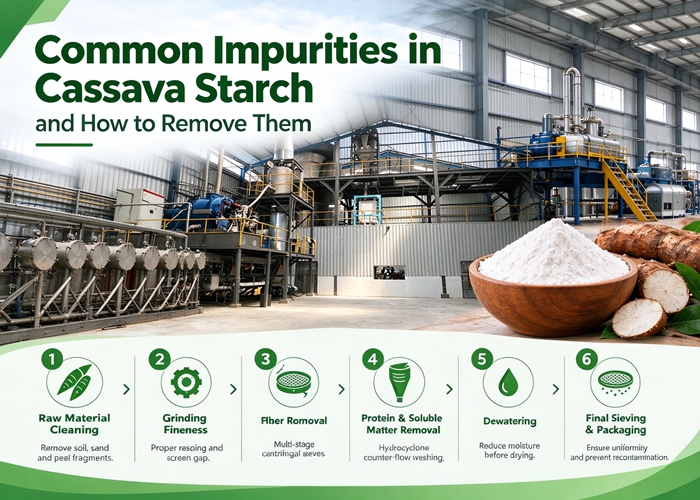
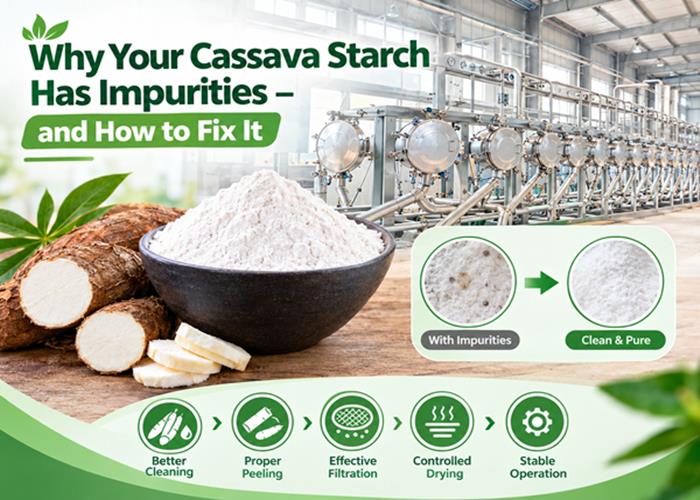
Cassava starch rarely fails on purity for exotic reasons. Almost every batch that looks gritty, grey or off-white can be traced to the same six control points along the processing line: raw material cleaning, grinding fineness, fiber removal, protein washing, dewatering, and final sieving. When each stage is set correctly, purity climbs and the residual fiber, protein and grit that drag quality down simply disappear.
The fastest way to act on this is to work the line in process order – cleaning, crushing, fiber removal, protein removal, dewatering, sieving – and check one stage at a time. The table and sections below walk through what causes impurities at each point and the equipment setting that fixes it, so you can find the weak link and close it without guessing.
Quick reference: impurity source and fix by stage
| Processing stage | Why impurities remain | Recommended fix |
|---|---|---|
| Raw material cleaning | Sand, soil and skin carry over when screening and washing are too shallow | ~14 mm dry screen + two-stage paddle washer in counter-flow |
| Grinding / rasping | Starch granules stay locked inside unbroken fiber when fineness is too coarse | Cutter pre-crush + rasper at ~2 mm gap, 1.8 mm bottom screen |
| Fiber removal | Coarse and fine fiber slip through when screening stages are too few | 4–5 centrifugal sieves in series + two-pass fine residue sieve |
| Protein / soluble matter | Dissolved protein and ash stay in the milk when washing is insufficient | 18-stage hydrocyclone station in counter-flow washing |
| Dewatering | Wet cake holds moisture and entrained matter when dewatering is incomplete | Peeler Centrifuge, cake moisture 36.5–38% |
| Final sieving & packing | Oversize particles and dust re-enter at the last step | Fine square/rotary sieve (10–100 mesh) + sealed automatic packing |
Impurity source 1: Inadequate raw material cleaning
Why it happens: Cassava roots arrive with soil, sand and peel fragments. If the dry-screen gap is too wide or the washer runs a single shallow pass, grit and skin scale are carried into crushing, where they shatter into fine particles that no later step fully removes. This shows up as ash and dark specks in the finished starch.
How to fix it: Fit a ~14 mm dry screen to strip coarse trash, then run a paddle washer in two counter-flow stages so clean water meets the cleanest roots last. This lifts soil and skin out before they can ever be ground fine.
Expected result: Sand, grit and surface ash drop at the source, easing the load on every downstream stage.
 Cassava starch production
Impurity source 2: Insufficient grinding fineness
Why it happens: Starch lives inside the cassava cell structure. If the cut is too coarse or the rasp gap too wide, granules never separate from the fiber skeleton, so they leave with the residue: free-starch yield falls and fiber carryover rises.
How to fix it: Pre-crush with a root cutter, then fine-rasp on Jinrui Foodtech’s (Henan Jinrui’s) two-stage cutting-and-rasping system (root cutter + rasper) at about a 2 mm drum-to-screen gap and a 1.8 mm bottom screen. The rasper reaches a crushing rate above 94%, versus about 80% for a hammer mill, so more granules are freed from the fiber skeleton and the fiber fraction separates cleaner.
Expected result: Free-starch release rises; fiber-bound starch loss and fiber carryover fall.
Impurity source 3: Weak fiber removal configuration
Why it happens: After rasping the milk carries both coarse and fine fiber. One screening pass cannot hold both fractions: too open a mesh lets fiber through, too tight a mesh floods and short-circuits.
How to fix it: Series-connect 4–5 centrifugal sieves to take the coarse fiber, then run the overflow through a fine residue sieve in two passes to catch the fine fiber a single screen misses.
Expected result: Fiber-type impurities are intercepted before protein washing, protecting downstream sieve and nozzle life.
Impurity source 4: Residual protein and soluble matter
Why it happens: Dissolved protein, pigments and soluble ash are the hardest impurities to remove; they stay suspended in the milk and survive plain sieving. Without enough counter-flow washing they remain in the product as yellowing, foaming and higher ash.
How to fix it: The 18-stage hydrocyclone station from Jinrui Foodtech washes in counter-flow while doing concentration, starch recovery and protein separation in one pass, reaching a stated separation purity of 99.5% and a starch extraction rate near 94%.
Expected result: Protein and soluble solids drop sharply; purity and white stability rise.
 Cassava starch processing machine
Impurity source 5: Incomplete dewatering carrying contaminants
Why it happens: If the wet cake leaves dewatering holding excess moisture, it drags soluble matter with it and overloads drying, where trapped moisture can bake impurities onto the granule and push up fuel cost.
How to fix it: Use a Peeler Centrifuge to bring cake moisture down to 36.5–38% before drying, then finish in a 130–150 °C drying band.
Expected result: Lower drying load, less impurity concentration, more even moisture in the finished starch.
Impurity source 6: Final sieving and packaging contamination
Why it happens: Even a clean line can fail at the end. A coarse finishing screen lets oversize granules and broken fiber pass, and open handling re-introduces dust and debris into the packed product.
How to fix it: Sieve the dried starch through a fine square or rotary vibrating sieve (10–100 mesh) and pack it on a sealed automatic packaging line.
Expected result: Uniform particle size and no post-process contamination.
FAQs on cassava starch purity
My old line uses settling ponds – is upgrading to sieving plus hydrocyclones worth it?
Settling ponds remove little protein or soluble matter and waste both space and water. Moving to staged sieving plus a hydrocyclone washing stage is normally the single biggest purity gain available on an ageing line.
Which stage should I upgrade first for the best return?
Start where the losses show up in the product. If grit and ash are high, fix cleaning and rasping first; if yellowing and foaming persist, the hydrocyclone washing stage usually pays back fastest.
Will tighter purification raise my water consumption?
Counter-flow washing reuses wash water from cleaner to dirtier stages, so purity rises without a proportional water increase; a recovery loop on the cyclone overflow keeps total consumption controlled.
Does removing impurities also help food safety, such as cyanide residue?
Yes. Much of the cyanogenic matter sits in the peel and in the liquid removed during washing, so thorough cleaning and counter-flow washing lower it alongside fiber and protein.
Does finer grinding reduce my starch yield?
Finer rasping releases more granules and raises free-starch yield. Yield only falls if the screen is too tight for the rasp, which is exactly why sieving is staged rather than single-pass.
Turn the fix plan into a cleaner cassava starch batch
Purity problems on a cassava starch line are not mysterious. They come from six reachable points – cleaning, rasping fineness, fiber removal, protein washing, dewatering and final sieving. Work them in process order, set each stage to the configuration above, and fiber, protein and grit come down together instead of one at a time.
If you would like Jinrui Foodtech to review your current line and map the highest-return impurity fixes for your throughput, send us your process flow and target purity and we will come back with a configuration proposal.