

Cassava Starch Production: The 3 Critical Checkpoints for Consistent Quality
If your cassava starch comes out discolored one week and fine the next, you are not alone — and the problem is usually easier to fix than you think.Consistent quality is not luck. It is the result of controlling the right checkpoints at the right stages of production. The three most critical checkpoints in cassava starch production are:
Raw material quality — what enters the line
Extraction and separation — what happens inside the line
Dewatering and drying — what happens at the end of the line
Getting each one right is the foundation of producing consistent starch batch after batch. Here is how to manage each one — regardless of your scale of operation.
Quality in cassava starch production starts before the processing line even begins. The raw material is the foundation, and no amount of downstream effort can fully compensate for poor-quality cassava roots.
Cassava variety
Not all cassava varieties are equal when it comes to starch production. Varieties with higher starch content—typically above 20–25% on a fresh weight basis—yield significantly more starch per ton of roots. Equally important is the cyanide content. Low-cyanide varieties are safer to process and produce cleaner, better-tasting starch that meets food safety standards more easily.
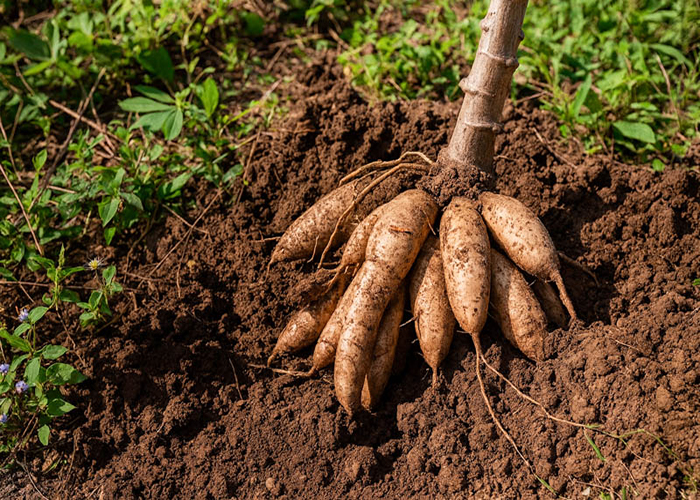 High‑starch cassava raw material
Harvest timing
The starch content in a cassava root changes as the plant matures. Roots harvested too early tend to have lower starch content and higher moisture, reducing your yield. Most varieties reach peak starch content between 10 and 12 months after planting. Harvesting too late can lead to fiber deterioration and spoilage. Timing the harvest matters.
Freshness and logistics
Cassava roots begin losing starch to natural enzymatic conversion the moment they are harvested. Processing roots within 24–48 hours of harvest is ideal. Any longer, and you are starting with a degraded raw material that produces lower yield and lower-quality starch—no matter how well your equipment performs downstream.
Once good-quality cassava enters the cassava starch production line, the next critical checkpoint is extraction and separation. This is where the actual starch is separated from the fiber, peel residues, and other impurities. How well this stage is managed directly determines the yield and purity of your final starch.
Rasping fineness
The rasping stage breaks open the cassava cells to release the starch. Fine, uniform rasping produces maximum starch release—which directly translates to higher yield. A coarse or uneven rasp leaves significant starch locked inside fiber and pulp, and there is no way to recover it later. Regular maintenance and replacement of rasping drums is one of the highest-return investments in your entire production line.
Fiber separation
After rasping, the cassava mash passes through fine fiber sieve that separates the bulk of the fiber from the starch milk. This step needs to be efficient—the more fiber removed at this stage, the less burden on the downstream refining process. Proper fiber separation also reduces wear on subsequent equipment and improves overall processing efficiency.
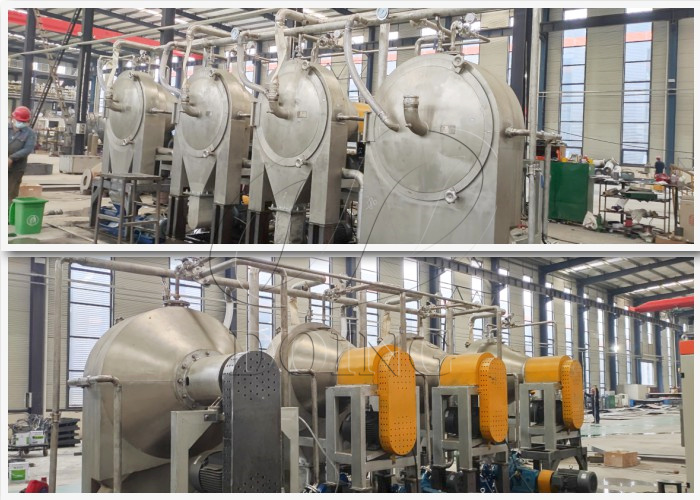 The fiber separation machine from Jinrui Foodtech
After the fiber is removed, the starch milk enters a multi-stage hydrocyclone system. Each stage further removes residual fine fiber, protein, cell sap, and other impurities from the starch milk, gradually increasing the purity of the final product. More washing stages mean cleaner starch—but also higher water consumption. The right number of stages depends on your target market: food-grade or pharmaceutical buyers typically require more stages than industrial buyers.
The third and final critical checkpoint is dewatering and drying. Even with excellent raw material and efficient extraction, improper dewatering and drying can ruin the quality of your finished starch—and poor storage conditions can undo all of that work after the product leaves your facility.
Dewatering
The refined starch milk is first dewatered using a scraper centrifuge, which spins the starch milk to separate the bulk of the water and produce a starch cake at around 35–40% moisture. Proper dewatering here removes the majority of the water efficiently, preparing the starch for the final drying stage.
The dewatered starch cake is then dried in an airflow dryer, which brings the moisture content down to below 14% quickly and evenly. The dryer uses controlled airflow and temperature to evaporate moisture without damaging the starch granule structure. Heat that is too high damages the starch—affecting its gelatinization temperature, viscosity, and texture. This is particularly important for starch intended for food or pharmaceutical applications. Controlled drying produces a bright, fine powder that meets buyer specifications.
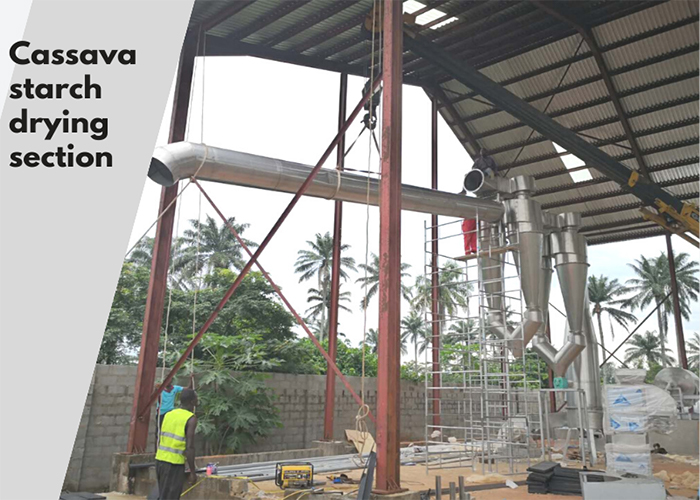 Cassava starch drying section
Final moisture and storage
The target moisture content for finished cassava starch is below 14%, with most quality-conscious producers targeting 12–13% as a safe margin against mold during storage and transport. After drying, the starch should be packaged in clean, moisture-resistant bags and stored in a dry, well-ventilated warehouse off the ground. Exposure to humidity after drying can cause clumping, discoloration, or mold growth—undoing the work of the drying stage.
Knowing the three checkpoints is essential — but knowing whether you are hitting them on every batch is equally important. Without a way to measure quality at each stage, you are running blind.
Key things to monitor at each checkpoint:
| Checkpoint | What to Measure | How Often |
| Raw material | Starch content (refractometer or lab test), root freshness | Every delivery |
| Extraction | Starch recovery rate, fiber content in pulp | Every 2–3 hours |
| Dewatering | Cake moisture before drying | Every batch |
| Drying | Final moisture content (moisture analyzer) | Every batch |
Batch records — timestamped logs of temperature, moisture, pH, and output at each stage — serve two purposes. First, they let you spot problems before they ruin a batch. Second, they are the documentation that buyers in regulated markets require for traceability. Automated data logging through a PLC control system makes this effortless and reliable.
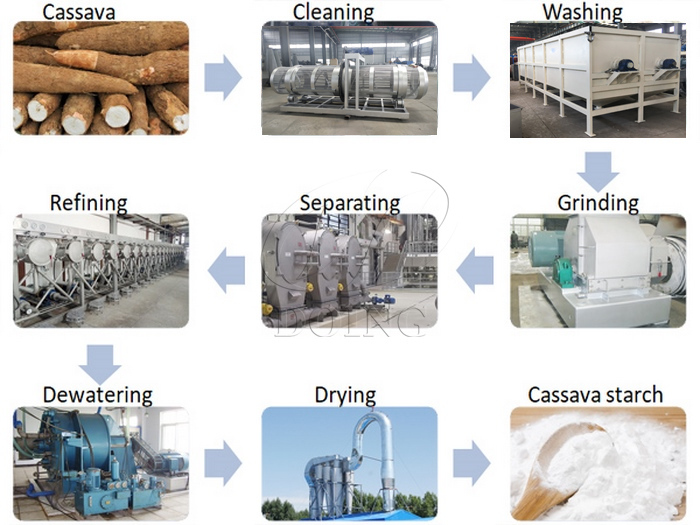 The consistent quality of cassava starch production line
Consistent quality is the result of managing all three checkpoints in sequence. Weakness at any one of them undermines the work done at the others. But each checkpoint is manageable — with the right knowledge, the right equipment settings, and a way to measure what is actually happening on your line. Jinrui Foodtech has delivered cassava starch lines worldwide, helping customers manage the checkpoints that matter most for their production goals. Welcome to contact us for a free consultation.
Q1: How long does it take to install and commission a cassava starch production line? A1: Manufacturing and delivery typically take 30–60 days after order confirmation. On-site installation and commissioning usually take 2–4 weeks, depending on site readiness and the complexity of the line. We provide installation guidance and operator training as part of our project support.
Q2: What after-sales support do you provide?
A2: We offer long-term technical support and spare parts supply. Remote troubleshooting is available for common issues, and we can arrange on-site visits when needed. For West African customers, our local warehouse in Nigeria allows us to ship spare parts more quickly.
Q3: What water and power supply is needed for the production line?
A3: Water consumption depends on your configuration and washing stages—a typical line uses 5–15 tons of water per ton of finished starch. Power requirements vary by capacity: small-scale lines need around 80–150 kW, while large industrial lines may require 500 kW or more. We provide specific specifications in your project proposal. Q4: Can I visit your factory or see a reference project?
A4: Yes. We welcome customers to visit our manufacturing facility in China to inspect equipment quality and discuss your project in person. We can also arrange visits to reference projects in your region where possible. Contact us to schedule a visit.
Q5: Do you offer equipment customization for specific project conditions? A5: Yes. We configure equipment based on your cassava variety, target starch quality, local climate conditions, and production goals. Every project is different, and we adjust the process design accordingly.