

How Much Potato Is Needed to Make One Ton of Starch?
How Much Potato Is Needed to Make One Ton of Starch? The short answer is a ratio, not a single number: one tonne of potato starch usually takes about 5 to 8 tonnes of fresh potato, with roughly 8:1 being the common working figure for average potatoes. The exact amount swings on two variables – the starch content of your variety (typically 10–20% by weight) and the extraction rate your process actually achieves (a well-tuned line recovers around 94%). Higher-starch potatoes and better recovery both pull that ratio toward the 5-tonne end.
This article unpacks the calculation behind the potato-to-starch ratio, shows the realistic range by variety, explains what quietly pushes your potato consumption higher than expected, and ends with the process levers that let you make the same tonne of starch from fewer tonnes of fresh potato.
Quick answer: fresh potato needed per tonne of starch
Worked at a 94% extraction rate, the table below converts fresh-potato starch content into tonnes of potato per tonne of starch. Use your own variety figure to read off the input you should plan for.
| Fresh-potato starch content | Starch recovered per tonne of potato | Fresh potato per tonne of starch |
|---|---|---|
| 10% (low-starch / northern origins) | 0.094 t | about 10.6 t |
| 13% (typical processing potato) | 0.122 t | about 8 t (common 8:1 rule) |
| 15% (good table/industrial potato) | 0.141 t | about 7 t |
| 18% (high-starch cultivar) | 0.169 t | about 5.9 t |
| 20% (premium starch cultivar) | 0.188 t | about 5.3 t |
The potato-to-starch math: how the ratio is worked out
The ratio is not a guess – it falls straight out of two numbers multiplied together. The starch you can sell is the starch in the potato, multiplied by however much of it your equipment actually frees and captures:
Formula: Starch per tonne of potato = starch content (%) x extraction rate (%).
Flip it: Fresh potato per tonne of starch = 1 / (starch content x extraction rate).
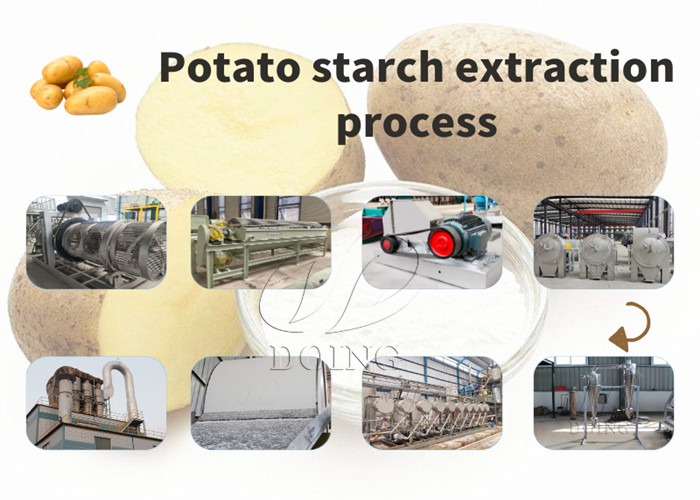 Potato starch extraction machine
Worked example
Take an average potato at 13% starch on a line recovering 94% of it. Starch recovered per tonne of potato = 0.13 x 0.94 = 0.122 tonne. One tonne of starch therefore needs 1 / 0.122 = about 8 tonnes of fresh potato. That is where the industry 8:1 figure comes from.
Move only the content figure and the answer moves fast: an 18% cultivar on the same line needs roughly 5.9 tonnes, while a weak 10% potato can demand over 10 tonnes. The extraction rate is the second dial – dropping from 94% to 85% turns an 8-tonne job into roughly a 9-tonne job for the same potato.
What changes how much potato you need
Four things decide whether you land near 5 tonnes or creep toward 8+ tonnes per tonne of starch:
1. Variety and starch content. Potatoes range from about 10% to 20% starch, and content falls the further north you grow and rises in cooler western regions. A variety 5 points richer in starch can cut your raw-material bill by a third for the same output.
2. Freshness and storage. Starch converts to sugar and the tuber degrades after harvest. Process within three days, never beyond a week, and reject sprouted or greened stock – every lost gram of starch is extra tonnes you must buy.
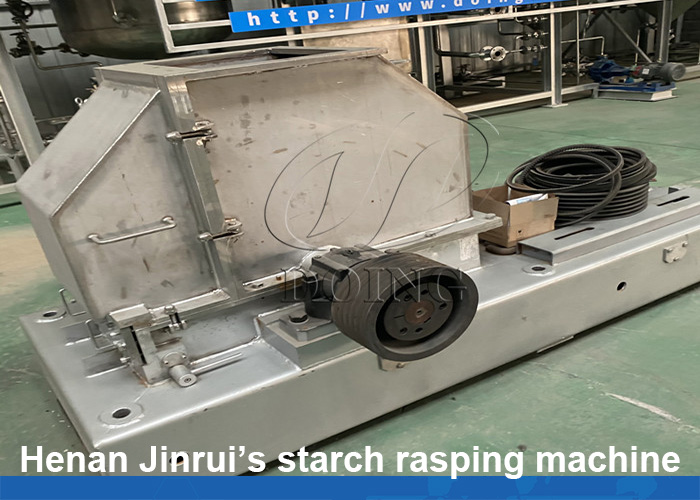 Rasper for potato starch processing
3. Grinding fineness. Starch is locked inside plant cells; if grinding is coarse the granules never free themselves and pass into the fibre waste no matter how fine your later screening is. The Jinrui Foodtech (Henan Jinrui) rasper grinds against a 2 mm tooth gap at over 2,000 rpm, holding grinding losses low where older or hammer-type sets leave whole recovery well short.
4. Extraction equipment capability. Sieve mesh, cyclone staging and separation purity decide how much freed starch is captured rather than discarded. A potato line typically runs a 60 × 325 mesh stainless face screen on the centrifugal sieve; undersized screening silently raises your potato-per-ton figure.
How to raise yield and use less potato per ton
Every point of recovery you add is raw material you stop buying. The controllable chain, in process order:
Grind finer, not harder. A properly set rasper (2 mm tooth gap) releases far more free starch than a coarse grind, lifting recovery before any screening happens – old lines grinding under 90% commonly reach 95%+ after a rasper upgrade.
Screen in multiple stages. Multi-stage centrifugal sieving strips fibre away while keeping starch in the milk, so fines do not drag granules out with them.
Wash and recover in an 18-stage hydrocyclone station. The recovery section returns starch that a single-pass or settling-pond setup throws away; a Jinrui Foodtech cyclone station runs 18 stages with a built-in recovery loop to hold extraction near the 94% line.
Dehydrate and dry without losses. A vacuum filter first takes the starch milk down to 38–40% moisture, then the Jinrui Foodtech flash dryer finishes it to 10–12% under a negative-pressure (sub-atmospheric) air flow. Because the wet powder is carried through a closed, lower-pressure stream rather than a hot open duct, far less fine starch escapes as airborne dust, and there is less sticking and scorching to rework – so more of the starch you already freed actually reaches the bag as sellable powder, which is a direct gain in yield.
Run these together and the same potato crop yields more starch, which is the same thing as needing fewer tonnes of potato per tonne of product.
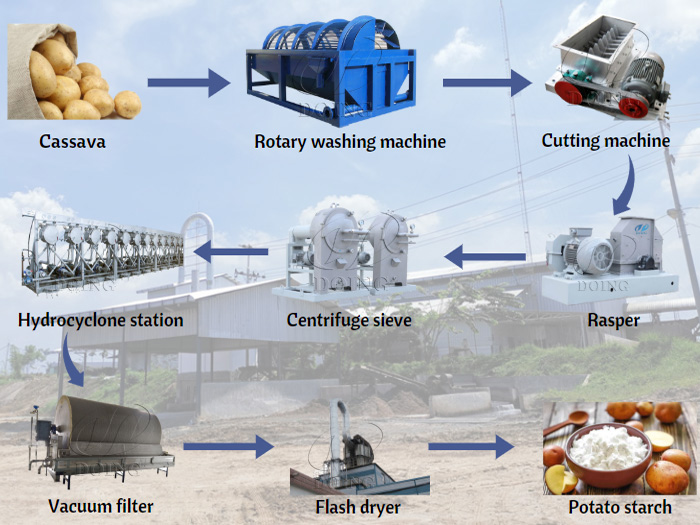 Potato starch production line
Planning raw material for a real potato starch line
Once you trust the ratio, sizing a plant is arithmetic. Multiply your target starch output by your potato-per-ton figure, then check that potato tonnage against local supply and the water duty (a potato line uses roughly 1.3 tonnes of process water per tonne of potato).
Worked example - a 10 t/day starch line
At the common 8:1 ratio, 10 tonnes of starch a day needs about 80 tonnes of fresh potato a day, or roughly 24,000 tonnes a year on a 300-day calendar. Switch to an 18% high-starch cultivar and the same output drops to about 59 tonnes a day – nearly 21 tonnes a day less to source, store and transport.
The practical lesson for feasibility studies: measure your real starch content and target extraction rate before committing to a supply contract, and specify the grinding and recovery equipment that actually holds the ratio you built the budget on. A properly configured potato starch line – complete set, PLC-controlled – is sized from these same figures so the potato-per-ton promise survives real production.
Frequently asked questions
Can one starch line run both potato and cassava, or do I need separate lines?
Mostly one line, with swaps. Potato and cassava share the same wet backbone – washing, grinding, screening and the hydrocyclone recovery loop – so changing feedstock mainly means fitting the right screen mesh and re-setting the grinding gap and cyclone staging for the new crop. Many operators run one line across two tubers by season. The catch is that the potato-to-starch ratio itself must be recalculated for each crop, because starch content and cell structure are different.
Is a higher-starch potato always the cheaper raw material?
Not always. High-starch cultivars often give fewer tonnes per hectare and can carry a farm-gate premium, so a cheap 13% potato delivered from a nearby field can beat a costly 18% potato hauled from far away on the real metric – cost per tonne of starch, not tonnes of potato. Weigh yield, delivery distance and starch content together before you sign a supply contract.
Do potato fibre and protein waste water count against my yield?
No – they are by-products, not starch you failed to recover. The real starch loss lives in the cyclone recovery section, which is why a multi-stage loop matters. The fibre can be dewatered and sold as feed, and the protein-rich water sent to a separator, so captured properly these streams add revenue rather than eating into your tonne-of-starch figure.
How does finished-powder concentration relate to yield?
They are different things: yield is the share of potato starch you recover, while concentration (degrees Baume of the starch milk before dehydration) reflects how much water you have driven off. Good concentration lowers drying load but does not recover starch you never freed in grinding.
Why do small lines recover less than large ones?
Small setups often rely on settling ponds and single-pass screening, which leave starch in the effluent and cap recovery. Larger lines use cyclone recovery loops and staged sieving that capture that starch, so the gap is mostly in the purification and recovery sections, not the grinding.
Turn the ratio into less potato per ton of starch
Potato per tonne of starch is not a fixed cost of doing business – it is starch content times extraction rate, and both are under your control. Choose a richer variety, keep the potato fresh, and let fine grinding, staged sieving and an 18-stage recovery loop hold recovery near 94%, and the same crop turns into more starch with fewer tonnes of raw material to buy and haul.
If you are evaluating potato starch processing equipment – whether a compact modular line or a full-capacity plant – Jinrui Foodtech designs and builds the complete chain from washing and rasping through fibre removal, hydrocyclone extraction, dewatering and flash drying. Send us your raw material details and target capacity, and we will work out the configuration and budget for you.