

How Much Factory Space Does a Cassava Flour Processing Line Need?
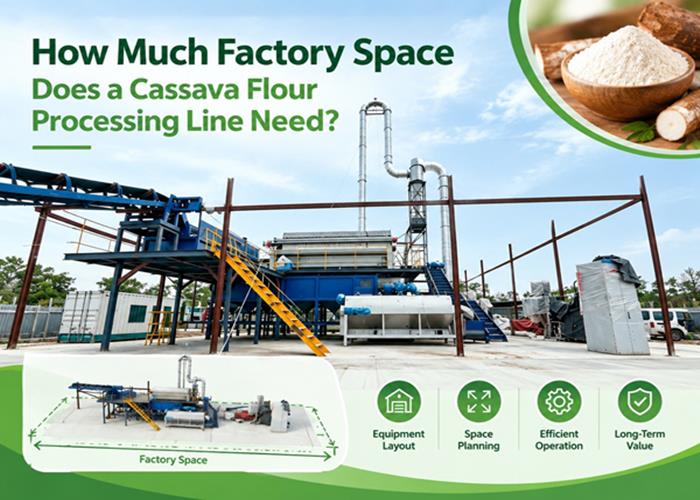
There is no single number that fits every cassava flour project. The floor area a cassava flour line needs is driven by three things: how much finished flour you want to produce per hour (TPH — tonnes of finished cassava flour out of the line, not the fresh cassava fed into it), whether you run the wet or the dry process, and how the workshop is laid out. As a working reference, Jinrui Foodtech (Henan Jinrui) sizes cassava flour workshops at roughly 360 m² for a 1–2 TPH line up to about 720 m² for a line of 8 TPH and above, with the workshop height kept at 6 to 7.5 metres.
This guide shows the area needed at each capacity band, the functional zones you must reserve inside that area, and the layout rules that stop a "big enough on paper" building from failing in practice — so you can judge whether your current site works, or how large a new one should be.
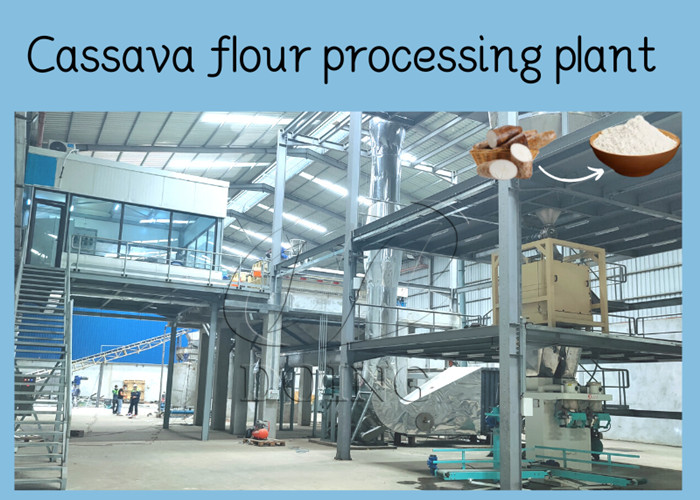
 Cassava flour processing factory
What Drives the Factory Space of a Cassava Flour Processing Line
Before you size walls and roof, it helps to know what eats up the floor. In cassava flour, four things decide the footprint.
Output capacity
Cassava flour lines are quoted by how much finished flour they turn out per hour. A 1–2 TPH line and a line of 8 TPH and above handle very different volumes of root, washwater and powder, so their workshops are not interchangeable. Capacity is the first thing to fix, because everything else follows from it.
Process route
A full automatic cassava flour line is a wet process that starts from fresh cassava: washing, peeling, size reduction, dewatering, drying, milling, sieving and packing. A dry process line, working from bought-in dried cassava chips, is far shorter and can be housed in a smaller, cheaper building. The route you choose changes both the area and the construction cost.
Conveying height
A cassava flour line is not laid out flat on the floor. Material travels between machines on conveyors, and the flash dryer with its cyclone separator rises vertically. That is why ceiling height, and not floor area alone, sets how tight a layout can be.
Reception and storage
Fresh cassava is bulky and perishable, and finished flour has to stay dry. Reception and storage often take up as much room as the machines they feed.
Cassava Flour Processing Line Workshop Size by Capacity
The table below gives the indoor workshop footprint Jinrui Foodtech applies to cassava flour lines, written as length × width so you can test it against a real plot of land. Every capacity in it is finished cassava flour output.
| Line capacity (finished flour output) | Workshop (length × width) | Approx. indoor floor area | Workshop height |
|---|---|---|---|
| 1–2 TPH | 30 × 12 m | ~360 m² | 6–7.5 m |
| 4–6 TPH | 42 × 12 m | ~504 m² | 6–7.5 m |
| 8 TPH and above | 48 × 15 m | ~720 m² | 6–7.5 m |
Two things stand out here. Floor area does not grow in step with capacity — the middle band needs a slightly longer shell rather than a proportionally bigger one, because the extra output comes from larger machines on the same line, not from a second line running beside it. And the height holds at 6–7.5 m right across the three bands: that headroom is there for the drying section, which is why a low-roofed shed of the same floor area still cannot take the line.
The figures above cover the indoor production area only. Outside the workshop you still need land for trucks to turn, for fresh cassava to be stacked, for a generator house, and for collecting waste and washwater. As a rule of thumb, plan the whole plot 20–30% larger than the indoor workshop.
 Cassava flour processing plant
How to Divide the Workshop: Functional Zones of a Cassava Flour Line
A well-sized cassava flour workshop is really four working zones that flow in one direction — cassava in at one end, packed flour out at the other. Getting the share of floor right for each zone is what turns a bare area into a working plant.
| Zone | Share of indoor area | Example at 504 m² | What sits there |
|---|---|---|---|
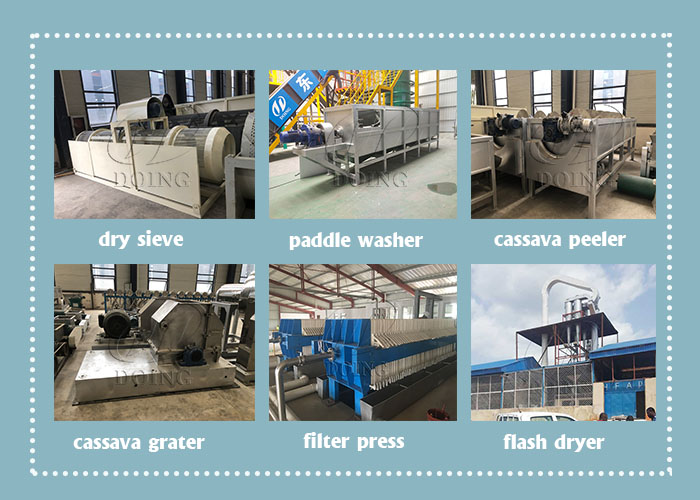
| Raw material and washing | 15–20% | ~76–101 m² | Cassava reception, dry sieve (often placed just outside the wall) and paddle washer. This zone needs water supply and drainage, and takes the wettest, dirtiest traffic. |
| Process core | 40–50% | ~202–252 m² | Peeler, cutter, rasper, dewatering press, flash dryer with cyclone, and fine mill. The tallest, hottest and dustiest zone. |
| Finishing and storage | 20–25% | ~101–126 m² | Vibrating sieve, automatic packing machine, and the dry flour warehouse. |
| Auxiliary | 10–15% | ~50–76 m² | Control room, light maintenance area, office and welfare space. |
Treat these shares as planning guidance rather than fixed rules — the final split follows your machine list and how much of the process you automate.
Wet Process or Dry Process for a Cassava Flour Processing Line
The same target output can mean two very different buildings, and this is where buyers most often mis-size their land.
Dry process: from dried cassava chips
A shorter line — washing, milling, sieving and packing. Fewer machines, simple water handling, and a smaller, lighter, cheaper building. It suits small or budget-limited producers and is often run on purchased dried chips. The trade-off is product quality: dry-process flour is coarser and carries more fibre and other non-starch material, so it fits industrial uses such as alcohol, feed and chemical processing rather than food-grade markets.
Wet process: from fresh cassava
The full automatic line: washing and de-sanding, peeling, size reduction, dewatering, flash drying, fine milling, sieving and packing. Peeling matters more than it looks — cassava skin carries cyanogenic compounds that have to be removed, and Jinrui Foodtech's peeling stage reaches a peeling rate of about 95%. The wet route needs more floor, a real drainage system and full ceiling height, but it delivers finer, whiter flour with controlled hydrogen-cyanide levels, which is what food-grade and export buyers ask for.
If you already own a low, simple shed, the dry route may fit it as it stands. If you want food-grade flour from fresh cassava, plan for the wet-route footprint in the capacity table above.
 Cassava flour production line
Layout Rules for a Cassava Flour Processing Line That Actually Runs
Floor area alone does not make a factory work. Five rules decide whether a building that measures right also runs right.
One-way flow. Cassava in at one end, packed flour out at the other, with no backtracking between the wet end and the clean end.
Check the height before you sign. These workshops run 6–7.5 m to clear the dryer and cyclone. Verify the clear height of any building you inspect — before renting it, not after.
Design water and drainage in from day one. The wet route produces process water, and the washing zone needs floor falls and drains from the start; a washwater line back to the washing stage saves both water and cost.
Leave one expansion bay. Cassava operations grow. Sizing for today's capacity plus one step is far cheaper than rebuilding later.
Keep the flour store dry and dust-free. Finished cassava flour is hygroscopic, so keep the store at the clean end, as far from the wet end as the building allows — a damp corner undoes an otherwise good line.
FAQ: Sizing a Cassava Flour Processing Line for Your Site
Can I fit a cassava flour processing line into a building I already own?
Often yes for the smaller bands or for a dry-process line, and usually no for a full wet line in a low shed. Check three things first: floor area against the capacity table, clear height against the 6–7.5 m the drying section needs, and whether the building allows a one-way flow from washing to packing. Many otherwise usable sheds fail on height, not on area.
Does a cassava flour line need as much space as a cassava starch line?
No — a cassava flour line needs less. Cassava starch has to be refined: multi-stage centrifugal sieving, desanding, a hydrocyclone station and disc separation all add equipment and floor area. A cassava flour line skips that refining train entirely, which is why its footprint is smaller at the same nominal capacity.
Can a cassava flour line and a garri line share one workshop?
They can, and Jinrui Foodtech has built combined flour-and-garri plants — but plan it as a design decision, not a space-saving trick. Garri adds a fermentation stage and a heated frying section, which brings its own ventilation and fire-safety needs. A shared workshop has to reserve the extra zone and the extra headroom from the start.
Does the flash dryer have to be inside the workshop?
The dryer and its cyclone are normally housed indoors so that dust, moisture and product quality stay under control, and the building height is quoted for exactly that. Moving them outdoors changes the structure and the layout, and should be settled with the equipment supplier before the building is designed.
What makes the final size differ from these reference figures?
Mostly four things: the exact machine models and their footprint, the number and position of columns, how much of the process you automate, and whether raw-material reception and the flour store sit under the same roof. Treat the table as a starting point for a plot test, and confirm the final layout against a drawing.
Where to Start Sizing Your Cassava Flour Processing Line
Start from your target finished-flour output in TPH and your process route, take the matching footprint from the capacity table, add the outdoor allowance, and confirm that the building clears the 6–7.5 m the drying stage needs.
If you are planning a cassava flour processing line, contact Jinrui Foodtech with your target output in tonnes per hour, your raw material (fresh cassava or dried chips), and the dimensions of any building you already have — our engineers will match the equipment list to a factory layout and send you a drawing and quotation covering the washing, peeling, crushing, dewatering, drying, milling and packing stages.