

Which Machines Help Reduce Labor Costs in Garri Processing
The biggest labor savings in a garri processing line usually come from mechanizing three stages: peeling, hydraulic pressing and frying. In a traditional setup, workers squat to peel cassava tubers, use heavy weights or jacks to squeeze out water, and stand over hot pans to stir-fry garri for long periods. Replacing these steps with a cassava peeling machine, a hydraulic press and an automatic garri frying machine turns intermittent manual work into continuous mechanical operation.
For small and medium producers, the practical question is not whether to automate everything at once, but which machine removes the heaviest manual burden first. A typical garri line can run between 1 and 50 TPD finished garri, and the configuration can start from a few core machines and expand as capacity and budget grow.
Where Labor Is Spent in a Traditional Garri Line
Garri production begins with cleaning and peeling fresh cassava, followed by grating, dewatering, frying and sieving. Among these steps, peeling, dewatering and frying are the most labor-intensive.
Manual Peeling Is Slow and Physically Demanding
Cassava skin is uneven and fibrous, so manual peeling requires many workers and still produces inconsistent results. Workers often spend long hours squatting and scraping tubers by hand. This not only limits throughput but also makes it difficult to keep a steady feed for grating and pressing.
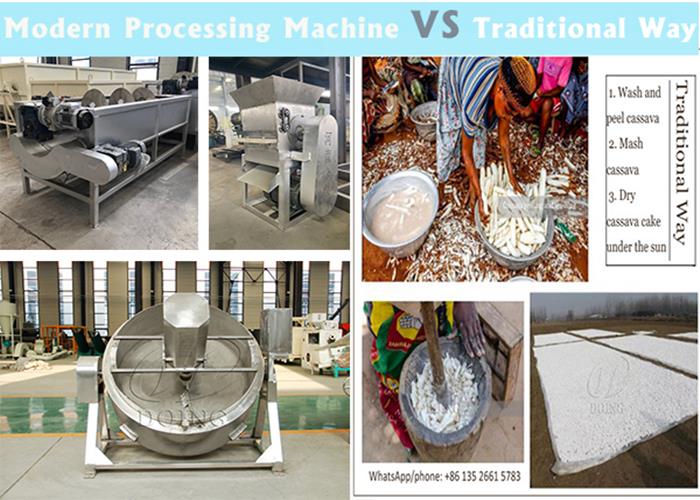 Manual cassava processing
Manual Dewatering Is Hard to Control
Without a hydraulic press, cassava mash is usually dewatered using sacks, heavy weights or simple jacks. The process is physically demanding and difficult to standardize. If too much water remains, frying takes longer and consumes more fuel. If pressing is uneven, the final garri texture can become coarse or inconsistent.
Manual Frying Is the Heaviest Bottleneck
Garri must be stirred continuously over heat so that the starch gelatinizes evenly and the moisture drops to a stable level. Manual frying demands constant attention, strong physical effort and careful control of temperature. If stirring is uneven or the heat is too high, the garri can easily scorch, turn too dark, or develop an inconsistent granule structure. This makes frying both a labor bottleneck and a quality risk.
Which Machine Replaces Each Labor-Heavy Stage
The most effective way to reduce labor costs is to match each manual bottleneck with a machine that can run continuously with fewer operators.
| Garri labor stage | Labor-saving machine | Jinrui key spec / benefit |
|---|---|---|
| Peeling | Cassava Peeler | Abrasive/brush roller peeling; peeling rate 95%; 1–5 t/h; only 1–2 operators needed |
| Grating | Garri Grinder | Grinds peeled cassava into uniform mash for fermentation and pressing; typical capacity 1–2 t/h |
| Dewatering | Hydraulic Press | Moisture 38–40% after pressing; SS304 contact parts; reduces frying load |
| Frying | Automatic Garri Fryer | 150–200°C adjustable; 10–20 min/batch; 3–5× faster than manual frying; 20–30% energy saving; 1 operator can monitor multiple units |
| Sieving | Vibration Sieve | 10–100 mesh; stable grading for uniform granule size |
The automatic garri frying machine is usually the most important upgrade for labor reduction. According to Jinrui Foodtech (Henan Jinrui) product data, it integrates heating, automatic stirring and temperature control, so one operator can manage the frying process without standing over an open pan. A batch can be finished in about 10 to 20 minutes, compared with one to one and a half hours for manual frying. The insulated frying chamber also helps cut fuel consumption by around 20 to 30 percent, and the equipment can pay back its investment in roughly 6 to 12 months depending on local production scale.
Hydraulic pressing matters just as much. By pressing cassava mash to a stable 38–40 percent moisture, it reduces the work that the frying machine must do. Jinrui Foodtech hydraulic presses are available in several models, so producers can choose according to daily output.
| Hydraulic Press model | Capacity | Pressure | Drum diameter | Material |
|---|---|---|---|---|
| 100 type | 250–300 kg/h | 5–30 T | Φ450 mm | SS304 |
| 200 type | 450–600 kg/h | 5–30 T | Φ550 mm | SS304 |
| 300 type | 700–900 kg/h | 5–30 T | Φ650 mm | SS304 |
| 400 type | 950–1,100 kg/h | 30–100 T | Φ750 mm | SS304 |
| 500 type | 1,200–1,400 kg/h | 30–150 T | Φ850 mm | SS304 |
The peeling machine removes the need for workers to squat and scrape cassava by hand. With a peeling rate of about 95 percent, it can be operated by only one or two workers and feeds the following stages more smoothly. The garri grinding machine then crushes the peeled cassava into wet mash. Garri production does not require extremely fine grinding; the aim is even granulation and stable flavor rather than ultra-fine powder.
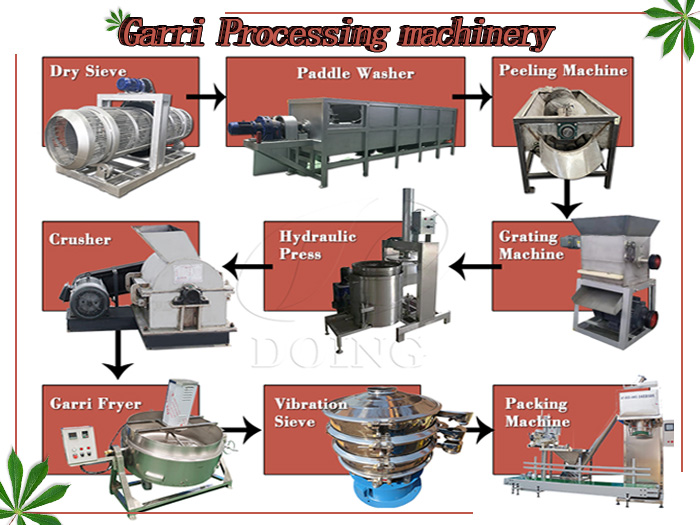 Garri production line
Choosing a Setup by Scale: Semi-Automatic, Fully Automatic, or Full Line
A garri line does not have to be fully automatic from the beginning. The right setup depends on daily output, available labor, fuel cost and whether the producer plans to expand later.
1–5 TPD semi-automatic setup — Suitable for small workshops. A basic line may include a peeling machine, a grater, a hydraulic press and one automatic garri frying machine. The frying machine alone can significantly reduce the hardest manual work.
5–20 TPD fully automatic single line — Suitable for medium producers. Multiple hydraulic presses and frying machines can be arranged so that pressing and frying run continuously. Jinrui Foodtech garri lines in this range typically use standardized units that can be added as capacity grows.
20–50 TPD full processing line — Suitable for larger plants. A full line with automatic feeding, temperature control and sieving is more suitable. At this scale, labor reduction comes not only from individual machines but also from smoother material flow between peeling, pressing, frying and sieving.
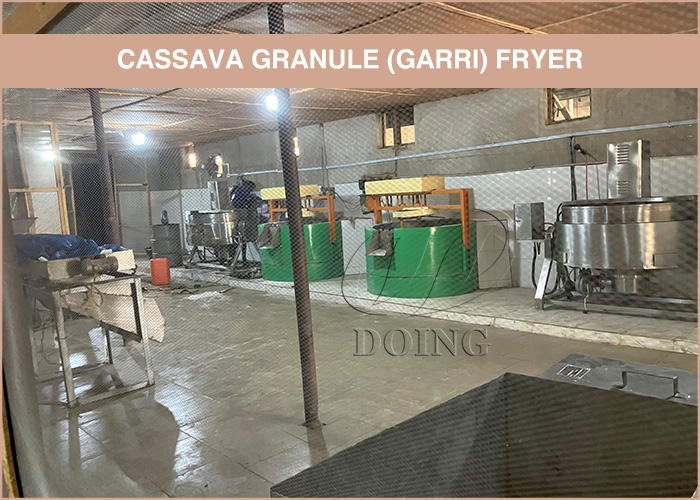 Garri processing plant
A Real Upgrade Example in Ondo State, Nigeria
In Ondo State, Nigeria, a 2 TPD garri processing project was installed and put into operation in May 2024. The line was designed for a producer who wanted to reduce manual work while improving product stability.
The equipment configuration included a peeling machine, a grating machine, a dewatering machine, two garri frying machines and a vibrating sieve. The line could produce both white and yellow garri. This example shows how a small or medium garri producer can move from manual frying and pressing to a more stable, machine-driven process without necessarily starting with a very large plant.
FAQ: Labor-Saving Garri Processing
If I can only afford one machine for now, which one should I buy first?
Start with whichever of the three heavy stages you still do by hand, in this order: frying, then pressing, then peeling. Frying comes first because it ties up the most hours and cannot be left unattended; pressing next, because drier mash shortens every frying batch; peeling last, because it is the easiest to keep partly manual without breaking the flow.
Can I connect new machines with my existing garri equipment?
Yes. Many garri producers upgrade step by step. A new peeling machine, hydraulic press or frying machine can often be connected to existing cleaning, washing or sieving equipment. The key is to check capacity matching, material transfer height and power supply before installation.
How do I choose between gas, diesel and electric heating for the frying machine?
The choice mainly depends on local fuel price, supply stability and plant infrastructure. Gas and diesel heating are common where fuel is readily available, while electric heating may be more suitable where electricity supply is stable and the team wants to avoid on-site fuel handling. For reference, Jinrui Foodtech garri frying machines can be configured with gas, diesel or electric heating, and typical consumption is about 30 liters of diesel per ton or 25 liters of LPG per ton of garri.
What makes garri frying different from ordinary cassava drying?
Garri must be fried so that the starch gelatinizes, the moisture drops and the characteristic granular texture forms. This requires continuous stirring and careful temperature control between about 150 and 200°C. Ordinary cassava flour or starch drying does not involve the same frying and gelatinization step, so garri frying equipment must be designed for direct heat, agitation and moisture control.
If I start with only part of the line, where does the bottleneck move?
It moves rather than disappears. Add the frying machine and the press becomes the limit; add the press and peeling or grating becomes the limit; add the peeler and feeding and sieving become the limit. Plan your purchase order around that moving bottleneck, and keep one manual fallback — usually sieving or feeding — until the line is complete.
Where to Start Cutting Labor
The most reliable way to reduce labor costs in garri processing is to start with the stages that consume the most time and physical effort. A peeling machine reduces manual scraping, a hydraulic press stabilizes dewatering at 38–40 percent moisture, and an automatic garri frying machine replaces long hours of manual stirring while improving batch consistency.
If you are planning a garri line upgrade, contact Jinrui Foodtech with your current daily output, the number of workers handling peeling, pressing and frying, and your target capacity. Our team will then match an equipment list to your production scale and prepare a quotation for peeling, pressing, frying and sieving machines for your garri processing line.