

How to Replace Manual Cassava Peeling Without a Full Processing Line
Manual peeling is usually the first stage a cassava processor wants to remove - and it is also the stage that can be mechanised on its own, without committing to a complete processing line. A single semi-automatic peeling machine placed ahead of the existing washing, grating and pressing stations cuts labour hours, improves flesh recovery and raises hygiene at once, while every other part of the workflow stays exactly as it is today.
The practical sequence is to mechanise one station, prove the saving on that station, then add the next machine when the next bottleneck appears. That path suits small and mid-scale garri processing and cassava flour operators working with limited capital, uneven daily root supply, or a workshop that cannot be shut down for a full rebuild. The equipment options, sizing logic and scale-up route are set out below.
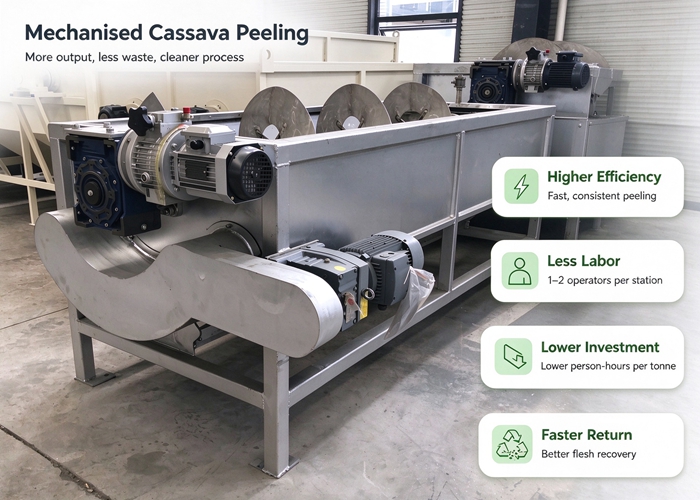 Cassava peeling machine
Why Peeling Is the First Stage to Mechanise
Labour hours dominate the cost
Hand peeling with a knife is slow and inconsistent, and it consumes more person-hours per tonne of roots than almost any other stage in the chain. On a manual setup the peeling team is typically the largest single labour block, and that cost grows almost linearly with output. A mechanised peeling station compresses the block into one or two operators who feed the machine and inspect the discharge.
Hand peeling wastes recoverable flesh
The cassava bark is thin, but the peel is irregular, so workers cut deep to be certain the brown skin is gone - removing edible, starch-bearing flesh along with it. The loss is invisible until throughput is measured. An abrasively driven peeling machine removes the bark in a controlled layer instead of a knife-deep cut, so the bark comes off without the starch-bearing flesh a knife takes with it. A properly sized abrasive peeler is therefore rated by its peeling rate - the share of bark it strips cleanly - which runs above 95% on correctly sized roots.
Hygiene problems start at the peeling table
Roots arrive covered in soil, and that soil moves straight into the hand-cutting step, where bare flesh, knives, boards and hands all meet before any washing can reach them. These contact points are also the hardest to keep clean across a long shift. A machine that washes and peels in one continuous flow removes that open-air handling step, shortening the distance between field soil and the fermented pulp.
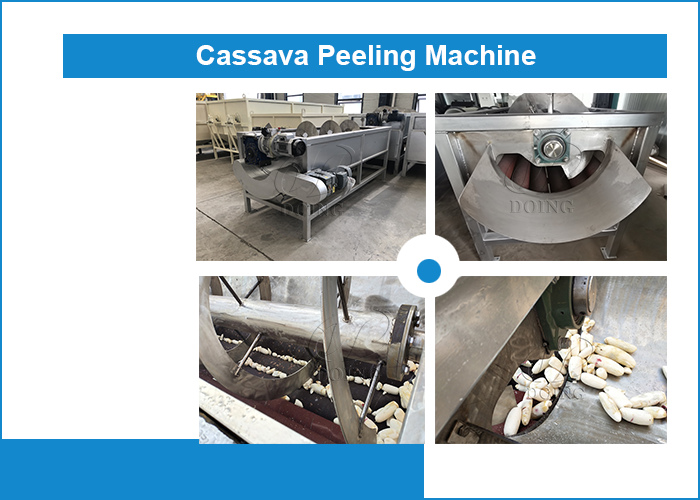 Sand roller cassava peeler
Semi-Automatic Peeling Options Before a Full Line
The drum-type machine is the workhorse for a peeling-only upgrade. Roots are fed into a rotating drum, friction strips the bark while a water flush carries it clear, and the peeled roots discharge at the far end. Within that drum format there are a few distinct types of cassava peeling machine, and the type you choose decides peeling quality and running cost more than any other single factor.
The table below compares the main types of cassava peeling machine used for a partial, non-full-line upgrade.
| Type of peeling machine | How it peels | Peeling rate | Contamination risk | Wear & upkeep |
|---|---|---|---|---|
| Abrasive drum peeler (sand / emery roller) | Controlled abrasion strips the bark only | High - 95%+ bark removal on sized roots | Low - no loose filaments | Roller is a predictable consumable, stocked locally |
| Brush peeler / washer-peeler (plastic bristle) | Loosens surface skin; weak on mature bark | Low - leaves bark on mature roots | Low | Bristles wear down fast; cutting geometry lost early |
| Nail / tooth drum peeler | Steel teeth cut aggressively into the root | High, but deep cuts waste flesh | High - metal filaments can shed into the product | Teeth chip and need frequent replacement |
For a garri or flour line that is still partly manual, the cassava peeling machine - such as the cassava peeler supplied by Jinrui Foodtech (Henan Jinrui) - is usually the safer default: it removes bark consistently without the flesh loss of a deep tooth cut or the filament risk of a metal-tooth peeler.
Matching a Peeling Machine to Your Daily Throughput
Capacity should be chosen on tonnes of fresh roots per hour, then cross-checked against how many hours the machine will realistically run each day - and against the peak day, not the average one. Because cassava arrives in flushes around harvest, a machine sized to a quiet week is buried the moment thirty tonnes land at once, so the reference point is the busiest day the workshop can actually absorb.
The table below lists the capacity classes in Jinrui Foodtech's cassava peeler range, along with the installed power, footprint and weight each model needs on site.
| Model | Root throughput | Installed power | Dimensions (mm) | Weight |
|---|---|---|---|---|
| Qp1 | 1-2 t/h | 3 + 1.1 kW | 2980 x 1100 x 1230 | 850 kg |
| Qp2 | 2-3 t/h | 4 + 1.1 kW | 3490 x 1380 x 1700 | 1200 kg |
| Qp5 | 4-5 t/h | 4 + 4 + 1.1 kW | 4260 x 1250 x 1540 | 1970 kg |
How a Peeling-First Upgrade Scales Later
A peeling machine installed on its own does not lock a processor into a fixed layout, because each following station can be mechanised in the same manner the moment its own bottleneck becomes visible. The usual sequence runs peeling -> washing and grating -> dewatering -> frying -> sieving and packing, with the machines already installed being reused rather than scrapped at every step.
This is not a theoretical path. A modular garri project carried out by Jinrui Foodtech in West Africa followed exactly this order - starting from the core peeling and processing machines, then adding equipment stage by stage as each capacity constraint appeared, until the workshop reached a fully automated line while the existing building and layout were carried straight through to the final configuration.
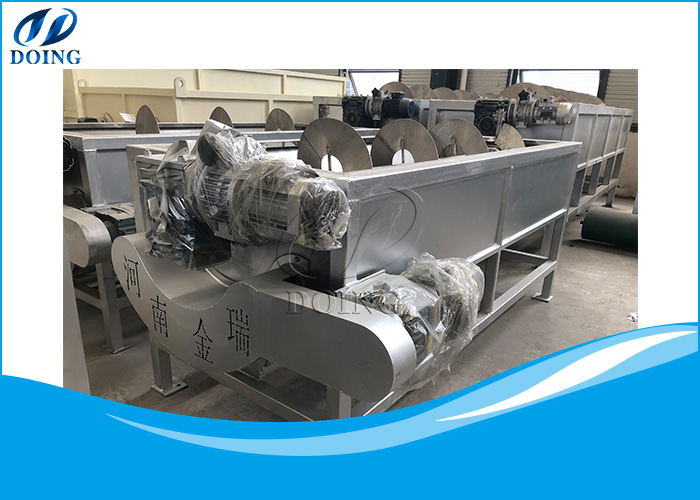 Cassava peeler
What to Verify Before Choosing a Peeling Machine
Before committing to a model, the aim is to confirm that the supplier is solving a peeling problem rather than simply selling a drum. A short checklist separates a capable integrator from a machine-only seller, and every item below maps directly onto how the upgrade will behave once it is running in your workshop.
Does the supplier ask about daily root volume and root size range before quoting a model?
Is the rated throughput stated as fresh roots per hour, and does it match your peak day rather than your average day?
Is the discharge arrangement compatible with the station that follows peeling today?
Does the quotation cover installation, operator training and commissioning, or delivery only?
Can the same supplier take the next stage when you decide to mechanise beyond peeling?
Frequently Asked Questions
What power supply does a semi-automatic peeling machine need?
The small units can run on a standard single-phase supply, but the larger classes use two drive motors plus a wash pump, which calls for a three-phase supply and a proper starter panel rather than a single socket. Confirm what is available on site - grid, generator or solar-diesel - before fixing the model, because the power option can change the drive specification and price.
Are replacement rollers and wear parts available locally?
Peeling runs wet, gritty and continuously, so rollers, screens and seals are consumables, and how quickly a worn roller can be replaced decides how long a machine stays in service. Jinrui Foodtech operates a Nigerian branch with a parts warehouse in Ogun State, holding wear items for peeling and downstream machines so a roller change does not wait on international shipment.
How much does a cassava peeling machine cost?
For semi-automatic peeling machines in the small to mid capacity classes, a reasonable budget range is roughly USD 3,000 to 15,500, rising with capacity class and drive configuration. The figure covers the machine itself; shipping terms and installation move the final number, so a firm quote only follows a confirmed throughput target.
Can a peeling machine handle curved, split or thin roots?
Uniform roots peel best. Heavily curved, split or very thin roots are commonly diverted to a small hand-peeling table, which is one reason processors keep that table running alongside the machine instead of removing it entirely - the machine carries routine volume, the table absorbs the awkward residue.
Will mechanised peeling change my final garri quality?
It changes the input to every downstream stage: more uniform peeled roots give more consistent grating, more predictable fermentation and a cleaner finished colour. Texture still depends on fermentation and frying practice, so peeling should be treated as the enabling step rather than the whole quality fix.
The Bottom Line
Replacing manual cassava peeling does not require a full processing line. A correctly sized semi-automatic peeling machine can carry a peeling team's work on its own, with the existing washing, grating and pressing stations left in place - and it can stay in service as the first segment of a line that grows stage by stage.
Jinrui Foodtech supplies and installs cassava peeling machines as single stations or as the starting point of a phased cassava processing upgrade, with wear parts held in Nigeria. Tell us your daily root volume and power situation, and we will size the peeling stage and map what follows it.