

How to Choose the Right Garri Processing Plant Capacity for Your Business
2.Key Factors to Consider When Choosing Garri Plant Capacity
3. How to Choose the Right Capacity: A Practical Decision Framework
4. Real Garri Processing Projects: How Different Businesses Choose Capacity
5. Frequently Asked Questions About Garri Processing Plant Capacity
6. Conclusion: Choose the Capacity Your Business Can Sustain
The right garri processing plant capacity is never a one-size-fits-all number. It depends on four interdependent factors: how much fresh cassava you can reliably supply throughout the year, how much garri your target market can absorb, your available investment budget, and the production efficiency you aim to achieve.
For a new investor, 1–3 TPD may be a practical starting range. An existing processor upgrading from manual methods may choose 2–5 TPD. Established businesses with strong cassava supply and committed wholesale demand may consider 5–20 TPD or more.
The largest plant is not always the best choice. This guide from Henan Jinrui, walks through each key factor — from raw materials and utilities to labor and future expansion — so you can make a capacity decision your business can actually sustain.
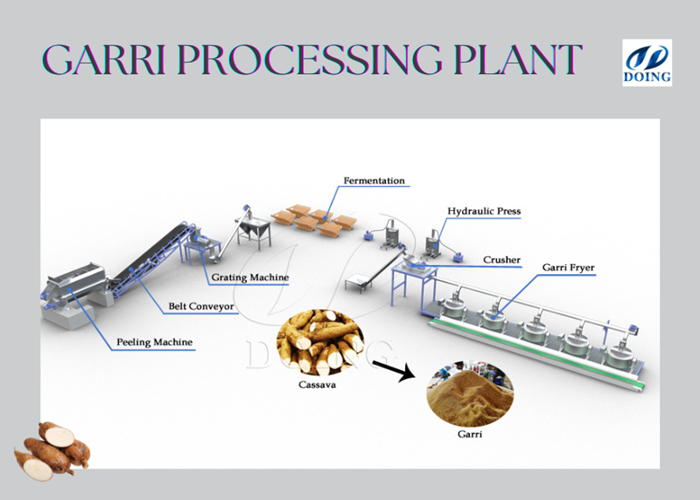 Garri making line
1.Garri Processing Plant Capacity at a Glance
The table below gives a quick overview of garri processing plant capacities by tier, showing the typical equipment configuration, suitable business type, and workshop space required at each level.
| Capacity Tier | Finished Garri Output | Typical Equipment Configuration | Suitable For | Workshop Space |
| Small-Scale | 1–3 TPD | Manual/semi -auto: peeler, grater, press, fryer, sieve | New investors, farmer -processors, local retail | 50–150 m² |
| Small Commercial | 2–5 TPD | Semi -auto with improved mechanization | Upgrading from manual, local wholesalers | 100–300 m² |
| Medium-Scale | 5–15 TPD | Semi -auto to fully automated line with conveyors | Stable supply + wholesale orders | 300–600 m² |
| Large-Scale | 20–50+ TPD | Fully integrated system: automated washing, grating, dewatering, frying, sieving, packaging | Large commercial processors, exporters, institutional buyers | 600–1,500+ m² |
2.Key Factors to Consider When Choosing Garri Plant Capacity
2.1 Raw Cassava Supply
Before choosing a garri processing plant capacity, know this one number: how many tonnes of fresh cassava can you reliably source per day?
On average, 3.5–4.5 tonnes of fresh cassava produce 1 tonne of finished garri — equivalent to a root-to-garri conversion rate of approximately 20–27% (International Institute of Tropical Agriculture, IITA). For practical planning, many processors use 20–25% as a working estimate.
| Finished Garri | Example Fresh Cassava Requirement |
| 1 TPD | ~5 tonnes/day |
| 5 TPD | ~25 tonnes/day |
| 10 TPD | ~50 tonnes/day |
| 20 TPD | ~100 tonnes/day |
Match your garri processing plant size to your cassava supply—not the other way around.
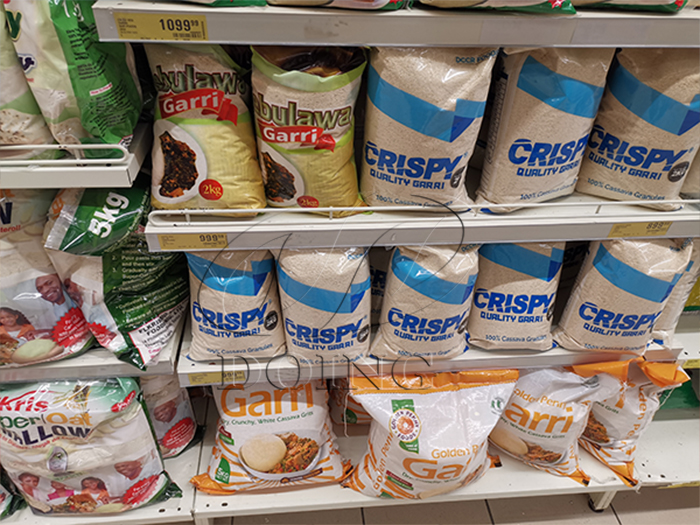 Garri market demand
2.2 Target Market Demand
A 20 TPD garri processing plant makes no sense if your current buyers only need 3 tonnes a day. The question is simple: how much garri can you realistically sell—whether to local retailers, wholesalers, supermarkets, institutional buyers, or export markets?
For a new processor building a customer base, a smaller plant (1–3 TPD) is the smarter start — you can scale up once demand grows. For businesses with committed wholesale or export orders, larger capacities (5–20+ TPD) are justified.
Let your sales volume determine your capacity—not the other way around.
2.3 Investment Budget
Your budget directly determines which garri processing plant capacity you can realistically consider:
1–3 TPD – Modest investment, achievable for most new entrants
5–10 TPD – Typically costs 2–3× more than 1–3 TPD, with higher output and lower per-unit cost
20 TPD+ – Substantial capital required, plus larger workshop, stronger power, bigger generators, and more working capital for daily raw material purchases
If your budget is limited, a smaller garri processing plant (1–3 TPD) lets you enter with manageable risk. With sufficient capital, a larger plant can lower per-unit costs—provided your market can absorb the output.
Your capacity should fit your budget — not stretch it to the breaking point.
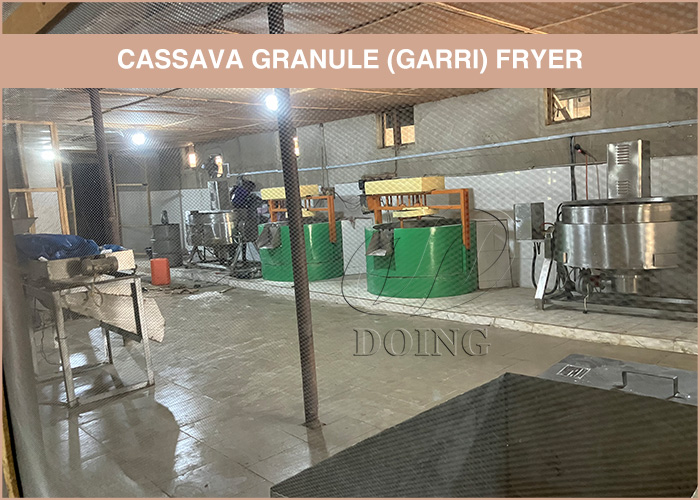 Garri processing workshop
2.4 Workshop Space and Utilities
Your chosen garri processing plant capacity must be supported by adequate infrastructure — otherwise the equipment will not perform as designed.
Space: A 1–3 TPD garri processing plant needs about 50–150 m². A 5–10 TPD line requires 300–500 m². Larger capacities need proportionally more space—plus room for raw material storage, finished goods, and generator housing.
Power: Typical power requirements range from 10 kW for small lines to 120 kW+ for large automated plants. In areas with unstable grid power, a diesel generator is essential for consistent production.
Water: Garri processing is water-intensive, especially for washing cassava. A reliable clean water source is a must.
Before choosing a garri processing plant capacity, confirm that your space, power, and water can actually support it.
2.5 Labor Availability
Your labor situation directly shapes your garri processing plant capacity choice:
If you have 5–10 workers for manual handling (peeling, grating, sieving), a 1–3 TPD garri processing plant is a realistic starting point.
When labor is scarce or costly, manual handling becomes a bottleneck beyond 3 TPD — mechanization becomes necessary to maintain output.
Operating at 20 TPD+ requires full mechanization — automated systems reduce labor to just 3–5 skilled operators per shift.
Your plant capacity should match the labor you can realistically hire—and the automation level your budget allows.
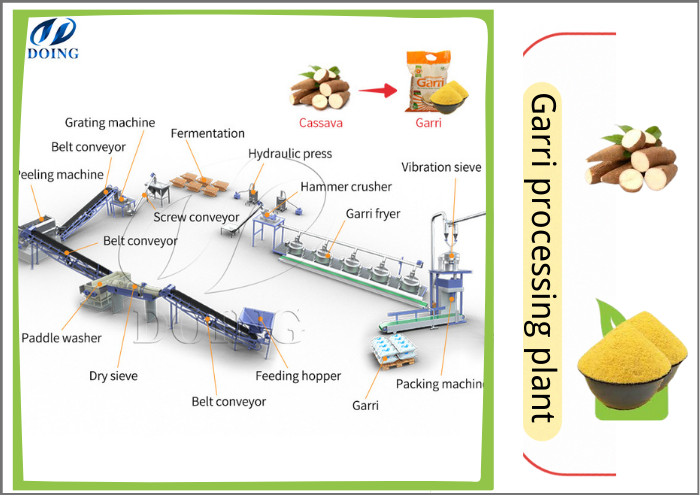 Set up a garri processing plant
3. How to Choose the Right Capacity: A Practical Decision Framework
Once you understand the key factors, use these five steps to choose a garri processing plant capacity that fits your business.
Step 1: Calculate Your Reliable Cassava Supply
Start with the amount of fresh cassava you can consistently source, rather than the maximum available during peak harvest. This gives you an upper limit for practical processing capacity.
Step 2: Estimate Your Realistic Garri Sales
Work backward from your expected monthly sales. If your market can only absorb 2–3 tonnes of garri per day, there is little reason to start with a plant designed for much higher output.
Step 3: Compare 2–3 Capacity Options
Once you have a realistic range, compare options such as 1 TPD, 2 TPD, or 5 TPD based on investment, operating costs, raw-material requirements, and future expansion.
Step 4: Match the Equipment to Your Capacity
Ask the equipment manufacturer for a complete proposal covering the process flow, equipment configuration, power requirements, workshop layout, and future expansion options. The individual machines should be properly matched so that one stage does not become a production bottleneck.
Step 5: Check Peak and Off-Season Conditions
Finally, test whether the selected plant can operate reasonably when cassava supply or market demand decreases. A plant that only works at full capacity during the peak season may not be the most economical choice.
The right capacity is the one your garri business can reliably supply, operate, and sell—not simply the largest capacity you can afford.
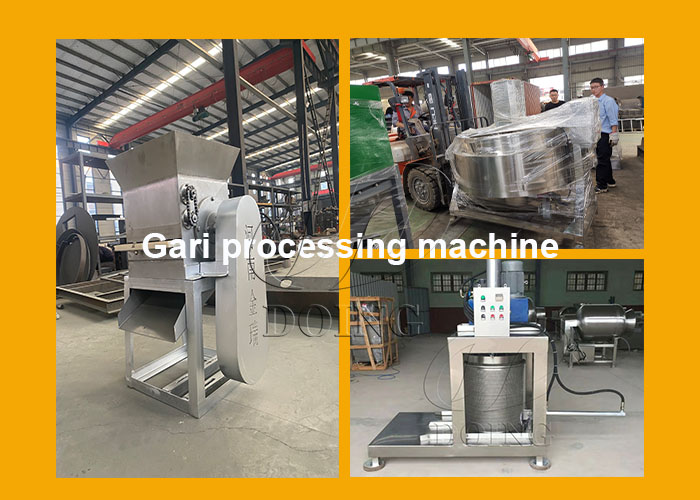 Garri processing projetcs
4. Real Garri Processing Projects: How Different Businesses Choose Capacity
At Henan Jinrui, we work with customers at different stages of cassava and garri processing. Here are two cases that show why the right capacity can be different for every business.
Case 1: A Cassava Grower Entering Garri Processing — 1 TPD in Benin
A cassava grower in Parakou, Benin, wanted to move from cultivation into value-added garri processing. Rather than investing in a large-scale plant, the customer chose a 1 TPD solution that provided a practical entry point — matching the current business stage while allowing room to learn the processing market. This approach minimized upfront risk and enabled the grower to build processing experience without overextending resources.
Read the full project → 1 TPD Garri Processing Machine for a Cassava Grower in Benin
Case 2: An Existing Processor Upgrading Production — 2 TPD in Nigeria
A processor in Ondo State, Nigeria, already had a garri operation and workshop but wanted to improve efficiency and mechanization. Rather than replacing the entire plant, the customer chose a 2 TPD upgrade that integrated with the existing setup — upgrading the bottleneck stages while keeping what still worked. This approach avoided the cost of a full rebuild and allowed the processor to maintain partial production during the transition.
Read the full project → 2 TPD Garri Processing Plant Project in Nigeria
The right capacity depends entirely on where you are starting from — not just where you want to end up.
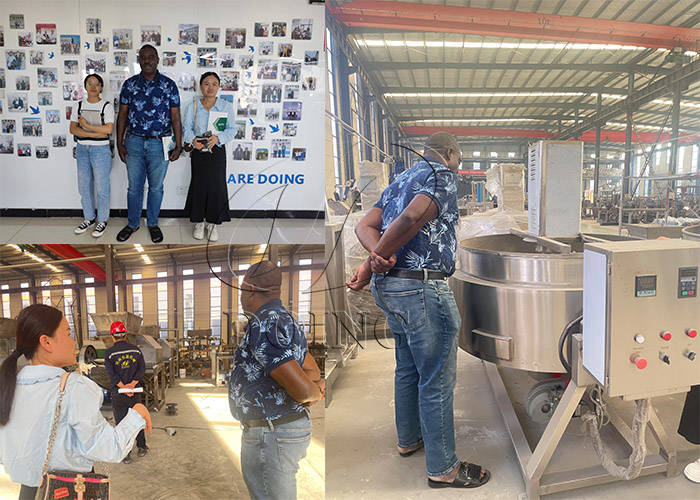 Garri processing factory
5. Frequently Asked Questions About Garri Processing Plant Capacity
Q1: What is the best garri processing plant capacity for a beginner?
A: For many new investors, 1–3 TPD can be a practical starting range. However, the specific right choice within that range depends on your actual cassava supply, your target buyers, and whether you plan to sell locally or to wholesalers from the start.
Q2: How much fresh cassava is needed to produce 1 tonne of garri?
A: A reliable planning estimate is 3.5–4.5 tonnes of fresh cassava per 1 tonne of garri, based on a conversion rate of approximately 20–27% (International Institute of Tropical Agriculture). The actual conversion varies with cassava variety, dry matter content, processing losses, and operating conditions.
Q3: Can I start small and expand later?
A: Yes. Many investors choose a smaller initial capacity and expand as their cassava supply and market develop. However, future expansion should be considered when planning the initial workshop layout and utilities.
Q4: Do I need a fully automated garri processing plant?
A: Not necessarily. Small and medium-scale plants can use semi-automated configurations, while larger plants generally require a higher level of mechanization to maintain efficiency and reduce labor requirements.
Q5: Can an existing garri processor upgrade the current equipment?
A: Yes. If the existing workshop and some equipment are still suitable, upgrading the bottleneck equipment can be more practical than rebuilding the entire plant.
Q6: How much does a garri processing plant cost at different capacities?
A: Cost varies significantly with capacity level, automation degree, and equipment origin. A small-scale semiautomatic plant (1–3 TPD) represents a modest entry-level investment. A medium-scale plant (5–10 TPD) typically costs 2–3× more, while a large fully automated line (20+ TPD) requires substantially higher capital plus larger workshop, power infrastructure, and working capital. For a detailed CIF quotation based on your target capacity and configuration, contact us with your capacity goal and preferred automation level.
6. Conclusion: Choose the Capacity Your Business Can Sustain
Choosing the right garri processing plant capacity is not simply a matter of picking a number — it is about matching four realities:
Raw Cassava Supply + Market Demand + Investment Budget + Production Efficiency
The wrong choice in either direction creates problems: too small and you cannot meet demand or grow; too large and you are paying for capacity you cannot fill.
Contact Henan Jinrui — a direct manufacturer of cassava and garri processing equipment — with your daily cassava supply, target market, and available budget. Within 24 hours, you will receive a capacity recommendation and a detailed equipment configuration proposal tailored to your project conditions.