

How to Upgrade an Existing Tapioca Starch Processing Plant in Thailand?
A tapioca starch plant upgrade in Thailand should not begin by simply replacing the oldest-looking machine. First identify what is actually reducing your saleable starch: low starch release, unstable starch quality, repeated equipment failure, insufficient drying, or several sections that can no longer work together. Each problem leads to a different upgrade path.
This article sets out a practical sequence for that decision: audit what the plant actually produces today, match the observed problem to one of three upgrade paths, check how new equipment connects with the machines before and after it, and then compare proposals on scope and responsibility rather than on the main machine price alone.
What Should You Check Before Upgrading an Existing Tapioca Starch Plant?
Before starting an existing tapioca starch processing plant upgrade, the first audit should produce numbers an engineer can work with. “The plant is old” is not enough information for an upgrade proposal.
Separate Rated Capacity from Actual Daily Output
The capacity on a machine nameplate is its rated capacity under specified conditions. It is not the quantity of finished starch your factory produces in one day. A line whose nameplates look adequate may run only part of the day because the rasper stops for cleaning, the feed is uneven, or the dryer cannot accept wet starch continuously.
For one representative operating day, record fresh cassava received, finished starch packed, actual running hours, planned and unplanned stops with their causes, starch remaining in fiber or lost with process water, and the moisture and purity of the finished starch. Then ask each supplier to state whether a quoted capacity means fresh-cassava input, wet-starch flow, or finished-starch output, because mixing these bases makes proposals impossible to compare.
Check Whether the Problem Is Yield, Quality or Reliability
Use the plant symptom to guide the audit:
| What you observe | What to check first | Likely upgrade direction |
|---|---|---|
| Too much starch remains in the fiber | Crushing fineness, rasping condition, screening stages | Crushing and extraction upgrade |
| Starch quality is inconsistent | Fiber carryover, slurry concentration, purification stages | Screening and hydrocyclone upgrade |
| Dryer cannot keep up | Wet-starch moisture, dewatering rate, dryer feed and air system | Dewatering and drying upgrade |
| Frequent unexpected shutdowns | Wear parts, bearings, corrosion, pumps, spare-parts supply | Replacement of aging equipment |
| Several sections stop one another | Transfer points, tanks, pumps, piping, controls, layout | Integrated line upgrade |
This classification prevents a common mistake: buying a new dryer to solve a crushing problem, or replacing a sound rasper when the real loss occurs during purification.
Record the Condition of the Equipment That You Want to Keep
For each machine, record its model, dimensions, motor data, connection sizes, foundation, wear parts, maintenance history, and current performance. A machine can be retained only when it still delivers the required process result and can be connected safely to the new section. Its age is one factor; performance, wear, hygiene, and interface compatibility matter more.
 Tapioca starch processing plant upgrade
Which Upgrade Path Fits Your Existing Tapioca Starch Plant?
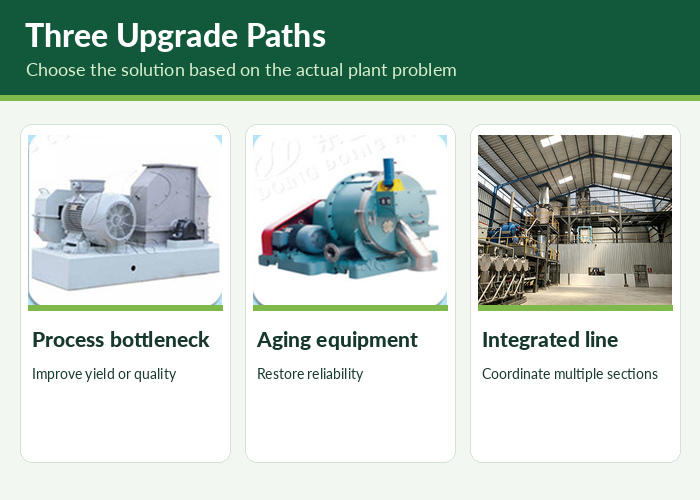
The three paths below solve different problems. Path 1 applies when the equipment runs reliably but a process result is unsatisfactory; Path 2 applies when the process is acceptable but the equipment itself is failing; Path 3 applies when the two problems overlap across several sections.
Path 1: Upgrade a Process Bottleneck
A bottleneck upgrade is the right choice when the equipment itself runs reliably but one process result — extraction rate, starch quality, or drying performance — is below target. The correct approach is to upgrade the section that produces that specific result, not to add capacity somewhere in the line and hope the result improves.
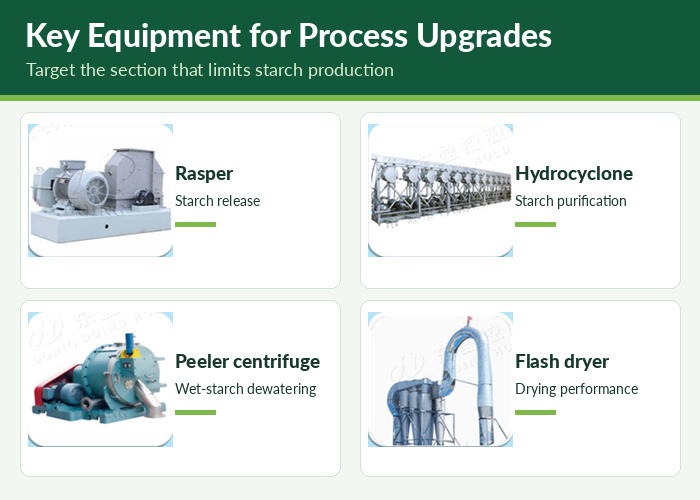
Low starch release is the clearest example. Starch that was never released from the cells cannot be recovered by any screen downstream, so when too much starch remains in the fiber, the cause is normally in the crushing section: the cassava pieces entering the rasper are too large, or the rasping surfaces are worn. If crushing is the confirmed cause, the targeted solution is a stronger crushing arrangement — Jinrui Foodtech (Henan Jinrui) designs a two-stage crushing section for cassava starch lines, with a documented crushing rate of about 94% under the relevant project conditions, so more starch is released before extraction. What must be verified is not the crusher alone, but whether feeding, dilution, and the extraction screens can accept the additional slurry it releases.
The same logic applies to the other two common cases. Unstable starch quality points to the purification section, where an 18-stage hydrocyclone arrangement gives the starch milk repeated separation and washing stages; a dryer that cannot keep up is often limited by the dewatering section before it, since the Peeler Centrifuge and Flash Dryer work as a pair and a wet, irregular feed will hold back any dryer. In each case, confirm the failing section first, then size the upgrade against the plant’s actual slurry concentration, water conditions, and product specification.
Choose this path only when the equipment itself runs reliably. If the same machine also fails repeatedly, Path 2 fits better.
Path 2: Replace Equipment That Is Becoming a Reliability Problem
Typical signs include the same bearing, blade, screen, seal, or pump failing repeatedly; corrosion or wear changing the process result; operators spending more time repairing than producing; and wear parts that are difficult to source. A short stop in one machine stops the whole wet process, so these failures cost more than the repair bills suggest.
Compare the accumulated cost of downtime and repeated repair with the cost of a cassava starch equipment upgrade for the critical machine. Then check whether the replacement matches the existing inlet and outlet positions, foundation, motor and electrical requirements, pipe connections, and control signals. The quotation should identify wear parts, recommended spares, installation responsibility, and the interface work needed to connect the new machine to the old line.
The deciding question that separates this path from Path 1: if the machine were mechanically reliable tomorrow, would the process result still be acceptable? If yes, replace it. If no, the process configuration also needs improvement, and the two paths should be combined.
Path 3: Upgrade the Whole Line or Several Connected Sections
Choose this path when several sections restrict one another, the production target is materially higher, or the existing layout cannot support the required process.
One Jinrui Foodtech project involved a cassava starch plant in Thailand that had been operating for about ten years. Rather than recommending a full rebuild, the project began with an equipment-by-equipment review of the old line, identified which machines could still be kept, then developed a revised process scheme and used the customer’s workshop drawings to integrate the new equipment into the existing building. The project shows what a whole-line upgrade should deliver: a revised process scheme, a retained-equipment list, a replacement list, layout and interface drawings, utility requirements, a commissioning plan, and a responsibility matrix.
If your plant has one measurable problem and the rest of the line performs well, this path is unnecessary. Product consistency also matters for exporters: guidance from the International Institute of Tropical Agriculture (IITA) on cassava processing and starch production links stable starch quality to consistent process control from fresh-root handling through to drying, which is a practical reason to treat an upgrade as a process decision rather than a machine purchase.
 How to upgrade tapioca starch plant
How Do You Match New Equipment with the Existing Line?
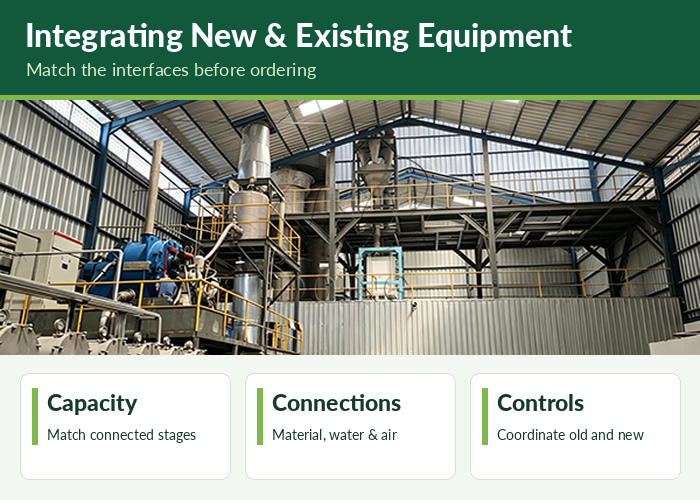
A new machine only performs when the section before it can supply it and the section after it can receive its output. Matching new equipment with an existing line therefore covers three different things: capacity between connected sections, the physical material, water and airflow connections, and the control interfaces between old and new equipment.
Match Capacity Between Connected Sections
Capacity must match across the processing chain, not machine by machine. If one section is upgraded beyond what its neighbors can accept, the bottleneck simply moves to the next section. The clearest example is the feeding chain between the cutting machine and the rasper: if the cutter feeds faster than the rasper can process, cassava accumulates and may overload the feed system; if it feeds intermittently, the rasper runs dry and daily output falls even though the rasper nameplate looks large enough. The same check applies after a two-stage crushing upgrade (screening, pumps, and hydrocyclone feed must accept the extra slurry) and after a dewatering upgrade (the Flash Dryer must accept the wet-starch flow), so every connected section should be sized against actual feed records, not nameplates alone.
Confirm Material, Water and Airflow Connections
A correctly sized machine still fails if it cannot be physically connected to the line. Confirm the inlet and outlet positions against the existing layout, the slurry pipe diameters, slopes and pump heads between the new section and its neighbors, the process-water source and pressure for washing and dilution, the route for transferring wet starch from the Peeler Centrifuge to the Flash Dryer, and the dryer’s hot-air supply, exhaust and powder-recovery arrangement. Drainage and wastewater routing belong in this check as well, so they are part of the layout before the equipment is ordered.
Coordinate Control and Operating Interfaces
Old and new equipment must work as one line from the operator’s point of view. Confirm which signals the new machines will exchange with the existing control system, whether variable-speed conveyors and pumps are needed to stabilize the feed, where level, slurry-concentration and drying-temperature monitoring will be read, and which interlocks should stop the cutter when the rasper stops. Not every plant can connect new equipment directly into an older PLC, so the integration method must be verified against the site’s actual control system before the quotation is finalized.
 Integrating existing & new starch equipment
What Should Be Checked in the Workshop and Utilities?
A cassava starch plant renovation can fail even when the selected machines are technically suitable, if the factory cannot receive, connect, clean, or maintain them. Before the layout is frozen, check existing foundations and elevations, inlet and outlet directions of retained and new equipment, slurry pipe routes and pump heads, process-water supply and drainage, electrical loads and control cabinet locations, dryer heat source and exhaust, and maintenance access for every machine.
Wastewater should be designed in from the start, not added after the equipment is ordered. In Thailand, factory wastewater discharge is regulated under the national environmental framework administered by the Pollution Control Department and related authorities, and plants inside industrial estates may face additional local requirements, so the applicable discharge conditions should be confirmed with the plant’s environmental advisers before the process design is finalized.
Responsibilities should be written down, not assumed. The buyer provides site data and coordinates local construction; the supplier defines equipment, process, interfaces, installation assumptions, commissioning tests, and exclusions; local contractors execute foundations, piping, electrical work, and demolition under the project documents.
How Should You Compare Upgrade Proposals?
Ask each supplier questions that force the proposal to deal with your actual plant:
Which observed problem does each proposed machine solve?
What will remain from the existing line, and what evidence supports retaining it?
Is the quoted capacity based on fresh cassava input, wet starch, or finished starch?
How will the new machine connect to the equipment before and after it?
Are foundations, conveyors, pumps, piping, cables, PLC changes, and local installation included or excluded?
What test will prove crushing, separation, purification, dewatering, and drying performance?
Which spare parts and wear parts are supplied at startup?
Who is responsible if a retained machine cannot meet the new process requirement?
A strong upgrade proposal contains a problem statement, process boundary, equipment and retained-equipment lists, interface conditions, layout, utility requirements, commissioning method, acceptance evidence, exclusions, and a responsibility matrix. Comparing only main machine prices hides the most expensive brownfield risks.
FAQ: Four Questions Worth Settling Before You Order
What evidence should be used to accept an upgraded section?
Agree on evidence before manufacturing starts, not after commissioning. Depending on the scope, acceptance may be based on stable feed, observed crushing result, fiber carryover, slurry condition, wet-starch moisture, final product moisture and purity tests, operating hours, and the absence of specified alarms or leaks during the agreed test. The acceptance method must reflect the equipment actually being upgraded, and the supplier’s proposal should state which evidence it commits to.
When should an old machine be retained instead of replaced?
Retain a machine only when its measured process result, mechanical condition, hygiene, safety, interfaces, and spare-parts plan meet the new design requirements. A machine should not be kept just because it still starts, and should not be replaced just because it is old. The test is whether it can hold the new line’s process conditions and be integrated without weakening reliability elsewhere.
Who pays for interface changes when a new machine does not fit the old line?
This should be allocated in the quotation before the order: foundations, pipe changes, conveyors, cables, control signals, demolition, and local installation each need an owner. Ask the supplier to mark the responsibility boundary on a layout or interface drawing. Verbal assumptions become difficult to manage once the old machine has been removed.
What Thailand-specific site information should be prepared for a supplier?
Prepare the plant location and site access, lifting conditions, electrical supply, water source and drainage route, environmental requirements, workshop drawings, local contractor availability, and any inspection or export-quality requirements. This lets the supplier separate equipment engineering from work that must be completed locally, and prevents the site side of the project from becoming a late-stage surprise.
Upgrade Your Tapioca Starch Plant with Jinrui Foodtech
An existing plant does not need a full rebuild by default. Start by measuring what the line actually produces, classify the problem as a process bottleneck, an equipment reliability issue, or a line-integration constraint, match new equipment to the machines around it, and compare proposals on scope, interfaces, and responsibilities rather than on the main machine price alone.
If you are planning to upgrade an existing tapioca starch plant in Thailand, contact Jinrui Foodtech directly. A short description of your current line, the problems you observe on site, and your target output is enough for the engineering team to begin the assessment, recommend the upgrade path that fits your situation, and prepare a proposal based on your actual plant rather than a standard configuration.