

How to Set Up a Food-Grade Cassava Flour Processing Plant in DR Congo?
Planning a cassava flour processing plant in DR Congo? Three decisions will make or break the project: the process route, a line whose sections all pass the same tonnage, and a workshop and root-supply plan settled before the first machine is ordered. Congolese households already buy cassava as flour every day, so demand is not the risk. The risk is building a plant that cannot hold food grade, or one that starves for roots.
The sections below follow the questions investors actually ask, in the order they ask them: why this market works, which route fits your buyers, what the line is made of section by section, how much building and how many roots to plan for, and what delivery looks like on a project that has already run.
Why Food-Grade Cassava Flour Matters in DR Congo
Food-grade flour is the tier that DR Congo’s substitution policy targets, and local supply has not caught up. Three forces line up behind that gap, and each one can be checked against published figures.
The raw material: about 46 million tonnes a year
FAOSTAT 2024 data put DR Congo’s cassava harvest at about 46.6 million tonnes a year — second in the world and in Africa, behind only Nigeria, and roughly 13.6% of global output (source: FAOSTAT 2024, FAO). Raw material is not the constraint here; collection is. Site the plant inside a growing belt and roots arrive within a short drive, which is what makes the three-day harvest-to-mill window realistic.
The market: about 353 kg per person a year
FAO food balance data put cassava supply at roughly 353 kg of fresh roots per person a year — the highest national figure on record, and about 145 kg once milled into flour (source: FAO food balance sheets). That flour is eaten as fufu, the dough that anchors the daily meal. You are not selling a new habit; you are industrializing an existing one, and the buyer’s question is whether your bag is consistent, not whether the food is familiar.
The policy: wheat flour is being partly replaced
The government’s substitution drive aims to cut a heavy wheat-import bill by working locally milled cassava flour into bread and baked goods, and FAO backs the programme with flour processing at the centre of its cassava industrialization work in the country. Substitution at national scale is standing demand for local millers — conditional on the flour actually meeting food grade.
What “food grade” actually requires
Food grade is a build standard, not a label printed on the bag. Buyers and inspectors test four things at the mill gate:
Fineness and whiteness — fine enough for bakery work, white enough to blend, with an even particle size
Low ash and fibre — grit, sand and coarse bran screened out rather than hidden behind colour
Controlled hydrogen cyanide — peel removed thoroughly and pulp handled wet, so cyanogenic compounds leave with the water
Moisture at 12–14% — dry enough to store and ship without caking
Your route and your equipment decide whether you hit those four. That is what the next section is about.
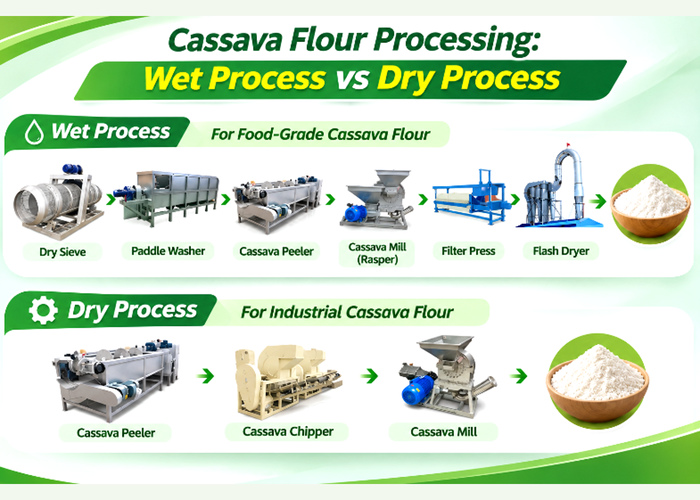 Cassava flour processing line
Choose the Wet Process Route for Food-Grade Flour
For food-grade cassava flour, the wet route is the one that meets the standard. That does not make the dry route wrong — it makes it a different business: dried chips in, industrial flour out, fewer machines and lighter investment.
Jinrui Foodtech (Henan Jinrui) builds both routes as complete lines: compact setups in the 2–5 t/h band, automatic lines from 6 to 40 t/h of fresh-root intake, contact surfaces in SS304 stainless steel, peeling rates above 90%. The route you pick is a market decision, not a supplier limitation.
Wet and dry, side by side
| Dry route | Wet route | |
|---|---|---|
| Starting material | Dried chips, bought or self-dried | Fresh roots |
| Main flow | Clean, peel, slice, belt-dry, mill, sieve, pack | Wash, peel, rasp, press, break the cake, flash-dry, sieve, pack |
| Flour you get | Coarser, higher impurity — fine for industrial use | Fine, white, low ash, controlled hydrogen cyanide |
| Best fit | Feed, alcohol and other industrial outlets; buyers working from dried chips | Bakeries, food processors and any food-grade market |
How to choose between them
Selling into feed, alcohol or industrial channels, or buying dried chips — take the dry route. Fewer machines, lighter investment, and the coarser flour suits those buyers.
Selling to bakeries, food processors or households buying food-grade flour — take the wet route. The extra equipment pays for itself in price, because only a wet line holds hydrogen cyanide at a consistent, controlled level.
Unsure which market you can hold — decide the buyer first. The line follows the buyer; a line bought before the market usually gets sold at a discount.
Peeling: the first food-safety gate
Cassava keeps its cyanogenic compounds in the peel, mostly in the outer layer but also in the second skin, so peeling is a safety step before it is a quality step. A sand-roller peeler that strips both layers at a peel rate above 90%, without carrying flesh away in the process, is what makes controlled hydrogen cyanide achievable for everything downstream.
Thick, fibrous roots from older stands need the roller grit and speed adjusted — in a 2 t/h Central African project, that adjustment was the difference between a clean peel and one that had to be re-run by hand.
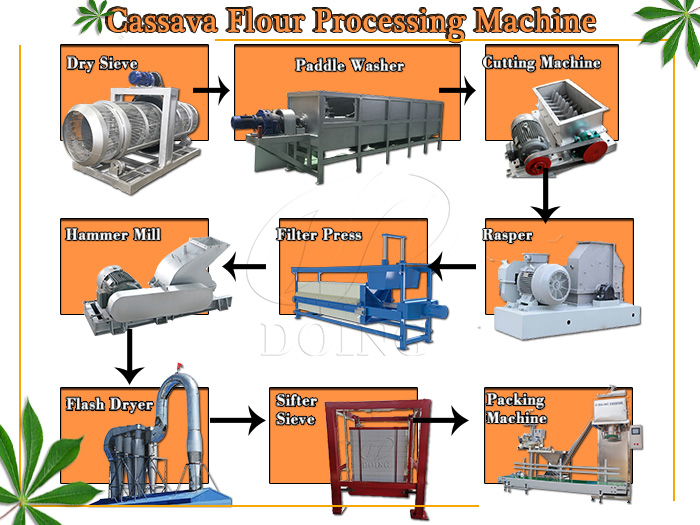 Cassava flour processing machine
Configure the Cassava Flour Processing Line Section by Section
A cassava flour processing line is a chain of matched capacities, not a shopping list. Every section has to pass the same tonnage per hour, or the bottleneck just moves downstream and the dryer ends up waiting on a press. What follows is the wet route in the order material flows; the figures below are working figures from that range, not catalogue maxima.
Cleaning and peeling
Two machines clean and one peels, and each has a different job. The dry sieve takes off what arrives with the truck — soil clods, stones, weeds, leaves — so the washer’s water goes on the roots instead of on the mud. The paddle washer then works the folds and ends of the skin in countercurrent water, which is exactly where hand washing fails.
Dry sieve — primary cleaning at intake; removes stones, mud, weeds and leaves
Paddle washer — countercurrent wash that reaches the folds in the skin
Sand-roller peeler — strips both skin layers with limited flesh loss
The peeler is the one machine worth customizing. Roots from old stands are thick and fibrous and need different roller grit and speed from young, thin-skinned roots.
Crushing: cut first, then rasp
Congolese roots are long and thick, and a rasper fed whole roots works harder than it needs to. A cutting machine pre-cuts them into short sections; the rasper then turns those sections into a fine pulp. Pulp fineness settles two things downstream — how much of the root’s solids end up in the wash water instead of the bag, and how fast the dryer can finish the cake.
After the rasper, a desanding unit and a magnet take out grit and stray metal. One nail hidden in a root can gouge a rasper blade and stop the line for a day, which is the cheapest failure in the plant to prevent.
Dewatering and cake breaking
Pulp arrives here at roughly 60% moisture and has to leave as a crumb the dryer can carry. A hydraulic press does that on compact setups, bringing the cake to 38–40% moisture; a plate-frame filter press does it on automatic lines, pressing to about 30% and keeping pace around the clock. A hammer mill then breaks the cake into crumbs.
Which press you take is a sizing question, not a design one: both sit inside the same line, and neither changes what happens downstream.
Drying, milling and sizing
Flash drying is where food-grade flour is won or lost. Hot air carries the crumbs through the duct and drops moisture to 12–14% in seconds, and the short residence time is also what protects whiteness — flour that sits warm for minutes darkens. An optional fine mill after the dryer takes the flour to 60, 80 or 100 mesh for bakery customers.
The sifter sieve closes the loop: fine flour goes to packing, oversize returns to the mill. Run the sieve without a return line and you either sell coarse flour at a discount or throw yield away.
Weighing and packing
An automatic quantitative packing machine weighs, fills and seals in one pass. That matters more than it sounds: hand-weighed bags drift, and a bag that runs 400 g light across a container load becomes a claim. Food-grade packing also means an inner liner and dust control at the spout.
Compact setup or automatic line?
Two configurations cover almost every project:
2–5 t/h, compact line — peeler, crusher, hydraulic press, flash dryer, fine mill, vibration sieve and packing machine. The simplest flow and the lowest investment, with the batch hydraulic press making it semi-automatic in operation; suited to a first plant on seasonal roots.
6–40 t/h, automatic line — dry sieve and paddle washer added ahead of the peeler, cutting machine and rasper replacing the simple crusher, a plate-frame filter press instead of the hydraulic press, and a hammer mill to break the cake before drying. Fully automatic and continuous, with steadier quality — and it needs a root supply that can feed it every working day.
Pick the band your roots can feed, not the band your capital can buy.
Plan the Workshop and Raw Material Supply
Plants that stall usually stall on the building or the roots, not on the machines. Both belong on paper before fabrication starts.
How much building to budget
The figures below are Jinrui Foodtech engineering references, drawn from cassava flour plants it has delivered — a starting footprint to confirm against your own equipment list, not an industry standard:
| Fresh-root intake | Workshop footprint (L × W) | Clear height |
|---|---|---|
| 2 t/h | 30 × 12 m | 6–7.5 m |
| 4 t/h | 42 × 12 m | 6–7.5 m |
| 6 t/h | 42 × 12 m | 6–7.5 m |
| 8 t/h | 48 × 15 m | 6–7.5 m |
Mind the 6–7.5 m clear height: a wet line stacks conveying and drying equipment vertically to save floor, and a low roof pushes the layout out long and flat — which costs more in civil works than the extra height would.
Keep the roots within three days of harvest
Fresh roots should be milled within about three days of harvest, and never beyond a week; the delay shows up directly in flour colour and smell. Site the plant close to the growing areas, and plan the receiving yard around the line’s daily intake rather than around how much a truck can carry.
Match the planting base to the machine
Capacity you cannot feed is idle steel. One Jinrui Foodtech project involved a 300-hectare cassava planting operation in DR Congo, whose owner started with single machines — grating, dewatering, fine milling and sieving — to lift processing efficiency in year one, then added equipment as the planted area grew.
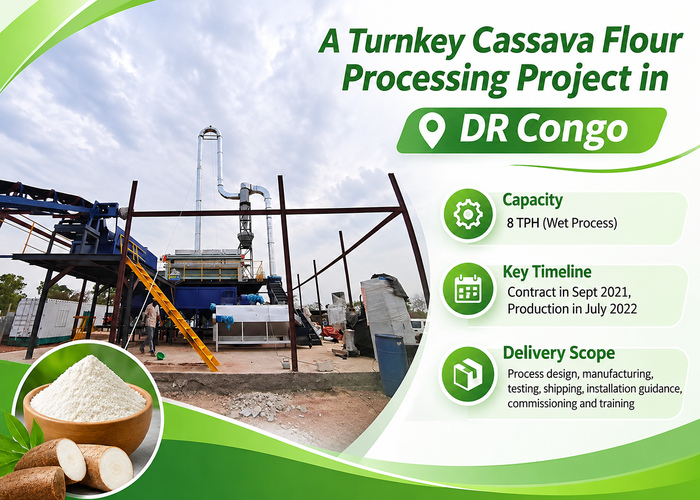 Cassava flour processing plant in DR Congo
Work With a Supplier Who Can Deliver the Full Project
In DR Congo, the supplier’s delivery record decides when flour actually ships. Fabrication is rarely the problem; installation, commissioning and training are where projects stall.
A delivered plant you can check
One Jinrui Foodtech project involved an 8 t/h wet-process cassava flour plant built in Kinshasa for a Lebanese industrial group that moved into flour on the back of the substitution policy.
The supplier’s engineers walked the client through the wet route, then hosted the client’s China-branch manager at the factory to watch the line run before the September 2021 contract was signed. The full line passed a pre-shipment trial before shipping in March 2022; when travel restrictions ruled out on-site engineers, a local crew installed it under step-by-step video guidance with full manuals, and production started in Kinshasa in July 2022.
That project shows turnkey delivery holding up under the worst logistics conditions — not that every plant follows the same calendar. The same configuration logic carried into a Central African government tender, where two 2 t/h automatic lines with a sand-roller peeler customized for thick-skin roots passed acceptance and entered production in 2025.
Who does what
You, the buyer: building, power, water, root supply and a local installation crew
The supplier: process design, manufacturing, pre-shipment testing, shipping, installation guidance, commissioning, operator training and ongoing technical support
Per contract: customs clearance and civil works
Put this split in writing before the deposit changes hands — it is the simplest way to keep a project moving. And check the after-sales footprint before signing: a branch and spare-parts warehouse in Ogun State, Nigeria, keeps response times short for West and Central African buyers.
Frequently Asked Questions
What should I prepare before asking for a quotation?
Five things: your target fresh-root intake per hour or finished-flour goal, the product tier you want to sell into, the automation level, your root situation — planted area or sourcing plan — and your site status: building size, power and water. Suppliers quote against these; without them, any number you receive is a placeholder.
How long does it take from deposit to first flour?
Roughly 5–8 months at typical scale, covering manufacturing, sea freight and installation. Three things stretch it: slow shipping, a building that is not ready, and remote video-guided installation where on-site engineers are not possible. Site readiness is the one first-time owners underestimate most.
What should the site have ready before installation starts?
Four things: the building completed to the layout drawing, power matched to the line’s electrical specification — confirm voltage and frequency early — water available for the wet route, and a local crew with basic lifting tools. Arrange roots for the trial run as well; commissioning needs material to run on.
Is it better to start small and upgrade later?
Start small when root supply is seasonal or unproven: a semi-automatic line or single machines keeps the first investment matched to real throughput. Move up when three things hold at once — plantation supply covers daily intake for a full season, buyer demand repeats, and one section, not the market, has become the bottleneck. Upgrading from that position is cheap; upgrading ahead of it strands capacity.
Start Your DR Congo Cassava Flour Plant on a Verified Route
A cassava flour processing plant in DR Congo rests on four settled decisions: the wet route if you sell food grade, a line whose sections all pass one intake figure, a workshop built to the 6–7.5 m reference with roots milled within three days, and a supplier judged on delivered plants.
You do not need drawings ready to start the conversation. Bring your target intake, your planting or sourcing plan and your site status; an engineering team can then judge the route and configuration, walk you through delivered reference projects and put dates against a build schedule. Contact Jinrui Foodtech to turn your cassava flour processing equipment plan into a working plant.