

How to Size a Cassava Grater (Rasper) for Your Starch Plant
In the cassava starch trade, "cassava grater" is a loose term. Most buyers mean the machine that turns washed roots into pulp so starch can be washed out, and in a starch line that machine is a rasper. Capacity matters more than most first-time buyers expect: a rasper that is too small starves or jams the line at peak, while one far too large wastes power on a half-empty drum grinding an uneven, thin layer of pulp. The goal is not the biggest machine in the catalogue but the one that keeps every stage behind it fed without becoming the bottleneck itself.
The right size comes from numbers you already control, such as how much finished starch you sell per day and how many hours you run a shift. The sections below turn those figures into a throughput target, map that target onto a model band, and show how the stages before and after the crusher quietly change the answer.
Cassava Grater vs Rasper: Which Machine Actually Fits a Starch Line
It is worth clearing up the terminology first, because a wrong machine cannot be sized into the right job. In strict usage both a grater and a rasper are crushing machines, and that overlap is exactly where confusion begins. A cassava grater is usually the spike-tooth roller crusher, a drum studded with hardened spikes that shreds peeled roots. It is the workhorse of the garri and cassava-flour line, where a burst rate of roughly 80–85% is acceptable because those products do not depend on extracting every last grain of free starch.
A rasper is built for a different goal. Its fine, fast saw-toothed drum ruptures almost every starch cell, reaching a burst rate of 96% or higher. That matters in starch because money is made on free starch: the more cells you break open, the more starch is released into the pulp for the screens and hydrocyclones to recover, and that is what lifts starch extraction to around 92–94%. A spike-tooth grater leaves far more starch locked inside unbroken cells, so the same tonnage of root yields less starch no matter how well the rest of the line is run.
So when a buyer searches for a "grater for starch production," the machine that fits the line is a rasper. Calling it a grater is no accident: both are crushing equipment, so the umbrella word is often applied to the starch crusher as well. The practical rule is to treat the word as a clue to the job, not the product, and to spec the machine by what it must produce, which in a starch line is high-burst pulp from a rasper.
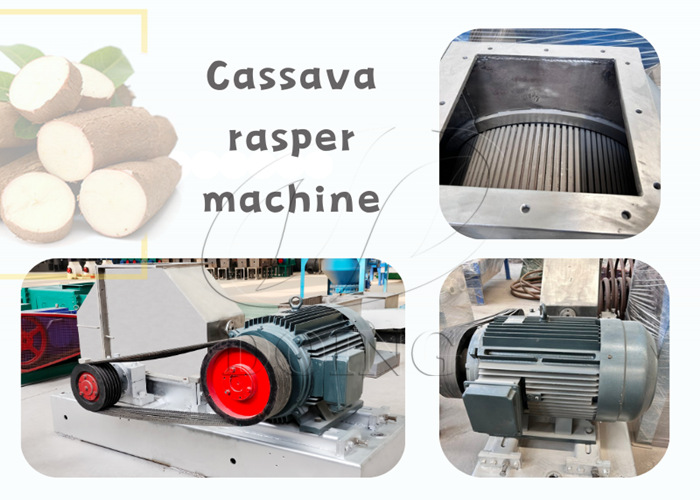 Cassava rasper
How to Calculate the Rasper Throughput Your Starch Plant Needs
The calculation begins with the product you intend to make, not with a machine nameplate. For preliminary planning, FAO references indicate that producing one tonne of native cassava starch commonly requires about four to five tonnes of fresh roots. This is a historical planning range, not a guaranteed yield for an individual factory: variety, root starch content, processing losses and final product moisture can all change the result. Keep this mass ratio separate from starch extraction rate, which for a well-run line is around 92–94% and measures only how much of the starch already inside the root your equipment recovers. The two describe different things and should never be tied together with a fixed equals sign.
With that distinction fixed, the sizing runs in three steps.
Step 1 – Estimate daily fresh-root input: target dry starch output (t/day) multiplied by the planning fresh-root-to-starch ratio (t/t).
Step 2 – Calculate hourly root intake: daily fresh-root input (t/day) divided by effective processing hours (h/day), using actual operating hours after allowing for cleaning, changeovers and planned stops.
Step 3 – Check the requirement against supplier data: compare the hourly root-intake range with a model's rated feed basis and expected operating range, and with the capacity of the upstream cutter and downstream extraction section. Any additional operating margin should be agreed with the equipment supplier rather than applied as a universal percentage.
Worked example: a plant targeting 20 tonnes of dry starch per day
| Sizing item | Illustrative value | Basis |
|---|---|---|
| Target dry starch output | 20 t/day | Project goal |
| Fresh roots per tonne of starch | 4–5 t/t | FAO planning reference |
| Estimated fresh-root input | 80–100 t/day | 20 × (4–5) |
| Effective processing time | 16 h/day | Example operating schedule |
| Required root throughput | 5–6.25 t/h | (80–100) / 16 |
In the Jinrui model specifications in the next section, the Cm5635 is listed in the 4–8 t/h range. That makes it a plausible model to evaluate for this example, not an automatic recommendation: the 6.25 t/h upper scenario must be checked against the machine's confirmed duty rating, the root characteristics and a continuously matched feed. If those conditions cannot be met, compare the next size or revise the operating schedule.
This example estimates fresh-root throughput. It is not the starch-milk flow, the wet-pulp throughput or the final starch extraction rate. Keeping these units separate is what stops an otherwise sensible calculation from selecting the wrong machine.
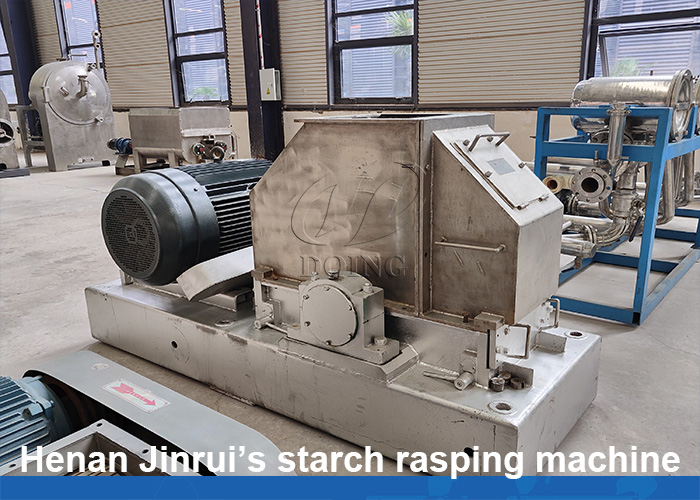 Jinrui Foodtech's rasper
Rasper Capacity Range You Can Order (4–50 t/h)
With a throughput target in hand, read it against the model series Jinrui Foodtech (Henan Jinrui) builds. This range is specific to Jinrui's own lineup rather than an industry-wide standard, and it spans from a single machine able to feed a small workshop up to a unit sized for a large continuous plant, running from the entry 4–8 t/h band to a top 30–50 t/h model.
| Model | Throughput (t/h) | Motor (kW) | Rotor dia / width (mm) | Speed (r/min) |
|---|---|---|---|---|
| Cm5635 | 4–8 | 45 | 560 / 350 | 2100 |
| CM7035 | 8–15 | 75 | 700 / 350 | 2100 |
| Cm8435 | 12–20 | 110 | 840 / 350 | 2100 |
| Cm8450 | 15–30 | 160 | 840 / 500 | 2100 |
| Cm8465 | 20–40 | 200 | 840 / 650 | 2100 |
| Cm10065 | 30–50 | 250 | 1000 / 650 | 1800 |
Read each model as a band rather than a single number. The spread within a band reflects feed size and root variety, so size to the upper part of a band only if your feed genuinely runs heavy and continuous. For a small line, the entry 4–8 t/h model already carries the duty with room to spare, which is usually better than stepping up and paying to under-load a larger drum.
Matching the Rasper to Upstream and Downstream Stages
A rasper is only as productive as the slowest stage around it, so the real test of a paper calculation is whether the machines in front of and behind it can keep pace.
Upstream, feed it correctly. Roots should arrive cut into 3–5 cm pieces by a cutter; a rasper fed whole or oversized roots reaches neither its rated throughput nor its 96% burst rate.
Fit a magnetic or de-stoning guard on the feed. Steel and grit carried in with the roots blunt the saw bars, dragging burst rate and capacity down over time.
Downstream, keep the back end in step. The centrifugal screen and hydrocyclone station must absorb the pulp the rasper produces.
Push more pulp than the washing stage can handle and it backs up until the whole line throttles to the bottleneck, so extra crushing capacity buys only a queue, not output.
Match the running pattern too. A 6–8 hour shift tolerates a smaller per-hour machine than a 20-hour plant for the same daily tonnage, while wet, muddy feed lowers throughput and raises the downstream washing load.
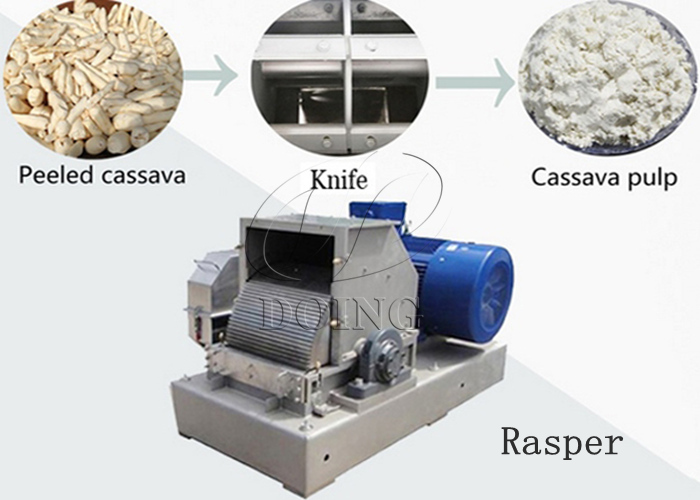 Cassava grater for starch plant
Common Mistakes in Rasper Capacity Selection
Sizing goes wrong in a handful of predictable ways. Spot them before the order is placed.
Buying the largest model 'for future growth'. A rasper only crushes well when its drum is properly loaded; an oversized unit grinding a thin, uneven layer wastes power without protecting the burst rate, and the hoped-for headroom becomes a cost.
Trusting the nameplate while ignoring the feed. The rated throughput assumes the right variety, piece size and clean feed; real capacity falls the moment those drift, usually because the cutter and magnetic guard were skipped.
Sizing the crusher but not the stages behind it. A rasper matched to tonnage but feeding screens and hydrocyclones it outruns simply rebuilds the bottleneck one stage downstream.
Running one oversized unit instead of two mid-size ones. A single large machine gives no redundancy: one fault stops the whole line, where two could keep the plant at partial load while the other is serviced.
Frequently Asked Questions
Can one rasper feed both a starch line and a garri line?
Not with the same duty. A rasper ruptures starch cells into fine pulp for washing, while garri uses a spike-tooth grinder on peeled roots aimed at a different texture. You can run both products in one shed on separate machines, but a single rasper is not a substitute for a garri grinder.
What power and starter does a sized-up rasper need?
Motors run from 45 kW on the smallest band to 250 kW on the 30–50 t/h model. Size your supply and starter, direct-on-line or soft-starter, to the heavy-load end of the band rather than the average, because a rasper pulls close to full current whenever it is actually crushing.
How does tooth wear change real throughput?
As the 65Mn high-manganese-steel saw bars dull, burst rate and throughput fall together, because fewer cells break per pass. Inspect and replace the bars on a schedule, and resist pushing feed faster to compensate, since that only overloads the drive without restoring the lost burst rate.
Is one large rasper better than two smaller ones?
For plants around 20 t/h and above, two mid-size units usually win on flexibility: they give redundancy, handle partial loads more efficiently, and let you service one while the other keeps the line running. A single large unit costs less in steel and floor space but stops the whole line for any maintenance.
Get the Right Rasper Size from Jinrui Foodtech
The right cassava rasper is not the biggest you can buy; it is the model whose throughput band fits the starch you want to sell and stays balanced with the cutter ahead of it and the washing stages behind it. Work backward from your finished-starch goal to an hourly figure, read that against the 4–50 t/h model series, and let your feed condition and upstream-downstream balance make the final adjustment.
Jinrui Foodtech can turn your own numbers into that pick. Send us your target starch output per day or per hour, the form of your feed, your operating hours and your site location, and our team will return a specific rasper model with the matching cutter, magnetic guard and downstream screening sized to keep your whole line feeding evenly.