

What are the Differences Between Dry and Wet Cassava Flour Processing
Cassava flour is produced using two main methods: dry cassava flour processing and wet cassava flour processing. Each approach impacts flour quality, taste, and overall production cost. Here, Henan Jinrui breaks down both cassava flour processing methods and compares the key differences, helping you decide which one fits your business needs.
Dry cassava flour processing is the more traditional and straightforward method. It is simple, requires relatively low investment, and consumes very little water, making it especially suitable for small-scale and medium-scale cassava flour production.
Henan Jinrui's dry cassava flour processing method follows a clear sequence of steps. First, fresh cassava roots are cleaned by a washing machine and peeled by a peeling machine. The peeled cassava roots are then sliced into chips by a cassava chipping machine. Next, these cassava chips are dried – either naturally under sunlight or by using a belt dryer. Once fully dried, the cassava chips are ground into flour by a milling machine. Finally, the flour is sieved by a sieving machine and then packaged as finished cassava flour.
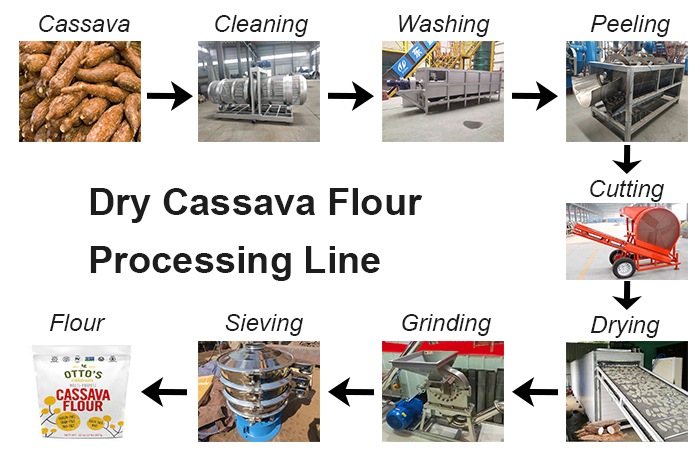 Dry cassava flour processing line
Different from dry method, wet cassava flour processing is a more advanced method that improves the overall quality of the final product. It produces flour with a lighter color, finer texture, and more uniform quality, while offering better control over hygiene and processing conditions. This makes it suitable for food-grade applications and export markets.
Henan Jinrui's wet cassava flour processing method involves several steps. First, cassava roots are cleaned with dry sieve and paddle washer, peeled with peeling machine, and then grated or crushed into a mash using a rasping machine. Instead, the mashed slurry is directly dewatered using a plate-and-frame filter press. After dewatering, the material is dried using an air flash dryer and sieved by a sieving machine to achieve a finer and smoother consistency. Finally, the finished cassava flour is ready for sale.
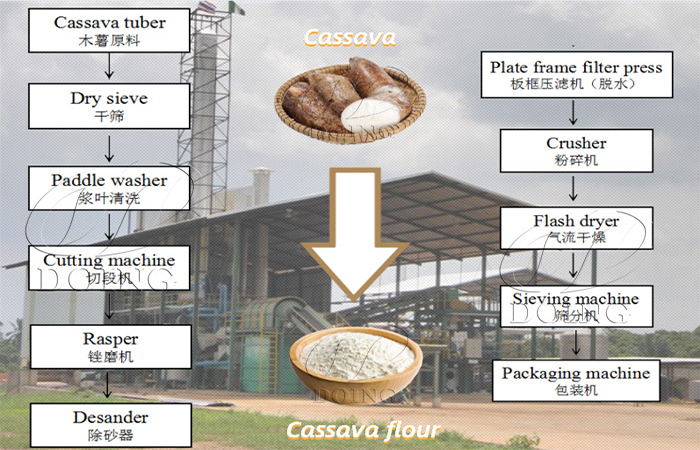 Wet cassava flour processing line
Both dry and wet cassava flour processing have their own strengths. The right choice depends on your budget, production scale, target market, and quality goals. Below, Henan Jinrui summarize the key differences between dry and wet cassava flour processing across five critical aspects to help you decide.
Investment & scale – Dry processing requires lower initial investment and is ideal for small to medium-scale production. Wet processing costs more but suits medium to large-scale operations.
Water & energy use – Dry processing uses very little water. Wet processing requires more water but allows better control over product quality.
Flour quality – Dry processing produces good quality flour for local markets. Wet processing delivers lighter color, finer texture, and more uniform quality, suitable for food-grade and export markets.
Drying & hygiene – Dry processing often uses sun drying or basic equipment. Wet processing uses flash dryers and offers better hygiene control, meeting higher food safety standards.
Target market – Dry processing is a practical choice for local and traditional markets. Wet processing opens doors to premium markets, industrial buyers, and export.
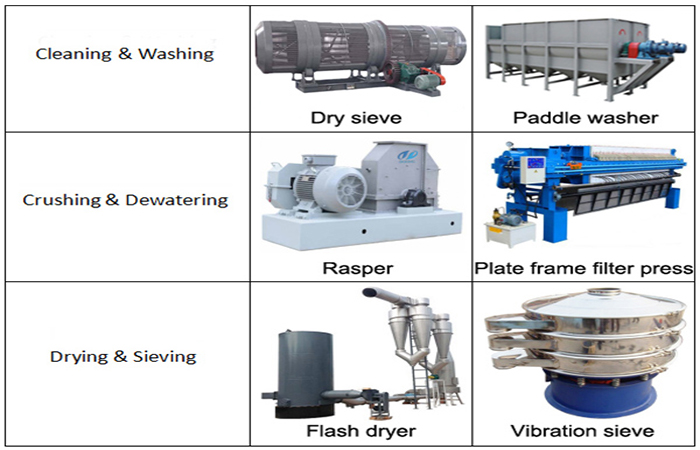 Cassava flour processing equipment
Understanding these differences between dry and wet cassava flour processing helps you decide which method aligns with your business goals. If you have a limited budget or serve local markets, dry processing is a practical choice. If you aim for higher quality or export, wet processing is worth the investment. Henan Jinrui offers complete cassava flour processing solution for both, backed by 10+ years of experience, a Nigeria warehouse, and tailored support. Contact us to find the right fit.