

Sweet Potato vs Potato Starch Processing Line: Can One Setup Run Both?
Yes – in most cases a single starch processing line can handle both sweet potato and white potato, because both crops become starch the same physical way: wash and destone, rasp into pulp, pull the fibre out, refine through hydrocyclones, then dewater and dry.
The catch is that "one line" does not mean "two identical machines". The back half of the line is genuinely interchangeable, but the front end and a handful of settings travel with the raw material, so the buying question is really whether the line you order today was specced from the start to switch cleanly between the two crops.
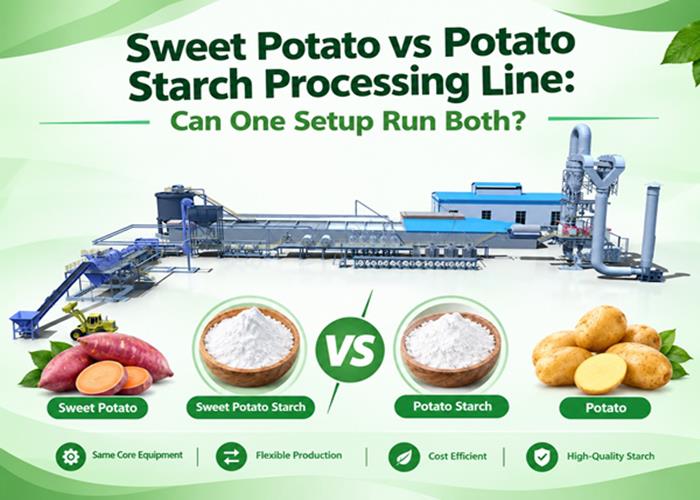 Shared line for potato and sweet potato starch
Sweet Potato vs Potato: Which Processing Equipment Can Be Shared?
Strip off the crop label and both products come off the same train. Raw roots pass a dry screen and a counter-current drum washer, get rasped into pulp, run through a coarse centrifugal sieve and a fine fibre sieve, then a bank of hydrocyclones – around eighteen in a well-tuned line – strips protein and cell sap out of the slurry. That slurry is dewatered to about 38–40% moisture and flash-dried down to a saleable 10–12%, all from one PLC panel. Because every step is physical separation rather than a chemical reaction tied to one tuber, the same machines hit the same 99.5% purity whichever crop is in the hopper, which is why Jinrui Foodtech (Henan Jinrui) builds these lines around one shared wet core instead of duplicating it. So the only thing worth working through is which stages need a change – and that is just the table below.
| Processing stage | Shared or differs | What you adjust |
|---|---|---|
| Dry screening / destoning | Shared | Same machine; wash and stone-trap intensity tuned per crop |
| Washing | Shared | Drum washer runs both; sweet potato needs stronger clay removal |
| Pre-cutting / cutter | Differs | Sweet potato needs a cutter; white potato feeds straight to rasping |
| Rasping | Shared | Same rasper; motor load and feed rate tuned for fibre |
| Fibre and slag separation | Shared | Same sieve + cyclone; mesh size and back-pressure changed per crop |
| Hydrocyclone refining | Shared | Identical – no change between crops |
| Dewatering and drying | Shared | Vacuum dewaterer and flash dryer run both unchanged |
| Colour / anti-browning | Differs | Sweet potato needs tighter oxidation control at rasping |
What Needs to Change When Switching Between the Two Crops?
Once you accept the shared core, the real differences are short and specific, and they fall into three groups. Each one only bites in one direction, so the question is always "what goes wrong if I run this crop the way I run the other one".
Pre-processing: the cutter and the wash
This is where the two crops part company. Sweet potato is bigger, more irregular and far more fibrous than white potato; fed whole into a fast rasper it bridges and jams, grates to an uneven size, and leaves more starch trapped in the residue – so a sweet-potato run has to carry a cutter ahead of the rasper, while white potato is firm and uniform enough to skip it. Skip the cutter on a sweet-potato day and you feel it straight away: the rasper chokes and yield falls. On the wash side, field-grown sweet potato usually brings more sticky clay, so the same drum washer and stone trap just want a harder wash and a firmer destoner setting – under-washed roots push grit downstream and wear out pumps and cyclones faster.
Grinding and fibre separation
The stringy character of sweet potato changes where the machine sits on its dial. Motor load climbs and the safe feed rate drops compared with white potato, which rasps cleanly at a heavier feed – run one crop at the other’s feed rate and you either trip the machine or leave capacity idle. The same logic runs through the separation stage: the fine fibre sieve mesh and the hydrocyclone back-pressure both move with the crop. Too fine a mesh on high-fibre sweet-potato pulp and it blinds and clogs; too coarse on white potato and fine fibre slips through into the starch and costs purity. Keep a matched set of spare meshes on the line and switching crops becomes a quick mesh change rather than an equipment swap.
Colour control
This is the difference buyers notice on the final bag rather than on the machine list. Sweet potato – especially the purple- and red-fleshed types – oxidises and browns far faster than white potato once the cells are broken at rasping. The fix is a routine, not extra hardware: keep oxygen out at rasping, flush the pulp promptly and keep pulp residence time short so the starch never sits exposed. Neglect it and the starch greys and dulls, dropping a grade on the spot. White potato needs the same discipline, only milder – so on a shared line the anti-browning step is weighted harder whenever the sweet potato is running.
How to Configure One Line for Both Crops
The configuration answer is one shared core plus a modular front end. Hold the back of the line still – rasper, sieving, hydrocyclone refining, vacuum dewatering and flash drying stay exactly as they are – and put all the crop-specific behaviour in two places: a cutter you can start, stop or remove at the front, and a set of interchangeable fine-sieve meshes, with anti-browning added as a routine per crop. Built this way, a single asset is quoted from day one to switch between the two tubers instead of fighting them, and the switch itself stays short and repeatable.
| Line setting | When running sweet potato | When running white potato |
|---|---|---|
| Front cutter | On – cut roots before rasping | Off or removed – feed straight to rasper |
| Fine-sieve mesh | Coarser mesh to pass high fibre | Finer mesh to hold purity |
| Hydrocyclone back-pressure | Tuned to sweet-potato pulp | Tuned to white-potato pulp |
| Rasping feed rate | Reduced for heavier load | Heavier feed at rated speed |
| Anti-browning practice | Oxygen control and prompt flushing | Standard wash-through |
One Shared Line or Two Separate Lines: Which Should You Choose?
This is a call about utilisation, not taste. A shared line keeps one asset running on whatever the field gives that season; two lines give you a full load on both crops with no changeover at all. Match it to how you actually receive your raw material:
| Your situation | Better fit | Why |
|---|---|---|
| Crops alternate through the season, both land at one site | One shared modular line | One asset stays busy across both intakes; lower capital |
| Only one crop is abundant most of the year | One shared line | Cutter on when the second crop appears; no idle machine |
| Both crops run near full capacity at once | Two lines, or one larger line | A shared line cannot run both at full load at the same time |
| Strict grade or customer separation is required | Two lines, or a larger line with isolation | Removes cross-crop changeover risk on high-value runs |
Whatever you land on, the one rule that never breaks is to buy capacity you can actually feed – the worst outcome is a fully automatic line standing idle half the year because it was specced for two crops you never both deliver.
Frequently Asked Questions
If I run sweet potato one week and white potato the next, will the two starch grades contaminate each other?
Starch itself does not carry flavour or residue forward, but colour and grade can. The safe habit is a short flush of the washing, rasping and refining circuit every time you change crops, plus one confirming batch before you release product to a customer spec. Because sweet potato is graded tighter on whiteness and spots, most plants run it after a clean wash rather than straight off a white-potato batch, and keep the two crops on separate packing days when they are headed to different buyers.
I receive one crop for only part of the year. How do I keep a shared line earning in the off-season?
This is exactly where a shared modular line earns its premium. When the second crop is absent, run the crop you do have at a higher duty, store the off-season root so the cutter end is not left idle either, and keep the cutter removed and the coarse mesh stored between changes so you are not paying a machine to sit. The whole case hinges on whether your two intakes add up to enough annual throughput to keep one line loaded; if they never overlap, the shared line simply runs one crop and waits.
My sweet potato starch comes out grey or dull – which stage do I check first?
On sweet potato, check anti-browning first: oxygen at rasping, pulp sitting too long before dewatering, and a slow flush between runs – in that order. If the colour is right but spots are high, move on to washing and destoning. On white potato a grey cast is more often a washing or refining issue than an oxidation one, because white potato browns far less readily. Same symptom, different starting point, which is exactly why the anti-browning routine is worth building into the sweet-potato recipe on a shared line.
Can the same line also take cassava, taro or arrowroot, or is it limited to sweet potato and potato?
Sweet potato and potato sit inside one wet-milling family, so they share a line cleanly. Cassava is a different family – it uses a different dewatering machine and a different fibre-handling sequence, so it is not just a mesh change on a tuber line. Roots like taro or arrowroot can share parts of the tuber workflow, but how much depends on their fibre and moisture. If a third crop is coming later, say so when you spec the line, because it changes what you size the rasping and separation stages for, not just which cutter you mount.
Talk to Us About a Dual-Crop Line
Underneath the two names is one wet-processing line: the differences almost all sit at the front – the cutter you fit for sweet potato and switch off for white potato – plus a short list of movable settings and the anti-browning routine that protects sweet-potato colour. A single modular line captures that overlap and turns it into equipment that stays busy whichever crop the season brings, and two lines only pay off when both crops genuinely fill a full line at the same time.
To price a dual-crop line, send us the crop types and the rough split between them, your annual throughput, the use you want the starch for, and whether you need to switch crops on the same line – with those details Jinrui Foodtech can tell you straight away whether one shared line or two is the better fit for your budget and scale.