

Semi-Automatic vs Fully Automatic Potato Starch Processing Plant: How to Choose
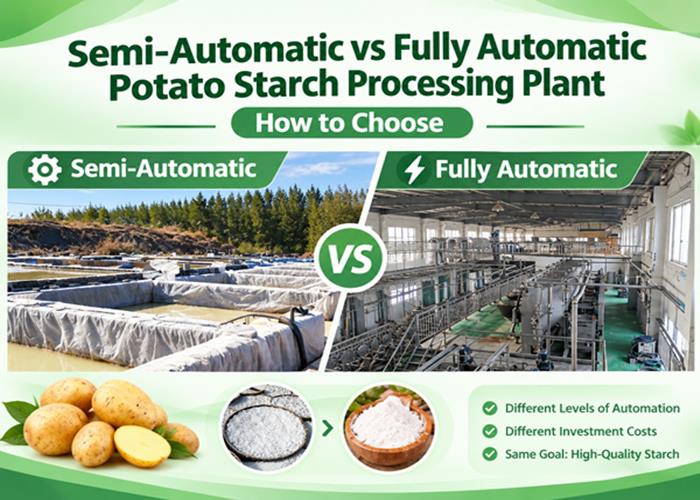
A semi-automatic and a fully automatic potato starch line are not a good-versus-bad choice. They are two different ways of spending money, and the difference is not how many buttons sit on a control panel. It is which stages of the process run on their own and which still depend on an operator standing at the machine. On a potato starch line that split concentrates in four places: purification (gravity sedimentation tanks versus a multi-stage hydrocyclone station), dewatering (manual pressing versus a vacuum dewaterer), drying (open-air drying versus a flash dryer) and control (operator judgement versus a PLC that links the whole line together).
In plain terms, the two are trades, not rankings. A semi-automatic line buys a low entry cost, a small footprint and a fast start, and accepts more manual labour, a lower starch recovery and softer compliance in return. A fully automatic line buys a higher and steadier yield, more consistent starch, fewer operators and easier compliance, and accepts a larger, slower investment in return. The right pick is whatever fits your own budget and scale, so this article compares the two on the factors that actually decide a purchase: investment and footprint, labour and skill, starch yield and quality, and maintenance and compliance.
Quick Comparison
| Dimension | Semi-automatic line | Fully automatic line |
|---|---|---|
| Automation level | Key stages partly mechanised; purification by settling tanks, drying often open-air, moisture judged by eye | Purification, dewatering, drying and control all run automatically as one linked line |
| Labour needs | More manual transfer between machines; depends heavily on experienced operators | Fewer staff for attendance and patrol; centralised control cuts labour needs |
| Output and quality | Lower and more variable from batch to batch | Higher, whiter and more consistent starch, with better recovery |
| Investment cost | Lower start-up cost, smaller footprint, faster to commission | Higher start-up cost, needs a standardised building, longer lead time |
| Maintenance requirements | Simple machines, but unstable batches and harder to keep compliant | More to maintain on a routine, but stable, durable and easier to keep compliant |
How the Two Lines Are Configured
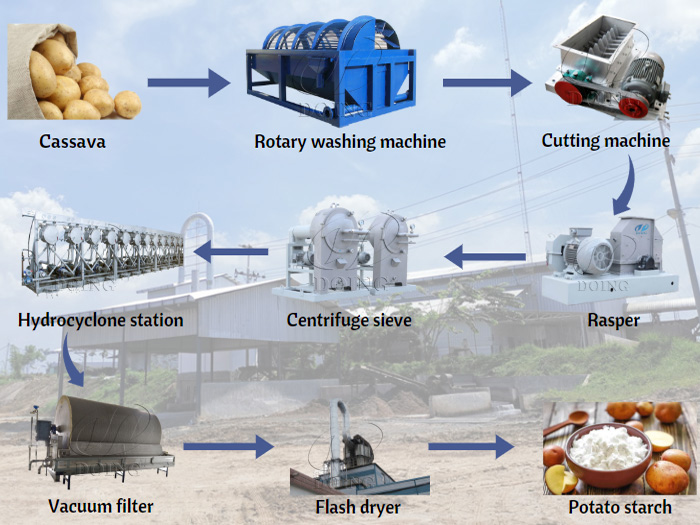
On both lines the front end is the same – receiving, dry screening, a water channel, de-stoning, drum washing and rasping – and potato lines normally run no chipper, so the route goes straight from washing to rasping. The two lines only part company at the back end: how the starch is purified, dewatered, dried and controlled. That is where the automation is actually bought, and where the two configurations differ.
 Potato starch processing plant
Two flow chains make the difference concrete:
Semi-automatic: receiving → dry screen → water channel → destoner → drum washer → rasp → sedimentation tanks (24–48 h settling) → manual pressing → open-air or simple drying → sieving → packing.
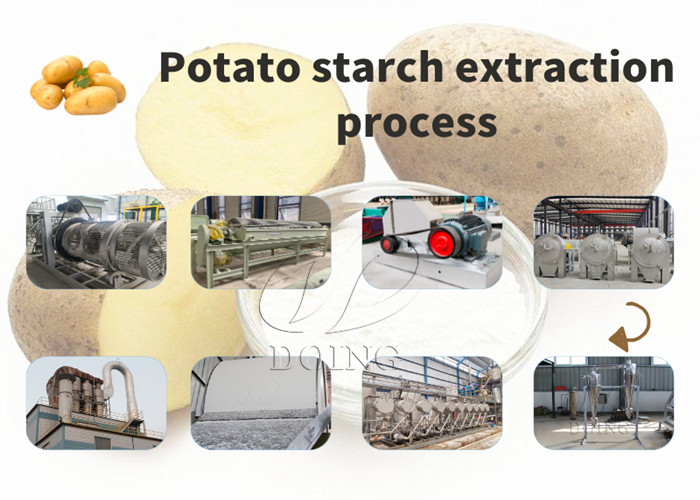
Fully automatic: receiving → dry screen → water channel → destoner → drum washer → rasp → magnetic separator → centrifugal sieve → desander → multi-stage hydrocyclone station (18-stage) → buffer tank → vacuum dewaterer → flash dryer → vibro sieve → automatic packing, with PLC control across the line.
| Stage | Semi-automatic | Fully automatic |
|---|---|---|
| Purification | Sedimentation tanks (batch) | Multi-stage hydrocyclone station (continuous) |
| Dewatering | Manual pressing / settling | Vacuum dewaterer |
| Drying | Open-air or simple drying | Flash / air-flow dryer |
| Sieving and packing | Sieve + manual packing | Vibro sieve + automatic packing |
| Control | Operator judgement | PLC centralised control |
How the Two Lines Compare on What Matters
Configuration is only interesting because of what it changes downstream. The four things that decide a purchase are investment, labour, starch yield and quality, and maintenance. Each is taken below.
Investment, footprint and lead time
The semi-automatic potato starch processing line wins on the entry ticket. Sedimentation tanks are cheap to build, the machine list is short, the footprint is small and the plant can be commissioned quickly, which suits operators testing the market or working with limited cash. The fully automatic line asks for more up front: a standardised building, a proper water and power supply, drainage and effluent handling, and a longer delivery and installation period. It is better read as a larger fixed investment traded against lower running cost and higher output per hour rather than as a simple "expensive option". Utility use is itself a cost line: a potato line runs at roughly 1.3 tonnes of water per tonne of raw potato, and a water-recycle loop brings that down.
 Potato starch processing machine
Labour and operator skill
This is where the automation shows up fastest. On a semi-automatic potato starch processing line, product is moved between stand-alone machines by hand, tanks are filled and drained by hand, and the quality of the run rests on how well the operator reads moisture and settling by experience. That makes output depend on who is on shift. A fully automatic line concentrates control in a PLC and needs only a small crew for attendance and patrol; centralised control cuts labour needs by around 50% compared with the semi-automatic route. A whole line typically runs somewhere in the 6–12 operator range depending on capacity, and automation lowers that figure. The trade is skill: an automatic line needs fewer people but people who can work with the control system.
Starch yield and product quality
Purification method is the main reason the two lines do not produce the same starch. A gravity sedimentation route typically recovers 70–85% of the starch (industry guidance, to be confirmed for a specific setup), and because settling is batch-by-batch the quality drifts from one tank to the next. A continuous 18-stage hydrocyclone station reaches an extraction rate around 94% on a Jinrui Foodtech (Henan Jinrui) potato starch processing plant – about 8 tonnes of fresh potato to 1 tonne of starch – with separation purity up to 99.5%, and holds that level across the run.
Maintenance, stability and compliance
Semi-automatic potato starch machines are simple and easy to fix, but the process behind them is unstable and the environmental side is usually thin – open sedimentation tanks consume a lot of water, take up space and are hard to keep compliant, which is one reason coarse small-scale operations are being phased out. A fully automatic line is built for continuous, sealed operation: equipment MTBF exceeds 8,000 hours, carbon-steel machines last 10 years or more and stainless machines 20–30 years. That durability still needs a routine – screen cloths and rasp teeth are wear parts that must be changed, and the vacuum filter needs cleaning on a set schedule (roughly every four hours on a working line). Done properly, the automatic line is the easier one to keep stable and to pass an environmental review.
 Fully automatic potato starch machine
Which Line Fits Your Budget and Scale
There is no universally cheaper or better line; the right answer comes from matching the trade to your own situation.
| Your situation | Line that tends to fit | Why |
|---|---|---|
| Limited budget, small or seasonal throughput, testing local demand | Semi-automatic | Low entry cost, small footprint, fast commissioning; accepts more labour and manual control |
| Steady raw-material supply, target brands or export markets | Fully automatic | Consistent high purity and whiteness batch after batch; fewer staff; easier compliance |
| Need high starch recovery and reliable quality | Fully automatic | Continuous 18-stage hydrocyclone purification protects extraction rate and whiteness |
| Plan to grow the business over time | Semi-automatic now, upgrade path kept open | Jinrui Foodtech keeps the shared washing and rasping front end, so you can add hydrocyclone purification, vacuum dewatering and PLC control in stages |
| Strict effluent or environmental approval required | Fully automatic | Sealed continuous process and water recycle are far easier to keep compliant than open settling |
A useful rule of thumb: buy an automatic line only when your throughput and your buyers can keep it fed – otherwise you pay for capacity you cannot use.
Frequently Asked Questions
What actually drives potato starch yield, and how do I protect it?
Yield is set before the machine choices matter: potato variety and its starch content (typically 10–20%, rising with latitude), how long the tubers are stored before processing, how well the washing and rasping free the starch, and whether the purification route recovers fine starch rather than losing it. To protect it, process within about three days of harvest, size the rasping and centrifugal-screen stage to your capacity, keep wash water clean, and run a recycle loop so recovery does not leak with the water.
I process seasonally – which line suits seasonal intake and storage?
A seasonal operation usually cannot keep a fully automatic line fed for most of the year, so idle capacity erodes the investment. A semi-automatic line matches an intermittent intake better: it is cheap to run for a short campaign and cheap to park. If your season is short but heavy, size the semi-automatic line for peak intake and store washed potatoes cool for a few days rather than buying a full-time automatic line.
What should I have ready before a fully automatic line is installed, and how long does commissioning take?
Before delivery, secure a standardised building with the right floor loading, a stable power supply sized to the motors, a water supply and recycle loop, and drainage or effluent handling. Have at least a few operators who can read and maintain a PLC. After delivery, the build, connection and commissioning plus staff training run over a matter of weeks rather than days, longer if site works (foundations, utilities) are done on site first.
My starch comes out grey or too wet – which stage do I check first?
For grey colour, work backwards from the dryer: an over-hot drying stage or an under-configured hydrocyclone station both darken starch, so check drying temperature first, then hydrocyclone stage count and wash-water cleanliness. For high moisture, check the vacuum dewaterer first (outlet should be near 38–40%) and its vacuum, then the flash dryer temperature and feed rate. On a semi-automatic line the same two faults point at sedimentation time and drying control.
Can the same line also run sweet potato, or is it potato-only?
Potato and sweet potato share the same equipment route – drum washing, rasping, centrifugal screening, hydrocyclone purification, vacuum dewatering and flash drying – so a line can run both. The differences are tuning, not design: sweet potato is higher in pectin, so its centrifugal sieve needs an alkali wash about once a month, and its dewatering behaviour differs, so plan a short changeover and cleaning when switching between the two.
Match the Line to the Business You Are Actually Running
Automation on a potato starch line is not a general upgrade – it is a purchase of four specific stages: continuous hydrocyclone purification, vacuum dewatering, flash drying and PLC control. A semi-automatic line buys a low entry cost and accepts more labour, lower recovery and softer compliance in return; a fully automatic line buys higher yield, steadier quality, fewer staff and easier compliance in return for a larger, slower investment. The choice comes down to how much throughput, quality consistency and regulatory headroom your business actually needs.
If you are weighing the two, Jinrui Foodtech can size either route against your numbers. Send your target product, your fresh potato throughput, your target daily output, how steady your raw-material supply is, and your sales market, and the line and configuration can be worked out around them.