

Rasper vs Hammer Mill for Cassava Starch Extraction: Key Differences
When buyers plan a cassava starch plant, the rasper and the hammer mill are often treated as two competing options for the same job. After all, both are machines that grind cassava, so the reasoning goes, one of them should be droppable. That assumption usually comes from seeing the two names sitting side by side in an equipment list — not from how the two machines actually behave once they are installed on a running line.
The short answer is that they are not interchangeable, and a serious starch line runs both. The rasper works at the very front, breaking fresh cassava to release starch; the hammer mill (a fine grinding machine) works at the very back, re-grinding finished dry starch that fails the target fineness. Between them sit opposite materials — wet slurry versus dry powder — and opposite quality goals — starch yield versus finished mesh. Understanding where each one sits is the quickest way to see why neither can be left out.
What Each Machine Actually Does
• Rasper — front of the line, wet duty. The rasper turns fresh cassava into starch-rich slurry. A high-speed drum running at 2,000+ rpm throws toothed blades against the root in an abrasive rasp; the gap between tooth and rasp block is about 2 mm, with a 1.8 mm long-slot bottom screen letting only fine particles pass. Because starch sits in the root as both free and bound starch, this thorough rasping is what frees the bound starch and sets the extraction rate. The rasper models from Jinrui Foodtech (Henan Jinrui) are built to reach a crushing rate of ≥94%.
• Hammer mill (fine grinding machine) — back of the line, dry duty. The hammer mill is a fine grinding machine placed after drying. High-speed hammers and collars impact coarse or oversize dry starch, and an interchangeable screen controls how fine the output leaves. Finished cassava starch is commonly ground to about 80–120 mesh, with the screen changed to match the mesh the market asks for. It grinds dry solids, never fresh root.
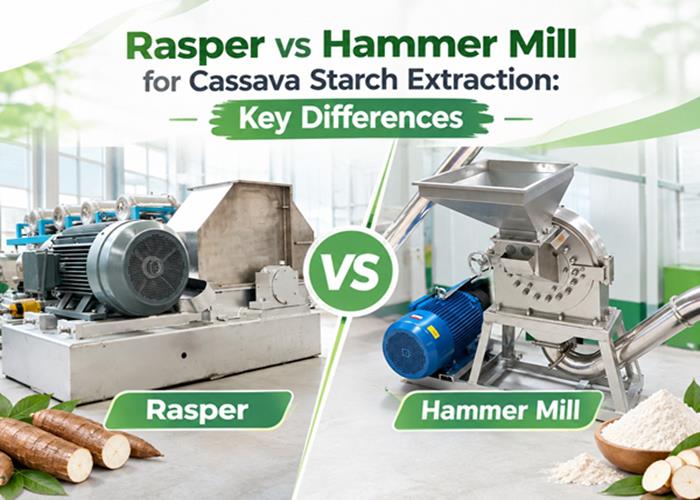 rasper and hammer mill in starch line
Where They Sit in the Cassava Starch Line
Reading the two machines along the process flow makes their separation obvious:
Fresh cassava → dry sieve + paddle washer → cutter (pre-breaking) → rasper → centrifugal sieve → hydrocyclone stations → dehydration → flash dryer → sifting → hammer mill (fine grinding) → sifter → packer
The rasper is the only machine that touches raw cassava to release starch, so its performance drives yield on every downstream tonne. The hammer mill does not touch slurry at all — it only sees dry starch that has already been extracted, dehydrated and dried. Jinrui Foodtech sizes both machines around the line’s cassava feeding capacity, with a standard range of 4–50 t/h feeding on the wet end.
Rasper vs Hammer Mill, Side by Side
A single comparison table captures the division of labour at a glance:
| Dimension | Rasper | Hammer Mill (fine grinding machine) |
|---|---|---|
| Line position | Front, after the cutter | Rear, after drying, before final sifting/packing |
| Material handled | Wet — fresh cassava to starch slurry | Dry — finished / oversize dry starch |
| Working principle | Abrasive rasp, drum 2,000+ rpm, ~2 mm tooth gap, 1.8 mm screen | High-speed hammer/collar impact + shear; screen mesh sets fineness |
| Primary purpose | Break cells to free bound starch: extraction rate | Re-grind off-spec starch: finished mesh and appearance |
| Key output spec | Crushing rate ≥94% | Finished fineness ~80–120 mesh (adjustable screen) |
| Capacity basis | Cassava feeding 4–50 t/h | Sized to finished dry-starch output, matched to the front end |
How Each Machine Is Sized to the Line
Each machine is sized on a different basis, and the two numbers are never quoted on the same scale. The rasper is sized from the cassava feeding rate — the same basis as the rest of the extraction front — while the hammer mill is sized from the finished dry-starch tonnage it must re-grind. Jinrui Foodtech standard rasper models cover 4–50 t/h feeding (a 2 t/h entry unit is also offered for pilot lines):
| Model | Feeding capacity (t/h) | Rotor diameter (mm) | Power (kW) |
|---|---|---|---|
| Cm5625 | 2 | 560 | 30 |
| Cm5635 | 8 | 560 | 45 |
| Cm7035 | 15 | 700 | 75 |
| Cm8435 | 20 | 840 | 110 |
| Cm8450 | 30 | 840 | 160 |
| Cm8465 | 40 | 840 | 200 |
| Cm10065 | 50 | 1000 | 250 |
Why the Line Needs Both — Not One
• They work in series, not as a backup. Yield and fineness are two gates standing in a row, not two interchangeable options. The rasper decides how much starch even reaches the downstream steps; the fine grinding machine decides how much of that starch leaves as an on-spec product. Lose either gate and the other cannot recover it — which is exactly why the cassava starch line is not designed to “pick one.”
• Each machine guards against a different kind of loss. A weak or missing rasper leaves starch locked in the fibre, costing throughput and raw-material efficiency. A missing fine grinding machine still produces starch but ships it off-spec, closing the door on premium and export buyers who price to a target mesh. The two gaps drain profit in different ways, so closing only one is never enough.
• Their upkeep does not overlap. Wear parts, cleaning routines and downtime windows are entirely different on a wet rasper versus a dry fine grinding machine. A line that must deliver both yield and mesh on schedule keeps both machines in the maintenance plan; running with only one means the other’s duty silently goes undone.
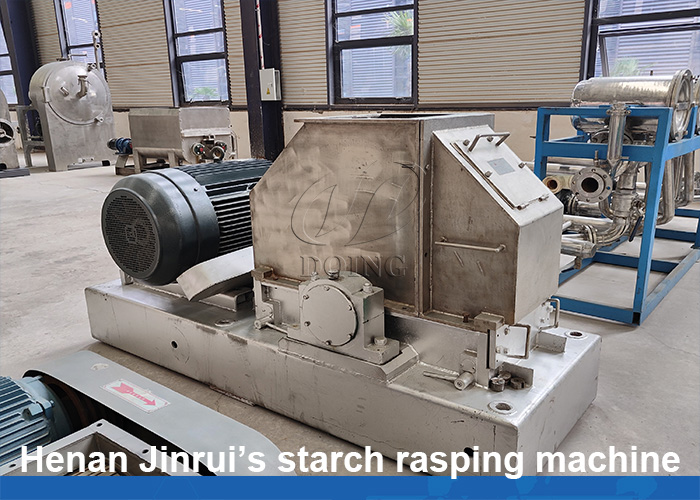 Starch rasping machine
Frequently Asked Questions
Can a hammer crusher replace the rasper at the front?
Not without losing yield. The front end has to turn wet root into slurry and free the bound starch, and the rasper’s abrasive action is what delivers a crushing rate of ≥94%. A front-end hammer crusher gives a coarser wet crush and a lower extraction rate, so it is a different-duty machine, not an equal substitute.
Is a hammer crusher the same machine as a hammer mill?
No. The hammer mill in this article is the end-of-line fine grinding machine that re-grinds finished dry starch. A hammer crusher is a front-end wet-crushing unit used on some low-cost lines. The two share only the word “hammer” — they sit at opposite ends of the line and do opposite jobs, and a hammer crusher’s wet-crushing action does not match a rasper’s ≥94% either, so it stands apart from the fine grinding machine as well.
My finished starch is too coarse — is the rasper or the hammer mill at fault?
Almost always the hammer mill and its screen, not the rasper. The rasper sets extraction rate, not finished mesh. Check the fine grinding machine’s screen size, feed rate and hammer/collar wear first.
What is the maintenance difference between the two?
On the rasper the wear items are the saw tooth and the bottom screen, and the magnet guard ahead of it matters because metal quickly ruins the saws. On the hammer mill the wear items are the hammers/collars and the screen. Both are consumable parts, but rasper saws cost more per tonne of starch, so protecting them with the magnet is the higher-value habit.
A small plant starting up — which machine do I prioritise?
Start with the rasper (paired with the cutter): without it you cannot extract starch in the first place. The fine grinding machine becomes essential the moment you must hold a specific mesh for premium or export buyers. For a saleable, on-spec starch rather than a raw bulk product, plan for both from the design stage.
The Bottom Line
The rasper and the hammer mill are not rivals competing for one job — they are partners working at opposite ends of the cassava starch line, the rasper protecting starch yield and the hammer mill protecting finished mesh. A complete, profitable line runs both.
Contact us today with your daily cassava throughput and target starch mesh, and Jinrui Foodtech will help you size both the rasper and the fine grinding machine for maximum yield and on-spec product.