

What Equipment Is Needed to Scale Fufu Flour Production from Manual to Semi-Automatic?
Choosing the manual to semi automatic fufu flour processing route does not mean buying a full line on day one. Start with the single machine that solves your biggest bottleneck, run it alongside the steps you still do by hand, and add the next machine when output, consistency, or labor pressure make it worth the spend.
What Each Stage Needs: Manual vs Semi-Automatic
A fufu flour production line runs through a fixed chain of stages — washing, peeling, crushing, fermentation, dewatering, drying, fine grinding, sieving, and packaging — and each stage has a manual version you run today and a semi-automatic machine that replaces it. The table below maps the fufu flour production equipment for each stage.
| Stage | What you do manually today | Semi-automatic machine | What mechanizing fixes |
|---|---|---|---|
| Washing & peeling | Hand wash, hand peel | Washer + peeler | Labor, consistency, throughput |
| Crushing | Hand grater | Rasper / cassava grater | Cell rupture, uniformity |
| Fermentation | Open tubs / sacks | Enclosed fermentation tanks (optional) | Hygiene, batch consistency |
| Dewatering | Sack press / manual | Plate-frame filter press | Moisture consistency, speed |
| Drying | Sun / rack drying | Mechanical dryer (flash) | Weather independence, throughput |
| Fine grinding | Hand pounding / stone mill | Fine milling machine | Particle fineness, capacity |
| Sieving | Hand sieve | Vibrating sifter | Uniform grade, dust |
| Packaging | Hand fill / weigh | Semi-auto weigher + sealer | Speed, accuracy, shelf appeal |
Three fufu flour processing machines decide most of your result, so weigh them carefully before anything else:
Rasper(crushing): sets how completely the raw cassava cells break open, which drives both yield and texture. A hand grater cannot hold that consistency at volume.
Dryer: replaces sun or rack drying, so output no longer depends on weather and you can run year-round.
Fine milling machine: sets the final powder fineness and smoothness — the attribute customers notice first.
Jinrui Foodtech (Henan Jinrui) supplies complete fufu flour lines and individual machines, configured to the process stages you are ready to mechanize.
Which Machine to Buy First: Start With Your Bottleneck
Mechanize the stage that limits you most — not the first stage in the chain. Buying in process order wastes money on stages that are not your constraint yet.
The stages that usually cap output and quality first are crushing, dewatering, and drying, then fine grinding. Washing, peeling, sieving, and packaging can usually wait, because they are less often the limit — though every line differs.
Find your own bottleneck with a one-week check:
Note where material piles up or an operator sits waiting.
Note which stage you cannot speed up no matter how many people you add.
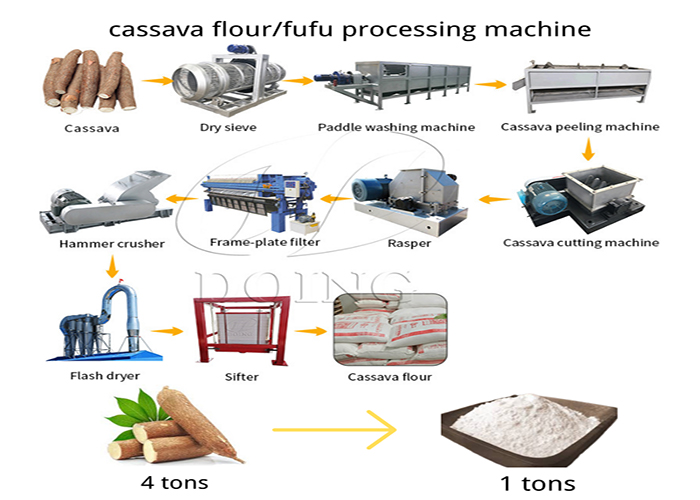 Fufu flour production machine for semi-automatic line
How to Size and Buy the Right Machines
Size every machine to the throughput you actually need, and confirm your site can support it before you commit. A semi automatic fufu flour processing line typically covers roughly 2–40 TPH of fresh feed.
Check four things before you buy:
Raw material: cassava variety and incoming moisture change how aggressively the rasper and dryer must work.
Power: machines need three-phase supply; confirm capacity on site.
Space and floor loading: a dryer and dewatering press need a footprint and a floor that can take the load.
Water and drainage: washing and dewatering move a lot of water that must drain away.
A common mistake is buying the most visible machine first — usually the packaging weigher — while the real constraint, such as the dryer or the plate-frame filter press, stays manual. Mechanize the bottleneck, not the showpiece.
Jinrui Foodtech sizes each machine to your target output and can run a trial on your raw material before you sign.
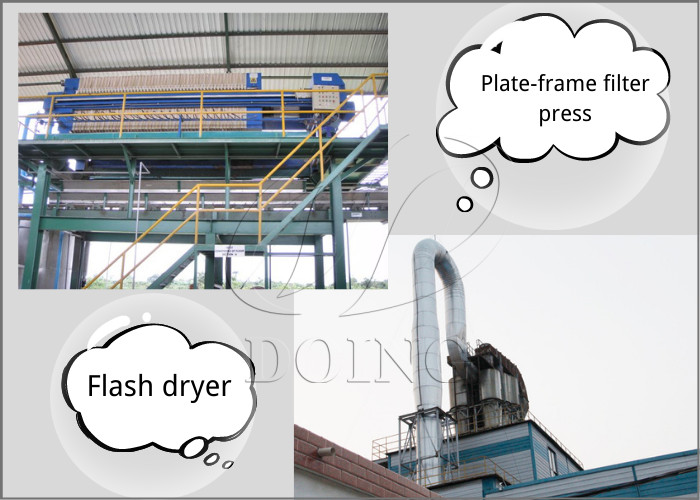 The right processing machine for fufu flour production
Phase the Upgrade Without Stopping Production
Scaling is a staged rollout, not a single switch. You keep producing by adding one machine at a time and running it alongside the manual steps that remain — you do not need the whole line in place before you see the benefit.
Run the rollout this way:
Install in bottleneck order: Add the machine you identified in the bottleneck check first, then the next constraint, one at a time.
Run hybrid during the change: The new machine handles its stage while everything else stays manual until you add the next unit. Production continues throughout.
Keep a manual fallback at each step: Until a mechanized stage is proven on your cassava, keep the old manual method available so a fault or adjustment does not stop the whole line.
Have the site ready before the machine arrives: Clear the footprint, confirm three-phase power, and have drainage in place (see the site checks above) so installation is not held up on arrival.
Trial on your own cassava at commissioning: Run the new machine on your actual raw material when it is installed, not only at the supplier's site, so settings match your variety and moisture before you rely on it.
Jinrui Foodtech supports phased commissioning, validating each machine on your line before the next one arrives.
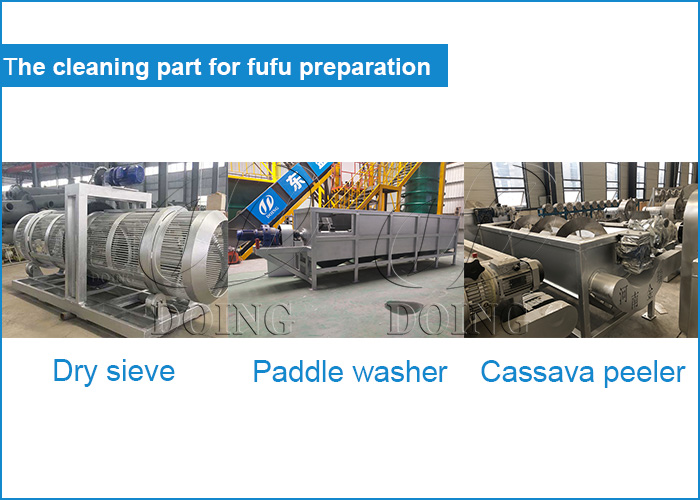 The cleaning part for making fufu
Frequently Asked Questions
What should I confirm with the supplier before buying my first machine?
Before you buy, confirm four things so the first machine fits the line you build later: a standard model in the supplier's range, inlet and outlet that connect to later stages, the same platform in higher capacities if you grow, and spare parts available for several years. If the supplier cannot answer these plainly, look elsewhere.
Does the fermentation step need equipment, or can I keep doing it by hand?
Keep fermentation manual if it already gives uniform results — many fufu producers ferment in covered tubs or sacks. Move to enclosed tanks only when consistency or hygiene start costing you: tanks hold temperature and timing steady and keep contamination out.
How do I keep fufu texture and taste consistent as I scale up?
Set four specs so machines hold steady what your team did by hand: fermentation time and temperature (sour note and elasticity), fine-grind mesh (smoothness), dryer temperature and residence time (final moisture), and incoming cassava quality. Put them in your acceptance criteria so a larger line stays consistent.
What hidden costs should I budget beyond the machine price?
Three often surprise buyers beyond the sticker price: spare parts you should stock before the first failure, wasted batches during commissioning while you tune each machine, and the ramp-up period when operators are still learning. Plan a 10–15% buffer on top of the machine price, and add insurance plus duties if the equipment is imported.
How long does installation and operator training take?
A single machine takes about 1–3 days to install and commission. A full line takes longer and is phased. Training is practical: operators learn by running your actual cassava with the supplier's engineer present, not from a manual.
When does a full semi-automatic line make sense instead of adding machines one at a time?
Move to a full line when three things hold: output is stable above where separate machines bottleneck you, your site is ready in one step (power, space, drainage), and you want unified control across stages. Until then, adding machines one at a time keeps risk and capital lower.
Get a Staged Equipment Plan for Your Fufu Flour Line
The right first machine is the one at your bottleneck, not the one that looks most impressive. Send Jinrui Foodtech your current process stages and target output, and get a staged equipment plan ordered by what limits you today.