

Can One Cassava Processing Line Make Both Flour and Starch?
A common question at the planning stage is whether one cassava processing line can produce both cassava flour and cassava starch. The appeal is easy to see: one building, one feed and washing system, one crew, and a smaller capital outlay than two separate plants.
The straight answer is that no single line makes both products at the same moment. Flour and starch part company at the back of the plant, because starch needs a purification stage that flour does not. What one line can do is share most of the front end – reception, washing, cutting and rasping – and let only the finishing diverge. Understanding where the two processes meet and where they split is what decides whether you should share equipment, switch between products, or run two lines.
Why Flour and Starch Are Two Different Processes
The raw material is identical – fresh cassava root – but the two products are physically different things, and that difference drives the whole machine list. The two routes read as follows:
Cassava flour route
Reception & washing → Peeling → Cutting & rasping → Dewatering → Drying → Fine milling → Sieving & packing
Cassava starch route
Reception & washing → (Peeling optional) → Cutting & rasping → Fibre removal → Purification → Dewatering → Drying → Fine milling → Sieving & packing
Three differences drive the equipment gap:
Peeling: flour is made from the whole root, so peeling is mandatory; starch strips skin and fibre during purification, so peeling is an optional yield choice rather than a rule – a stony or muddy crop can still justify a cassava peeler.
Purification: starch alone runs a centrifugal sieve and hydrocyclone stations to pull protein and fine fibre out of the starch milk. Flour has no equivalent stage.
Dewatering: flour squeezes water out with a plate-frame filter press; starch separates the wet granule with a peeler centrifuge.
Reading these three forks correctly is exactly what Jinrui Foodtech (Henan Jinrui) confirms with a client during the design stage, because each one changes both the machine list and the price.
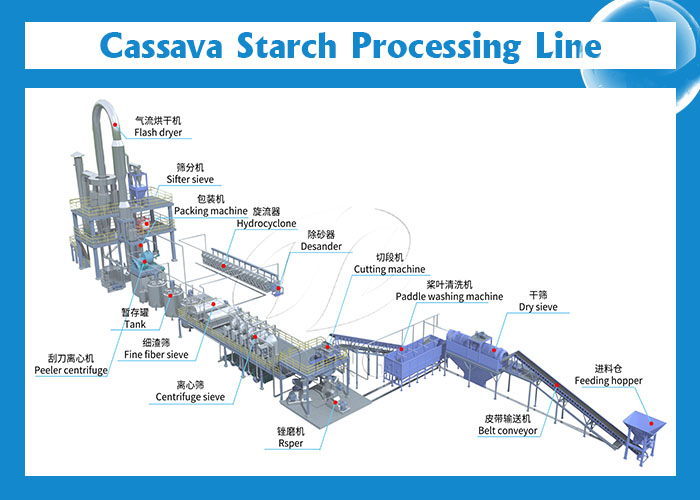 Cassava starch making line
What the Two Lines Share vs What Is Unique
The two lines overlap on the heavy, expensive front end and diverge on the finishing. Reception, washing, cutting, rasping, the drying equipment and the post-drying fine-milling hammer mill all carry the same duty on both lines. The difference concentrates in two places: the purification train that only starch needs, and the dewatering machine each product uses. Jinrui Foodtech builds both types to exactly this logic.
| Process stage | Cassava flour line | Cassava starch line |
|---|---|---|
| Reception & washing | Dry sieve + paddle washer (shared) | Dry sieve + paddle washer (shared) |
| Peeling | Required cassava peeler | Optional – often skipped to raise recovery |
| Cutting & rasping (pulping) | Cutter + Rasper (shared) | Cutter + Rasper (shared) |
| Fibre & protein removal | Not used | Centrifugal sieve + Hydrocyclone stations (starch only) |
| Dewatering | Plate-frame filter press (unique) | Peeler centrifuge (unique) |
| Drying | Flash dryer (shared) | Flash dryer (shared) |
| Fine milling | Hammer mill (shared) | Hammer mill (shared) |
| Sieving & packing | Sifter + Packer (shared) | Sifter + Packer (shared) |
The reading is simple: everything above "Fibre & protein removal" can be one machine set serving both lines. Everything below it must respect which product is coming out.
Where One Line Helps and Where It Does Not
Because the shared front end is the capital-heavy part, a buyer who wants both products can save real money by not duplicating it. The realistic configuration is a common front end plus a dedicated finishing train for whichever product is running – not one machine body that spits out flour and starch together. In practice:
Shared front end: one washing, cutting and rasping system serves both products, so those heavy units are bought once.
Switched finishing: the flour finishing (plate-frame filter press + flash dryer) and the starch finishing (Hydrocyclone stations + peeler centrifuge + flash dryer) run one at a time, fed from the same pulp line.
Change-over window: change-over lives entirely inside the finishing section; the shared section in between must be flushed so no starch carries into a flour batch or the reverse.
Capacity: both flour and starch lines are normally sized at 2–40 t/h of fresh cassava feed, so each product should be sized on daily feed volume before any sharing is decided – not on a switch-button idea. Where a dedicated flash dryer or finishing step matters most, sizing follows the drying and packing duty.
Jinrui Foodtech can assess how much of this front end is worth sharing for your throughput before you commit to a change-over line.
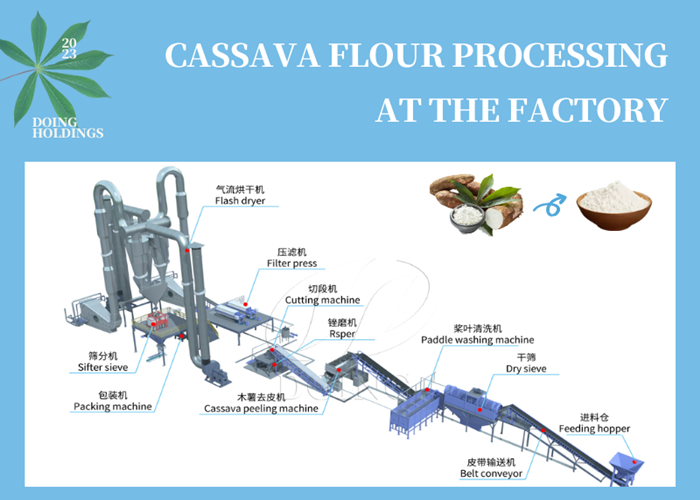 Cassava flour making line
When Two Separate Lines Make More Sense
Sharing the front end pays only when both products run often enough to keep the shared machines busy. Four situations usually argue for two dedicated lines:
Continuous double output: if both products are on stream most of the time, a shared section you can only run one product at a time throttles your true output.
Strict product separation: a white, high-purity starch and a speck-free flour from one shared section is one bad flush away from a quality claim.
Mismatched throughput: if the two products have very different throughputs, the smaller one ends up throttling a front end sized for the larger.
Capital and floor space: where budget and floor space allow, two dedicated lines run simpler, switch faster and avoid change-over losses altogether.
FAQ
Is cassava flour the same as cassava starch or tapioca flour?
No, and the buyer specs differ. Cassava flour is the whole dried root ground to a powder and behaves as a flour. Cassava starch (often labelled tapioca starch or tapioca flour in trade) is the purified granule used as a thickener and binder. They are not interchangeable in a recipe, so a machine list that treats them as one product will disappoint the end customer.
How much money does sharing the front end actually save?
It is a real but bounded saving. Sharing removes the duplicated washing, cutting, rasping and drying units and part of the building – that is where the capital goes. It does not remove the finishing trains, which still have to be bought per product, so you save on the front end, not on the whole plant. The exact amount depends on capacity and layout and is quoted per project.
Do flour and starch lines need the same workshop and staffing?
Not the same, and not one-for-one. A shared front end saves roughly one set of washing, rasping and drying floor space and the operators tied to it. But starch adds a purification skid and its pumps that flour does not need, and running both products means scheduling one finishing after the other rather than around the clock. Net result: a shared line is smaller and leaner than two fully separate plants, but larger and slightly more labour-intensive than a single dedicated line.
What breaks if I drop the purification section from a starch line?
You stop making starch as such. Without the centrifugal sieve and the Hydrocyclone stations, protein and fine fibre stay in the product, the powder greys, and it will not meet food- or industrial-grade starch specs. That section is not an option on a starch line.
I am a small plant wanting both – which line should I start with?
Start with the product you can sell first and that fits your capital. A flour line is usually the lower-cost, faster-to-commission entry; a starch line costs more because of the purification train. Once the first line earns, the shared-front-end logic lets you add the second product finishing rather than rebuilding from scratch.
Get a Quote for Your Cassava Flour or Starch Line
One line cannot make flour and starch at the same instant, but the two processes share the washing-and-rasping front end and differ only at the finishing – so the real decision is how much of a line you can share before the products must run separately. Jinrui Foodtech has delivered dedicated cassava flour and starch plants and will size yours around capacity, product mix and site. Contact us today with your daily cassava throughput and target products, and we will send you a line configuration and quote.