

What Equipment Is Required for a Medium-to-Large Scale Potato Starch Processing Plant? Full Line Configuration Guide
Building a medium-to-large scale potato starch processing plant is not a matter of buying a few machines and lining them up. The line is an integrated system that follows a fixed process route — washing, rasping, sieving, desanding, purification, dewatering, drying and packaging — where every stage feeds into the next. If any stage is under-specified, simplified, or mismatched in capacity, the whole line suffers: lower extraction rate, unstable output, and off-spec starch.
The real question for a serious investor is not just "what machines", but how they are configured, sized and connected. This guide walks through the full equipment configuration of a medium-to-large scale potato starch line, stage by stage, so you can evaluate your project and talk to suppliers on the same technical page.
Process Flow at a Glance
A standard medium-to-large scale potato starch line runs a continuous wet process along the following route:
Raw potato intake → washing and impurity removal → rasping (cell rupture) → centrifugal sieving and fiber separation → fine fiber sieving → desanding → 18-stage hydrocyclone purification → vacuum dewatering → flash drying → sieving → automatic packaging
The stages are linked by piping and transfer tanks into a fully enclosed, continuously running system, typically managed from a central control room. In a well-tuned line the entire cycle from cleaned potato to packaged starch runs in roughly 15 minutes, which protects starch quality and prevents fermentation during production.
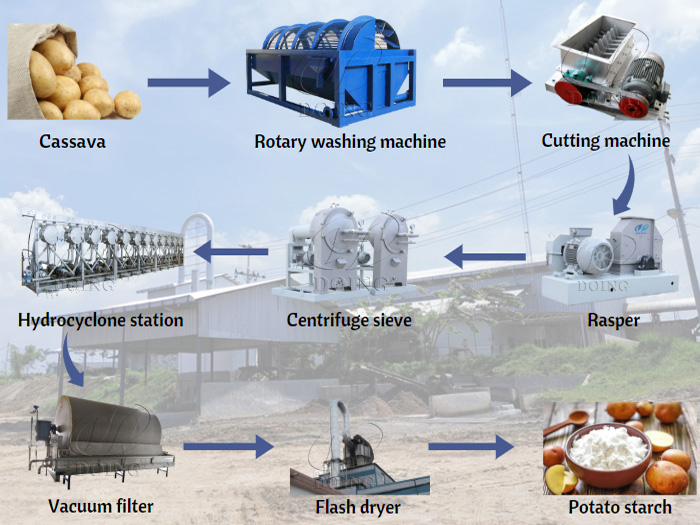 Potato starch processing line
Complete Equipment Configuration by Stage
Stage 1 · Dry Sieve, Rotary Washer and Destoner
Washing and impurity removal is the first gate of quality — the cleanliness of the raw material sets the ceiling for the cleanliness of the finished starch. How you feed and wash depends on the scale of the line, and the two approaches are alternatives, not a shopping list of everything below.
| Feeding method | Equipment set | Best fit |
|---|---|---|
| Dry feeding | Dry sieve + rotary washer | Smaller-capacity lines; potatoes are dry-screened to remove soil and stones first, then washed |
| Wet feeding | High-pressure water flushing + destoner (rotary washer as a secondary step) | Medium-to-large scale lines; higher throughput, and stones are removed early to protect the downstream rasper |
For medium-to-large scale operations the wet feeding route is generally recommended: high-pressure water flushing lifts surface dirt and the destoner pulls out stones and heavy impurities before they can reach the grinding stage.
Stage 2 · Rasper Grinder
The rasping stage — where cleaned potatoes are ground to rupture their cells and release free starch — is handled by a rasper grinder. The rasper uses high-speed serrated cutters to finely rupture the potato cells.
The rasper’s job is expressed in one number: cell rupture rate. A well-built rasper reaches a rupture rate of 94%–95%, which sets how much starch is available to recover in the stages that follow. The less complete the rupture, the more starch leaves with the fiber regardless of how good your downstream equipment is.
Stage 3 · Centrifugal Sieve System
The centrifugal sieving stage separates the starch milk from the fiber (pulp) after rasping. The slurry from the rasper holds starch milk, fiber and cell sap. A centrifugal sieve system, typically arranged as a 4-stage counter-current setup, separates the starch milk from the coarse fiber. Starch milk passes through the sieve mesh while the fiber is retained and washed stage by stage, so starch trapped in the pulp is recovered instead of lost. The separated fiber can be pressed and dried into animal feed as a by-product.
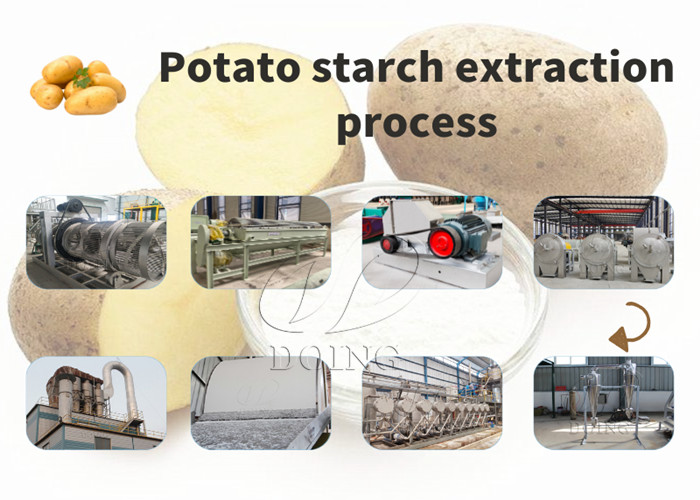 Potato starch processing equip
Stage 4 · Fine Fiber Sieve
After the main fiber is removed, the starch milk still carries fine fiber particles that are too small for the centrifugal sieve to catch. A fine fiber sieve strips out these remaining fine fibers before the milk enters the purification stage, preventing them from loading the hydrocyclones and keeping the final starch’s fiber content low.
Stage 5 · Desander
Fine sand that survived washing is too small to catch at the sieve but hard enough to score the inside of the cyclones downstream. A desander is placed after fine fiber sieving and before purification to strip out this sand and hard grit — protecting the core purification equipment and keeping the starch’s ash content in check.
Stage 6 · 18-Stage Hydrocyclone Stations
Purification is the quality watershed: it decides whiteness, ash and protein content. A hydrocyclone station is used, and for medium-to-large scale plants an 18-stage system is the recommended configuration. Fresh water is introduced counter-current at the end of the battery so it flows against the starch milk, washing out protein, pectin, cell sap and fine impurities stage by stage while recovering free starch. Fewer stages means lower purification precision, and food-grade or export-standard starch becomes hard to hit.
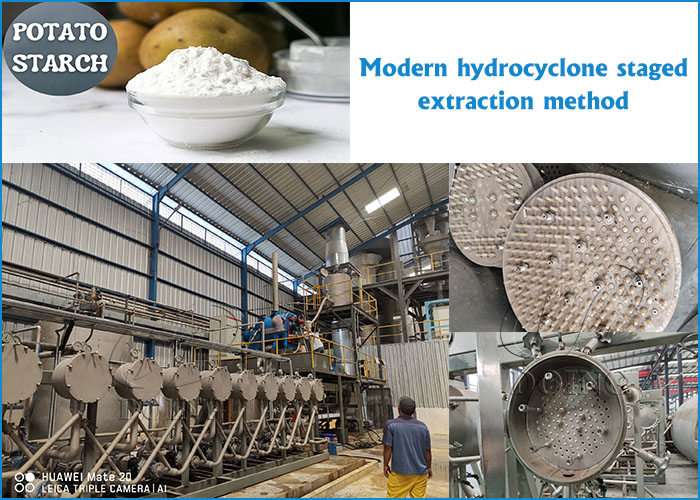 Hydrocyclone stations
Stage 7 · Vacuum Filter
The concentrated starch milk still carries too much water to dry efficiently. A vacuum filter (vacuum dewatering machine) filters it down to a wet-starch moisture of about 36.5%–38%. The drier the cake leaves this stage, the less heat energy the drying stage has to spend, so consistent moisture here directly trims operating cost.
Stage 8 · Flash Dryer, Starch Sieve and Automatic Packaging Machine
The final stage covers drying, sieving and packaging. The wet starch flashes through a stream of hot air in a flash dryer, drying in seconds under controlled temperature. Fast drying avoids the prolonged heat that would damage starch quality and brings the final product down to 12%–14% moisture — the food-grade range for stable storage. A starch sieving machine then evens out particle size and removes any agglomerates, and an automatic packaging machine fills and seals the finished starch into standard bags with minimal human contact.
Supporting Systems: PLC Control, Water Recycling and Food-Grade Stainless Steel
Beyond the eight core process stages, three supporting systems separate a real production line from a loose collection of machines:
PLC automatic control system — a central control cabinet coordinates the whole line, monitoring flow, speed, temperature and pressure in real time, with automatic alarm and shutdown on fault. Automation at this level keeps staffing low and prevents the quality swings and breakdowns caused by manual error.
Water recycling system — process water from washing, sieving and purification is settled, filtered and returned to the front of the line. Jinrui Foodtech (Henan Jinrui) designs these lines to a water-to-raw-material ratio of about 1:1.3 after recycling, cutting both fresh-water cost and wastewater discharge.
Food-grade stainless contact surfaces — all parts touching the starch are 304 food-grade stainless steel, corrosion-resistant and easy to clean, meeting food-safety requirements.
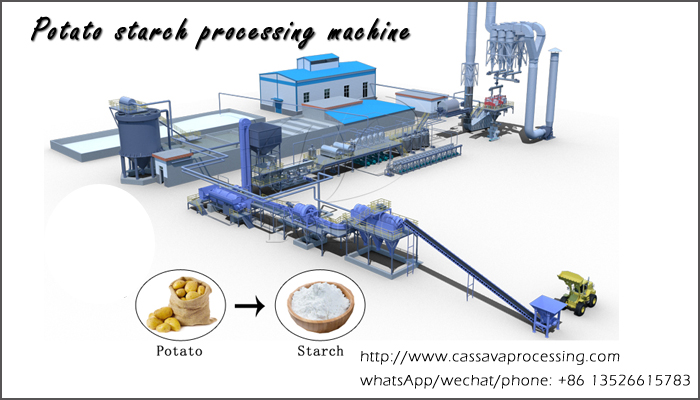 Complete potato starch processing machine
A Real Configuration to Reference
How these stages come together in practice is best seen in an installed line. A 30 TPH potato starch processing plant in Jiaozuo, Henan, built by Jinrui Foodtech and completed within one year from its 2014 start-up, is configured exactly along the route above: dry screening and cage washing at intake, three rasper grinders, five centrifugal sieves, a cyclone purification system, a vacuum filter, a flash dryer, a starch sieving machine and automatic packaging, joined by piping and transfer tanks into a fully enclosed, food-grade production system.
This line still serves as a working reference site for international customers evaluating a medium-to-large scale configuration — the same potato starch processing plant list described in this guide, running at 30 tons of raw potato intake per hour.
[Project case study → 30TPH potato starch processing plant project in Henan, China]
Frequently Asked Questions
How is "medium-to-large scale" defined for a potato starch plant?
In Jinrui Foodtech’s range, a medium-to-large scale line starts around 8 tons of raw potato intake per hour — a line built to produce roughly 1 ton of starch per hour, which works out to over 100 tons of potatoes processed per day.
What starch yield can I expect from a well-configured line?
A properly configured line reaches an extraction rate of up to about 94%, which corresponds to roughly 8 tons of raw potatoes yielding 1 ton of finished starch. The actual figure depends on potato variety and freshness, the rasper’s cell-rupture rate, and the efficiency of the sieving and purification stages.
How much floor space does the line need?
As a reference from Jinrui Foodtech’s own projects: a 20 t/h line fits a workshop of about 54 m × 18 m, and a 30 t/h line about 72 m × 18 m, laying out the full line from intake to packaging with maintenance access. These are project-based reference values, not fixed standards — actual layout depends on site conditions, and larger capacity needs proportionally more space, plus areas for raw material storage, finished-goods warehousing and wastewater handling.
How many operators does the line require?
Roughly 10 per shift is a typical Jinrui Foodtech reference for a medium-to-large line — intake (1), washing (1), processing (1–2), drying (1), central control (1), packaging (2–3) and a shift supervisor (1). Smaller lines run on 6–10 people and medium-to-large lines on 8–12. The higher the automation, the closer you sit to the lower end; these are reference figures, not an industry standard.
Plan Your Line Configuration
A medium-to-large scale potato starch line needs eight core process stages — washing, rasping, sieving, desanding, purification, dewatering, drying and packaging — each with the right equipment, sized and matched to your target capacity.
Jinrui Foodtech configures and supplies medium-to-large scale potato starch lines from 4 to 90 TPH, covering process design, equipment lists, layout planning and installation. Share your target capacity, raw-material supply and site conditions to get a tailored equipment configuration and proposal from us.