

Cassava Starch Dryer Upgrade: From Sun Drying to Mechanical Drying for Small Factories
For small-scale cassava starch producers, sun drying has long been the default method. It requires no fuel, no complex equipment, and minimal upfront investment. But as your business grows, the limitations of relying on the weather become increasingly apparent — inconsistent moisture content, contamination from dust and insects, production halts during rainy seasons, and the sheer labor and land required to spread and collect starch manually.
The most practical upgrade path for small factories is to move to a mechanical drying system, specifically choosing between a Drying Room (Oven) for low-budget batch processing and a Flash Dryer (Airflow Dryer) for continuous, high-quality output. This article will walk you through both options so you can make an informed decision that fits your factory's budget, space, and production goals.
Why Upgrading Your Cassava Starch Dryer Is a Business Necessity
Sun drying might have zero fuel cost, but it introduces significant business risks that limit your growth. If you are running a small factory, these are the hidden costs of relying on the sun:
Inconsistent Quality: Uneven drying leads to variable moisture content. Starch that is too moist will mold during storage; starch that is over-dried may cake and lose market value.
Hygiene and Contamination: Open-air drying exposes your product to dust, insects, birds, and other environmental contaminants, making it difficult to meet food safety standards.
Weather Dependency: Your entire production line halts during the rainy season, leading to lost revenue and an inability to fulfill orders on time.
High Labor and Land Cost: Sun drying requires a vast area of land and intensive manual labor for spreading and collecting the starch.
At Jinrui Foodtech (Henan Jinrui), we have seen firsthand how these challenges hold back small factories across Africa and Southeast Asia. Upgrading to a mechanical cassava starch dryer solves these problems, transforming your operation from a weather-dependent workshop into a stable, professional factory.
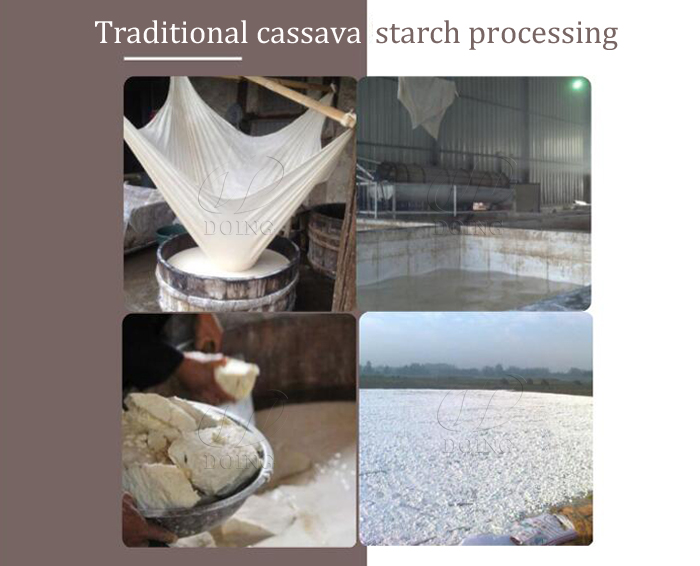 Traditional cassava starch drying method
Option 1: Drying Room (Oven) — A Simple Step Up from Sun Drying
A drying room is essentially an enclosed, heated chamber where wet starch is spread on trays or racks. Hot air is circulated inside the room to slowly evaporate moisture over several hours.
How it works:
Wet starch is manually loaded onto trays, which are then placed on racks inside the room. A heat source (coal, diesel, or electric) warms the air, and a fan circulates it. The process typically takes 10 to 20 hours, depending on the room size and heat intensity.
Advantages:
Lower upfront investment compared to a flash dryer system
Simple technology that is easy to understand for operators with limited technical experience
Batch processing allows for better control over individual batches if needed
Limitations:
Uneven drying: Starch on trays closer to the heat source may dry faster or even gelatinize (cook), while starch further away remains too moist.
Long drying time: The 10–20 hour cycle significantly limits your daily throughput.
High labor requirement: Loading and unloading trays is a manual, time-consuming process.
Larger footprint: A drying room requires a dedicated building or room.
Best suited for:
Very small workshops or startups with extremely tight budgets, low daily output (under 1 ton of dry starch), and access to ample space for a drying room structure.
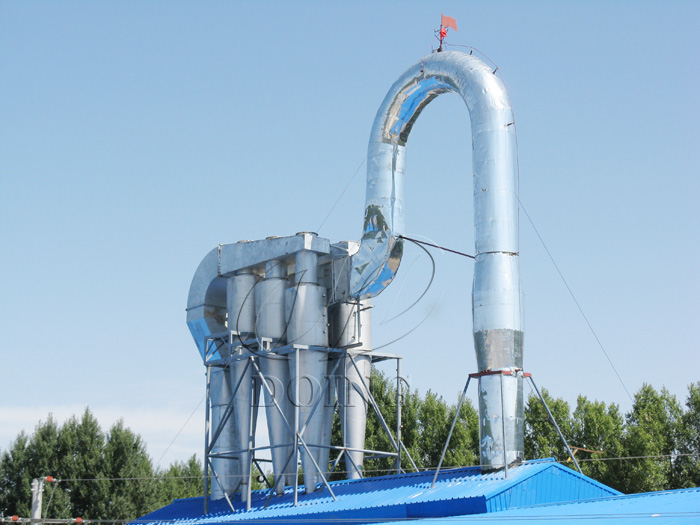
Option 2: Flash Dryer (Airflow Dryer) — The Industry Standard for Efficient Drying
A flash dryer, also known as an airflow dryer, uses high-speed hot air to suspend and transport wet starch particles through a vertical drying pipe. The drying process is completed in just 2 to 3 seconds. The performance data referenced in this article is based on typical specifications from Jinrui Foodtech flash dryer systems. Actual results may vary depending on raw material moisture, factory conditions, and operating parameters.
How it works:
Wet starch cake (typically 40–45% moisture) is fed into the drying pipe via an air feeder. High-temperature air, generated by a furnace, rushes through the pipe at high speed, instantly evaporating the surface moisture. The dried starch is then separated from the air stream by a cyclone separator and discharged automatically.
Advantages:
Instant drying (2–3 seconds): The extremely short heating time prevents starch gelatinization, preserving the natural white color and fine powder texture.
Consistent quality: The continuous, automated process ensures uniform moisture content, typically achieving a final moisture level of 12–14%.
Compact design: The system is primarily vertical, occupying a fraction of the space required by a drying room.
Closed-loop hygiene: The entire process occurs within sealed stainless steel pipelines, preventing contamination. Food-grade stainless steel should be used for all contact parts, ensuring no rust contamination and easy cleaning.
Negative pressure operation: No dust leakage into the workshop, creating a cleaner working environment.
Fully automatic: Once set, the machine runs continuously with minimal operator intervention. The system should be equipped with temperature and speed measurement devices, allowing operators to adjust the heat based on the moisture content of the incoming wet starch cake.
Limitations:
Higher upfront investment compared to a drying room (though the ROI is typically faster due to higher throughput and better product quality).
Requires basic technical understanding for initial setup and temperature adjustment.
Best suited for:
Small to medium-sized factories aiming for consistent, high-quality output, daily production of 1 ton or more, and a professional, modern operation that can meet food safety standards.
Side-by-Side Comparison: Drying Room vs. Flash Dryer
| Feature | Drying Room (Oven) | Flash Dryer (Airflow) |
| Drying Time | 10–20 hours per batch | 2–3 seconds (continuous) |
| Daily Capacity | Low (batch-limited) | High (continuous throughput) |
| Starch Quality | Medium (risk of uneven drying/gelatinization) | High (uniform, white, fine powder) |
| Final Moisture | Variable, harder to control consistently | Consistent 12–14% |
| Footprint | Large (requires dedicated room) | Small (vertical, compact structure) |
| Automation Level | Semi-manual (manual loading/unloading) | Fully automatic |
| Hygiene | Open trays, higher contamination risk | Closed stainless steel system |
| Labor Requirement | High | Low |
| Upfront Investment | Lower | Moderate |
| Best For | Very small workshops, tight budgets | Small to medium factories seeking quality and efficiency |
What Makes a Good Cassava Starch Dryer for Small Factories
Whether you choose a drying room or a flash dryer, the equipment you invest in should meet certain baseline standards to ensure reliable operation and product quality. The following criteria provide a practical framework for evaluating any cassava starch dryer system, regardless of the supplier.
Food-grade stainless steel contact parts: All components that come into direct contact with the starch should be made from food-grade stainless steel (typically 304 or 316 grade). This prevents rust contamination, resists corrosion from moisture and cleaning agents, and ensures easy cleaning -- all essential for producing food-grade cassava starch. When evaluating a supplier, verify the specific steel grade and ask about surface finish specifications.
Smart temperature and speed control: A reliable dryer should be equipped with temperature and speed measurement devices (thermocouples, tachometers, or digital sensors) so operators can adjust heat and airflow based on the moisture content of the incoming wet starch cake. Look for systems that provide real-time readouts and allow fine-tuning, rather than relying on fixed settings. Consistent drying regardless of input variations is the key indicator of good control design.
Efficient cyclone separation: The cyclone separator should achieve high collection efficiency (typically 95--99%+) while discharging moist air cleanly. Key indicators to check include the separator's diameter-to-height ratio, inlet air velocity, and whether a secondary bag filter or dust collector is included. Minimum material waste and clean exhaust air are the hallmarks of a well-designed separation system.
Flexible heat source options: A good flash dryer should be configurable to work with locally available fuel sources -- coal, diesel, natural gas, or biomass. The furnace design should match the fuel type and meet local emissions standards. Verify that the supplier can provide a furnace configuration tailored to your available fuel and local regulatory requirements.
Scalable capacity: The dryer should be available in a range of capacities to match your current and future production scale. For small factories, look for models covering 0.5 to 10 tons per hour of dry starch output. Confirm the supplier's ability to customize pipe diameter, air volume, and feeder size to your specific throughput requirements.
Local support and after-sales service: Drying equipment requires periodic maintenance and spare parts. A supplier with a local presence -- branch office, spare parts warehouse, or trained service partners -- ensures rapid response times. Verify their delivery experience in your region and whether they provide on-site installation guidance and commissioning support.
Taking Jinrui Foodtech as an example, their standard configuration includes food-grade stainless steel contact parts across all product lines, digital temperature and speed measurement devices, a high-efficiency cyclone separator with optional secondary filtration, multi-fuel furnace compatibility, scalable capacities from 0.5 to 10 tons per hour, and a local branch with a spare parts warehouse in Nigeria serving customers across Nigeria, Tanzania, Cameroon, and Southeast Asian markets.
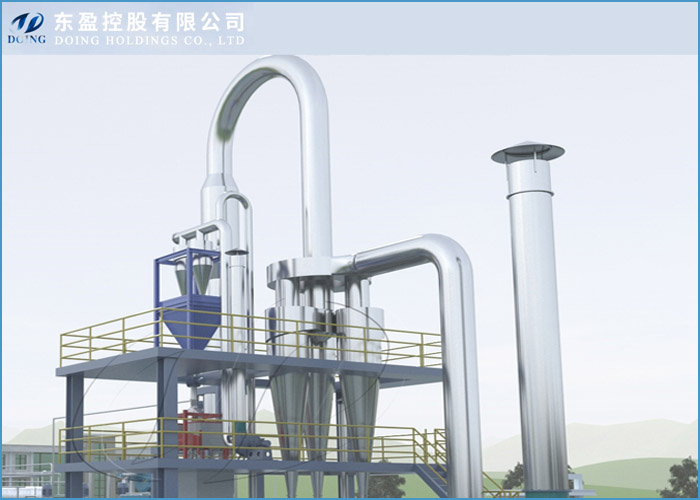 Henan Jinrui flash dryer
How to Choose the Right Cassava Starch Dryer for Your Factory
Making the right choice depends on several factors specific to your operation. Here is a practical checklist to guide your decision:
Assess your daily output target: If you aim to produce less than 1 ton of dry starch per day and have a very limited budget, a drying room may be a viable starting point. If your target is 1 ton or more, a flash dryer is the more practical and profitable choice in the long run.
Evaluate your available space: Do you have enough land or building space for a drying room with multiple racks? If space is constrained, the compact, vertical design of a flash dryer is a significant advantage.
Consider your labor situation: Can you afford the manpower required for manually loading and unloading drying trays multiple times a day? If labor is scarce or costly, the automated operation of a flash dryer will save you significant time and money.
Define your quality goals: Are you targeting the premium market where consistent whiteness, fine texture, and uniform moisture content command higher prices? If so, the flash dryer's superior drying quality is a clear advantage.
Plan for future growth: A flash dryer is not just a drying machine — it is an investment in your factory's scalability. As your production grows, the continuous drying capability ensures you won't hit a bottleneck.
FAQ: Cassava Starch Drying
Can a flash dryer be used for starches other than cassava?
Yes. The flash drying principle is highly versatile. The same system can be used for drying potato starch, sweet potato starch, corn starch, and wheat starch, with minor adjustments to the inlet air temperature and airflow speed.
What is the expected lifespan of a cassava starch dryer, and when do key parts need replacement?
With proper maintenance, a well-built flash dryer system can operate reliably for 10–15 years. Key wear parts such as the cyclone separator lining and fan bearings may need inspection or replacement every 2–3 years. Our food-grade stainless steel construction significantly extends service life compared to carbon steel alternatives.
How does a flash dryer prevent the starch from burning or gelatinizing despite using high-temperature air?
The key lies in the extremely short contact time. Although the inlet air temperature is high, the starch particles are only exposed to the heat for 2–3 seconds. This is sufficient to evaporate surface moisture but not long enough for the heat to penetrate the starch granule and cause gelatinization.
What kind of routine maintenance does a cassava starch dryer require?
Maintenance is straightforward and minimal. The system has very few moving parts. The primary routine tasks include regularly checking and lubricating the fan and motor bearings, inspecting the cyclone separator for wear, and ensuring the air feeder is clean and functioning properly.
Is it difficult to integrate a flash dryer into an existing small factory layout?
Not at all. Thanks to its vertical and modular design, a flash dryer has a small footprint and can be installed in an existing workshop without requiring major structural renovations. Jinrui Foodtech provides detailed layout drawings tailored to your workshop dimensions, along with on-site installation guidance and commissioning support.
Conclusion: Take the Next Step to Modernize Your Cassava Starch Factory
Upgrading from sun drying to a mechanical cassava starch dryer is one of the most impactful decisions a small factory owner can make. Whether you choose a drying room for its lower upfront cost or a flash dryer for its superior efficiency and quality, the move away from weather-dependent drying will immediately improve your product consistency, hygiene standards, and production reliability.
For most small to medium-sized factories aiming for sustainable growth and market competitiveness, the flash dryer offers the best balance of performance, quality, and long-term value. Its compact design, automated operation, and consistent output make it the ideal choice for factories ready to take their cassava starch production to the next level.
Jinrui Foodtech is here to help you make that decision. Based on the framework outlined above -- assessing your daily output target, available space, labor situation, quality goals, and growth plans -- our team of engineers will evaluate your specific production needs, workshop conditions, and budget to recommend the most suitable drying solution for your factory.