

Fiber Separation in Cassava Starch Processing: Equipment, Capacity and Starch Yield
In cassava cassava starch processing, fiber separation is the stage that removes fiber from the starch milk slurry so that starch can be recovered cleanly. It uses two pieces of equipment in sequence: a centrifuge sieve first, then a fine fiber sieve.
Get this stage right — your yield goes up. Get it wrong — starch leaves with the fiber waste, and no later stage can bring it back.
Here is what each piece of equipment does, how they work together, how the separation stage affects your capacity and yield, and how to size it correctly.
Why Fiber Separation Affects Your Starch Yield
Fiber separation is one of the stages that affects your starch yield — alongside rasping, refining, and drying. At this stage, fiber-bound starch is either recovered or lost for good.
Key facts:
The starch milk slurry from rasping contains starch granules locked inside fiber. If separation fails here, that starch is lost.
A two-stage configuration — centrifuge sieve followed by fine fiber sieve — significantly outperforms a single-pass setup.
The Two-Stage Equipment Setup: Centrifuge Sieve and Fine Fiber Sieve
The two pieces of equipment serve different purposes. They are a sequence, not alternatives.
| Equipment | Role | What it removes | Typical mesh range | Stage |
|---|---|---|---|---|
Centrifuge sieve | First pass — coarse separation | Bulk fiber from the starch milk | 80–120 mesh | Stage 1 |
Fine fiber sieve | Second pass — polishing | Fine fiber that passed the first screen | 120–200 mesh | Stage 2 |
Centrifuge sieve — first pass. Uses centrifugal force to spin the slurry against a rotating screen. Starch milk passes through; fiber is thrown outward and discharged.
Fine fiber sieve — second pass. Runs the already-separated starch milk over a finer screen to catch fine fiber particles. This is the polishing step that removes what the first pass misses.
The sequence is non-negotiable. Skip the fine fiber sieve and fine fiber — plus the starch it carries — ends up in the waste. Skip the centrifuge sieve and the fine fiber sieve gets overloaded, blinds quickly, and loses separation efficiency.
Jinrui Foodtech (Henan Jinrui) supplies both machines as part of its complete cassava starch lines. Its West African project references include a 20 TPD cassava starch line in Ghana — configured with a two-stage fiber separation setup sized to the plant's target recovery rate.
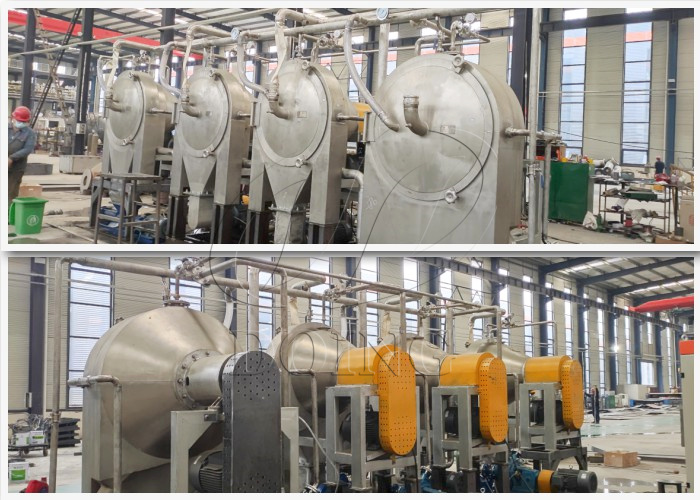 Centrifuge sieve from Jinrui Foodtech
Capacity: How the Separation Stage Affects Your Throughput
The fiber separation stage does not set the whole plant's capacity on its own — rasping and drying set their own limits too. But this stage is one of the line's capacity bottlenecks, and its throughput must keep pace with the rest of the line. Here is how the separation equipment affects your production capacity.
The centrifuge sieve sets the ceiling. It is the throughput driver for the separation stage. Its rated capacity follows your raw cassava intake — a 4–55 TPH unit covers most small to medium-scale starch operations.
The fine fiber sieve adds little throughput load. It processes already-separated starch milk, not raw slurry. Sized to match or slightly exceed the centrifuge sieve output, its effect on overall line throughput is minimal. Sizing it smaller than the centrifuge output creates a second-stage bottleneck.
Two things most often cut capacity at this stage:
Screen blinding: Too-fine mesh or too-high feed rate blocks the screen openings and drops throughput. Inspect and clear the screens regularly.
Inconsistent feed: A slurry that is too thick, or one carrying large fiber chunks, overloads the first pass. The centrifuge sieve reaches rated capacity only with a steady, consistent feed.
 Fine fiber sieving machine
Starch Yield: How the Separation Stage Affects Your Recovery
Fiber separation is one of the stages that affects your starch yield — rasping, refining, and drying matter too. But at this stage, any starch still locked in unremoved fiber is lost for good. Here is what shapes your recovery at the separation stage.
Screen mesh size sets the separation boundary. Coarser mesh lets more fiber and starch escape into the waste. Finer mesh gives cleaner starch but raises the risk of blinding. Match the fine fiber sieve mesh to your starch grade target — food-grade starch needs a finer screen than industrial grade.
Centrifuge speed controls separation force. Higher speed improves separation but raises power draw and wear. The right speed depends on your cassava variety's fiber content and your target throughput.
Screen wear is a hidden yield thief. Worn screens develop enlarged openings, letting fine fiber and starch pass straight into the waste stream. Inspect at every shift change. Replace when you see rising fiber carryover or falling purity at normal feed rates — typically every one to three months depending on load and material.
Jinrui Foodtech selects screen mesh, centrifuge speed, and stage configuration together — matched to your recovery target and raw material profile, not just to your throughput target.
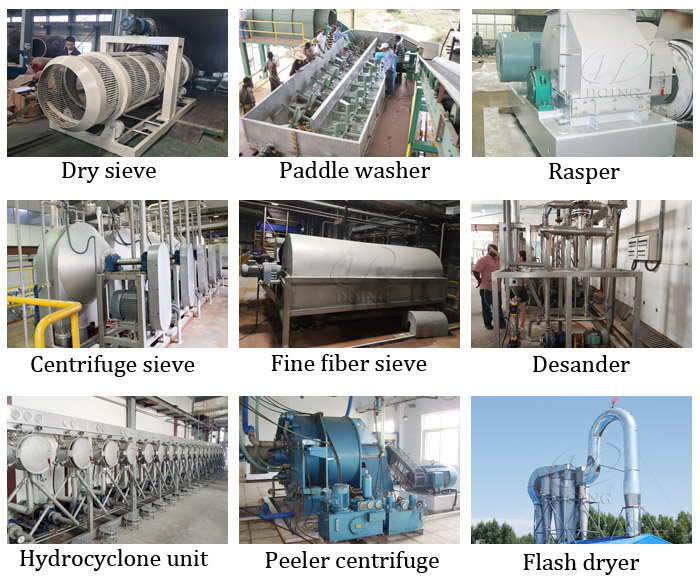 Cassava starch processing equipment
How to Size the Separation Stage for Your Line
For any cassava starch line, two stages are the standard configuration. Even at small scale, both are recommended.
| Parameter | What to check | Typical range / note |
|---|---|---|
Screen mesh | Match to your starch grade target. Food-grade needs finer mesh than industrial grade. | Centrifuge: 80–120 mesh. Fine fiber: 120–200 mesh. |
Centrifuge capacity | Match to your raw cassava intake. Verify motor rating and power supply on site. | 4–55 TPH covers most small to medium operations. |
Stage configuration | Do not use one sieve as a substitute for two. A single-stage centrifuge sieve is not sufficient for most quality targets. | Add the fine fiber sieve as a minimum second stage. |
Common mistake: Adding a finer screen to the centrifuge sieve and skipping the fine fiber sieve. This blinds the centrifuge screen, drops throughput, and still leaves fine fiber in the starch milk. You lose on both yield and capacity.
Frequently Asked Questions
What should you ask the supplier before signing, to confirm whether a single sieve stage is enough for your target?
Ask the supplier to specify your starch purity target, the fiber content of your cassava variety, and the screen mesh size of their proposed single-stage system. If they cannot give you a starch purity guarantee backed by a screen specification, that is the signal to walk away from a single-stage proposal. A credible supplier will size the fine fiber sieve as non-optional for food-grade starch.
What does poor fiber separation actually cost you in daily output — and at what point is the loss serious enough to warrant an upgrade?
For a 20 TPD starch line processing around 80–100 tonnes of fresh cassava per day, each percentage point of unrecovered starch translates to roughly 200–250 kg of finished starch lost per operating day. A well-configured two-stage system protects that output every day the line runs.
How do you know when screens need replacing — before yield visibly drops?
Check screens at every shift change for blinding, tears, or deformation. Replace every one to three months depending on fiber load and material — or earlier when you notice fiber carryover increasing even at normal feed rates.
Does fine fiber residue affect starch quality even without reducing yield?
Yes. Fine fiber that stays in the starch milk ends up as impurity in the final dried starch, reducing whiteness grade and affecting downstream performance. A finer fine-fiber screen means cleaner starch going into the next stage.
Can you substitute a finer refining stage for one of the sieve stages to simplify the line?
No. Refining stages improve purity through washing; they do not physically remove fiber from the slurry — the sieve stages must stay. Where refining adds value is after the sieve stages: when you are targeting food grade and need additional washing passes to lift purity further. The sequence is fixed: sieve to remove fiber, then refine to improve purity.
Get a Separation Stage Configured to Your Yield Target
The fiber separation stage is not a place to cut corners. Send Jinrui Foodtech your target capacity and raw cassava variety, and get a two-stage separation configuration sized to your recovery goal — not just to your throughput goal.