

Flash Dryer vs Rotary Dryer for Cassava Starch: A Lower-Fuel-Cost Alternative
When drying starts eating too much of your cassava starch budget, the real fix is usually not to run a rotary drum hotter or longer. It is to stop asking a rotary drum to dry a material it was never built for. Cassava starch reaches the dryer as a fine, partly-dewatered cake – roughly 36 to 38 percent moisture straight off a peeler centrifuge. That is the exact feed a flash dryer (also called a pneumatic or air-flow dryer) handles well, and the exact feed a tumbling rotary drum fights against.
In plain terms, the two machines solve different problems, so the honest answer is "it depends on your material and your fuel price." The comparison below walks through how each dryer works, what each does well and poorly, where the fuel gap actually comes from, and what to pin down before you spend money replacing a machine.
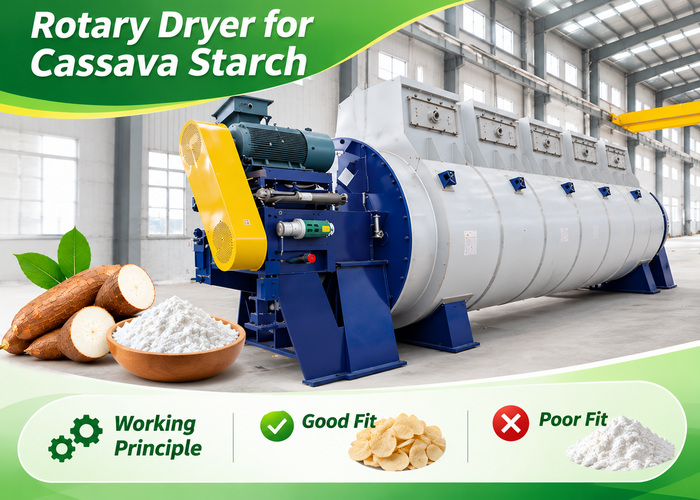 Rotary dryer for cassava starch
Rotary Dryer for Cassava Starch: How It Works, Where It Fits, and Where It Burns Fuel
How a rotary dryer works
A rotary dryer is a slowly turning, slightly inclined steel drum fitted with lifting flights inside. Wet feed enters at one end, the rotation lifts and cascades it through a stream of hot air, and the dried product leaves at the other end. Material typically spends minutes to hours inside the barrel, soaking in heat as it tumbles.
Pros and cons for cassava starch
Good fit: bulky, chunky or very wet feed such as cassava chips, peels and coarse mash; large batch loads; loose final-moisture targets. Poor fit: fine, pre-dewatered starch cake, which tends to clump and coat the shell instead of cascading evenly – leaving you to either over-dry the whole batch to fix the wet cores, or stop early and rework wet pockets.
Where a rotary dryer burns extra fuel
The long residence time is the cost driver. The hot barrel keeps giving off heat to the room, and a large share of the hot air leaves the discharge barely used. On coarse ore a drum can reach good thermal efficiency; on fine starch that efficiency does not hold, so more fuel is spent for every tonne of water evaporated.
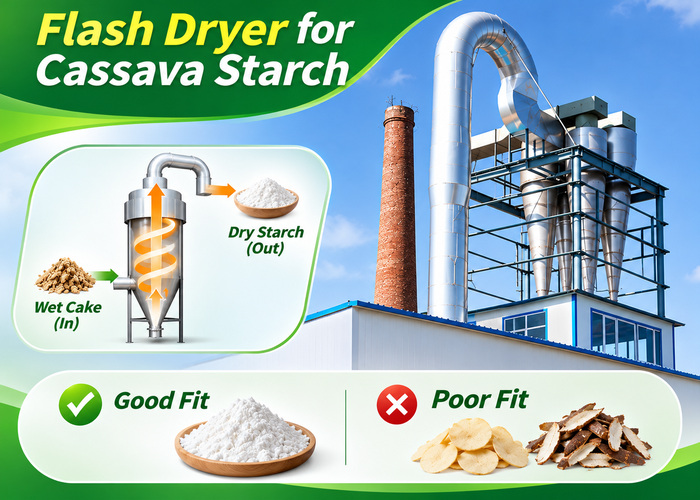 Flash dryer for cassava starch
Flash Dryer for Cassava Starch: How It Works, Where It Fits, and Why It Uses Less Energy
How a flash dryer works
A flash dryer breaks the wet cake into fine particles and blows them into a vertical duct carrying hot air. Suspended in the airflow, each particle is wrapped on all sides, so the surface area touching the hot air is enormous and the remaining moisture flashes off in seconds. It runs continuously – wet feed in at the bottom, dry product carried out at the top – with no tumbling and no long soak.
Pros and cons for cassava starch
Good fit: fine starch or flour that is already mechanically dewatered, continuous throughput, and tight final-moisture specs. Because it accepts a wet cake directly, it sits neatly after a peeler centrifuge and shortens the flow – no re-crushing, no pre-drying. Poor fit: coarse chips, peels or high-moisture mash, and small batch-only production. In Jinrui Foodtech (Henan Jinrui)’s starch lines the flash dryer runs hot air at roughly 130 to 150 degrees Celsius and brings product below 12 percent moisture in a single continuous pass, with a PLC holding temperature and airflow steady.
Why a flash dryer uses less energy
Less heat is wasted because drying is finished in seconds instead of an hour-long soak, and the design points below keep that heat where it does work. This is not a single vendor’s claim: researchers under the CGIAR Research Program on Roots, Tubers and Bananas, with Nigeria’s Federal Institute of Industrial Research (FIIRO) and the International Center for Tropical Agriculture (CIAT), built purpose-designed, energy-efficient flash dryers for cassava flour and starch. A pilot evaluation reported about 80.8 percent energy efficiency and specific energy consumption near 2,570 kJ per kilogram – positioning a well-built flash dryer as the lower-energy route for fine cassava products.
Side-by-Side: Flash Dryer vs Rotary Dryer at a Glance
| Aspect | Flash Dryer | Rotary Dryer |
|---|---|---|
| Working principle | Fine particles suspended in hot air; dried in seconds | Material tumbles in a rotating drum for minutes to hours |
| Best feed | Fine, dewatered starch or flour cake | Bulky, chunky or very wet chips and mash |
| Residence time | Seconds | Minutes to hours |
| Fuel-to-evaporation | Most heat goes into evaporating water | Heat lost to a long hot barrel and barely-used exhaust |
| Moisture control | Tight, PLC-locked temperature and airflow | Coarser; fine feed tends to over- or under-dry |
| Footprint | Tall vertical duct plus cyclone or bag filter | Long horizontal drum |
| Energy evidence (fine cassava) | Pilot units about 80.8 percent efficient, near 2,570 kJ/kg (CGIAR/RTB, FIIRO, CIAT) | Lower thermal efficiency on fine starch |
Four Ways a Flash Dryer Uses Less Fuel than a Rotary Dryer
The flash dryer’s fuel advantage is not magic and not simply "a smaller machine." It comes from four design features you should ask any supplier to point to on your own material.
1. The flash dryer dries in seconds, not hours
Particles finish in seconds, so starch is never held at high temperature long enough to waste heat or degrade product. Nearly all the heat goes into evaporating water rather than soaking a tumbling mass.
2. The flash dryer recirculates hot air
A large share of the warm exhaust is routed back to the heater inlet instead of being dumped. Re-heating air that is already warm costs far less fuel than heating cold make-up air from scratch.
3. The flash dryer keeps its heat inside sealed ducting
The vertical duct is insulated and sealed against leaks, so radiant and convective heat loss – a constant drain in a long open drum – is largely contained.
4. The flash dryer controls heat precisely with a PLC
Automatic control locks inlet temperature and air volume at set points, preventing the overheating and over-drying that quietly waste fuel in a manually tended drum.
Jinrui Foodtech states that its flash dryers use roughly 30 to 50 percent less fuel than conventional drum drying for cassava starch. Treat that as an indicative vendor figure, not a guarantee: the real saving moves with your heat source, feed moisture and duty cycle.
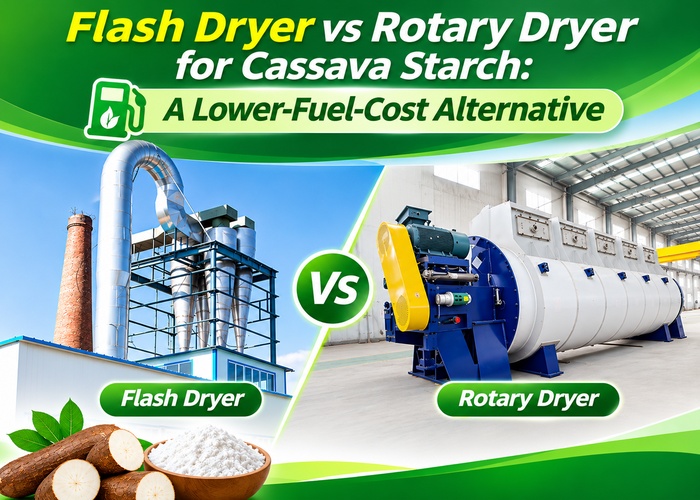 Flash dryer VS rotary dryer for cassava starch
When to Choose the Flash Dryer – and When to Keep the Rotary Drum
A flash dryer is the right swap when the material is a fine starch or flour, already mechanically dewatered, you need continuous throughput, and your final-moisture spec is tight. Keep the rotary drum when you are drying coarse chips, peels or high-moisture mash, when production is small and batch-based, or when loose moisture limits let a simpler dryer do the job.
A rotary drum is not a bad machine – it is a different tool for a different duty. The case here is narrow and honest: for the fine, pre-dewatered cake that comes off a starch extraction line, a flash dryer turns more of its fuel into useful evaporation.
What to Confirm Before You Replace the Dryer
A flash dryer bought on the wrong assumptions quietly wastes fuel too, so pin down four things before you sign.
Upstream cake moisture. The flash load is set by how wet the cake really is after dewatering, so confirm the peeler centrifuge discharge moisture first.
Heat source and its price. Whether you run natural gas, LPG, diesel or biomass, the local fuel cost decides how large your saving really is and shapes your operating budget.
Airflow, dust collection and footprint. A flash dryer is a tall vertical duct with a cyclone or bag filter for product recovery, so its height and dust handling differ from a horizontal drum’s footprint.
Capacity and final-moisture spec. Match the dryer’s rated output and target moisture to your line so the sizing does not drift.
Design quality matters as much as the label. A CGIAR/RTB diagnosis of small cassava dryers found that weak design – a too-short drying tube, an undersized heat exchanger or blower, and too low an air-to-product ratio – was a leading reason small units spent more fuel than large industrial plants. Ask for the duct length, heat-exchanger size, blower capacity and air-to-product ratio, not just the words "flash dryer."
Frequently Asked Questions
Can I retrofit a flash dryer onto my existing starch line, or do I need a new plant?
In most cases a flash dryer replaces only the drying stage, not the whole line, so it can be fitted where the rotary drum sat, as long as there is headroom for the vertical duct and space for a cyclone or bag filter. The two things to check are the feed interface - how the wet cake moves from your dewatering stage into the dryer - and the duct outlet, dust collection and floor space, which differ from a horizontal drum’s layout.
Does a flash dryer hurt starch quality – whiteness, gelatinization, moisture uniformity?
Generally the opposite. Because contact is brief and particle temperature stays low, there is far less time and heat to gelatinize or scorch starch granules than in a long drum bake, and tight PLC control yields a more uniform final moisture, protecting whiteness and functional quality.
Which heat source is cheapest to run a flash dryer on – biomass, gas, or diesel?
Fuel economics usually run diesel at the top, LPG and natural gas in the middle, and biomass (including biogas) lowest on fuel cost, though biomass adds handling and ash management. Work on large starch plants notes that switching drying from fuel oil to biogas markedly cut both fuel cost and emissions. The cheapest source is the one that is available and well-priced near your site.
Why would a flash dryer leave starch too wet or over-dry, and how do I fix it?
Starch coming out too wet usually means the feed rate is too high for the air volume, or the inlet temperature is too low; too-dry product points to under-feeding or excess temperature. Correct it by adjusting feed rate, inlet temperature and the return-air ratio, and by balancing blower airflow to the feed - all of which the PLC should make traceable.
How much maintenance does a flash dryer need compared to a rotary drum?
A flash dryer has far fewer large moving parts - no slow-turning shell, girth gear or riding rings to lubricate and realign - so routine upkeep is mostly the feeder, the blower, the heat exchanger and the dust-recovery filters. The rotary drum’s rotating shell and drive train carry more wear and downtime. Keep the duct insulation and air seals tight and you protect the energy advantage over time.
Talk to Jinrui Foodtech About Upgrading Your Starch Drying
If you are weighing a dryer change, the decision comes down to your material, your fuel price and your moisture target. Send us your current dryer type and heat source, the wet-cake moisture leaving your dewatering stage, and your target final moisture and daily capacity. We will map a flash drying configuration to those inputs, with the fuel and quality trade-offs spelled out, so you decide on evidence rather than a brochure.