

Cassava Starch Processing in Nigeria: Market & Plant Guide
Cassava starch processing in Nigeria offers opportunities for investors seeking to convert locally grown cassava into higher-value products for food and industrial applications. However, a successful starch processing business depends not only on the availability of cassava roots but also on reliable raw material supply, efficient starch extraction, consistent product quality, and suitable processing equipment. In short: the cassava is there, the market gap is documented, and the deciding factor is execution — securing a reliable root supply and converting it efficiently into starch that meets buyer specifications.
For businesses considering a new cassava starch factory or upgrading an existing facility, understanding both the market and the production requirements is essential. This article examines Nigeria’s cassava starch industry, the challenges facing commercial processors, how mechanized equipment can address technical limitations, and the key considerations when planning a complete cassava starch processing plant.
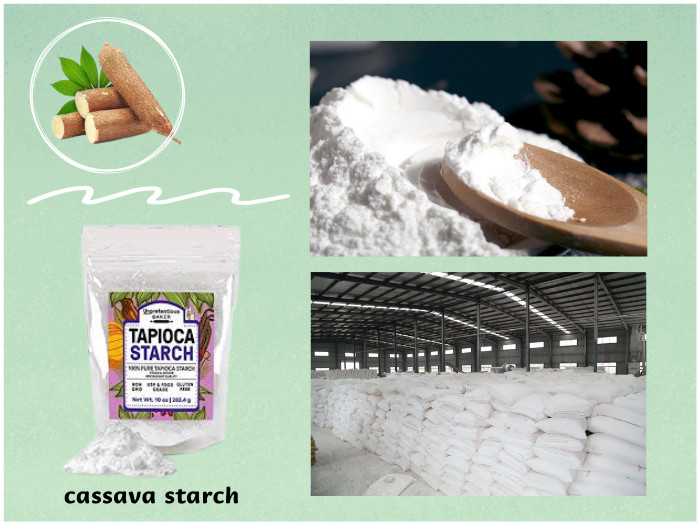 Cassava starch market in Nigeria
1. Current Status and Market Opportunities for Cassava Starch Processing in Nigeria
Nigeria is one of the world's largest cassava producers, providing an important agricultural foundation for cassava-based industries. However, the country's large cassava harvest should not be confused with the actual size of its starch market. Cassava roots are used for multiple products, including garri, fufu, flour, and starch, and only a portion of the available crop is directed toward industrial starch production.
Evidence of starch market opportunities comes from studies of downstream demand and domestic processing capacity, rather than cassava production figures alone. In its 2020 report, Harnessing the Economic Potential of Cassava Production in Nigeria, PwC estimated an annual supply-demand gap of approximately 290,000 metric tons for cassava starch. The report identified opportunities for greater domestic value addition, although this figure represents a historical estimate and should not be interpreted as the current market gap.
Cassava starch has applications in food processing, paper manufacturing, textiles, adhesives, and other industries where starch is used as a functional ingredient or industrial raw material. These different applications create potential markets for locally manufactured starch, but they may also require different product specifications and quality standards.
The commercial opportunity therefore depends on whether local processors can supply starch that meets buyers’ requirements at a competitive cost. Access to cassava roots is an advantage, but it must be supported by efficient processing technology, dependable factory operations, and established sales channels. For investors evaluating cassava starch production in Nigeria, the key question is not simply whether cassava is available, but whether it can be processed consistently into a marketable industrial product.
2. Challenges Facing Cassava Starch Processing in Nigeria
Research on cassava processing identifies several factors that can affect commercial starch production, including raw material shortages, incomplete starch release, separation losses, and moisture control. These challenges do not affect every factory to the same degree, but they are important when evaluating production efficiency and equipment requirements.
Unstable Cassava Supply and Low Factory Capacity Utilization
A major challenge for commercial cassava processors in Nigeria is securing a continuous supply of fresh roots. A 2017 study published in the Asian Journal of Rural Development reported that two commercial starch processing factories examined were operating below 30% of their installed capacity, with raw material shortages identified as the main constraint. The study also highlighted the difficulties created by the bulkiness and perishability of cassava roots, transportation distances, and poor road conditions. More recently, a 2026 report by BusinessDay Nigeria, citing research by the Nigeria Cassava Investment Accelerator, described processing facilities operating at approximately 30–40% of installed capacity because of irregular root supplies. These findings illustrate why factory capacity must be matched with realistic cassava procurement arrangements, rather than determined solely by the desired production volume.
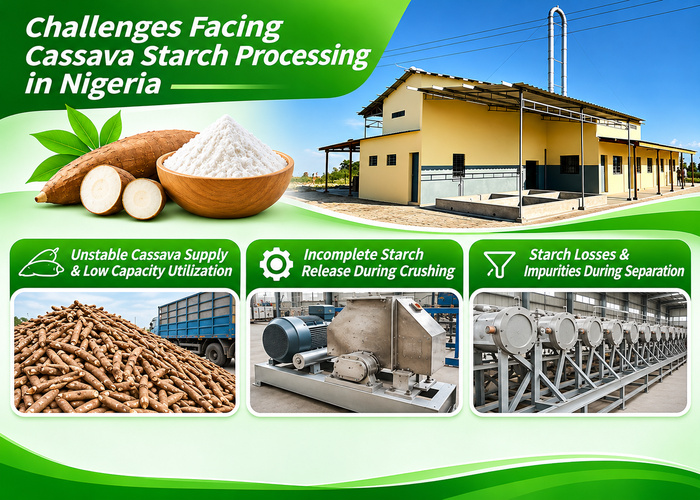 Challenges facing cassava starch processing in Nigeria
Incomplete Starch Release During Crushing
Cassava starch is contained within the cells of fresh cassava roots, so effective cell rupture is essential before starch can be extracted. According to FAO’s technical publication Cassava Processing, the proportion of starch released during a single rasping operation may vary between 70% and 90%, depending on the processing method and operating conditions. Starch remaining inside unbroken cells may subsequently be discharged with the fiber, reducing potential recovery. This does not mean that all cassava factories lose the same proportion of starch, but it demonstrates why rasping performance is an important technical factor in starch processing and why suitable crushing equipment is necessary for commercial production.
Starch Losses and Impurities During Separation
After rasping, cassava pulp contains released starch granules, fiber, water, and soluble components that must be separated. The World Bank’s technical literature on cassava processing describes wet screening as a method of washing starch from the pulp and separating the resulting starch milk from fibrous material. If screening and washing are poorly controlled, recoverable starch may remain in the discharged fiber, while insufficient purification can leave unwanted components in the starch slurry. The effectiveness of this stage therefore influences both starch recovery and the quality of the material entering downstream processing. Appropriate screening and purification equipment is particularly important for factories seeking consistent commercial starch quality.
Moisture Control During Dewatering and Drying
Starch slurry contains substantial amounts of water after extraction and purification. Removing this water efficiently is necessary before the product can be dried, finished, and packaged. Mechanical dewatering reduces the moisture load entering the dryer, while controlled thermal drying helps achieve the finished-product moisture specification. Poor coordination between these operations can increase drying requirements or result in inconsistent product moisture. Rather than treating drying as an isolated operation, commercial processors need to consider how purification, dewatering, and drying work together to produce starch suitable for storage and its intended application.
3. How Can Mechanized Equipment Improve Cassava Starch Production in Nigeria?
The technical challenges of cassava starch processing can be addressed through a coordinated mechanized production system. Different machines are responsible for starch release, fiber separation, slurry purification, and moisture removal. Their performance and capacity must be matched to ensure that improvements at one stage are not limited by another.
| Processing Requirement | Equipment Solution | Practical Benefit |
|---|---|---|
| Effective starch release | Cassava Rasper | Breaks cassava cells and releases starch for extraction |
| Starch and fiber separation | Centrifuge Sieve | Recovers starch slurry while separating fibrous material |
| Starch slurry purification | Hydrocyclone System | Washes and concentrates starch slurry |
| Mechanical moisture removal | Peeler Centrifuge | Reduces water content before thermal drying |
| Finished starch drying | Flash Dryer | Removes remaining moisture under controlled drying conditions |
Cassava Rasper: Improving Starch Release and Recovery Potential
The cassava rasper is one of the key machines affecting starch recovery because its primary function is to break cassava cells and release starch granules into the pulp. As noted in FAO’s technical literature, the rasping effect of a single operation may range from 70% to 90%, making equipment performance an important consideration when selecting a production line. Jinrui Foodtech’s CM-8435 cassava rasper is specified to achieve a rasping rate above 94%, with a rated fresh cassava processing capacity of 20 tons per hour. The machine also uses food-grade stainless steel for material-contact surfaces, supporting equipment hygiene and cleaning. These specifications demonstrate the machine’s intended performance advantages, although actual starch recovery will also depend on cassava characteristics and the efficiency of subsequent separation stages.
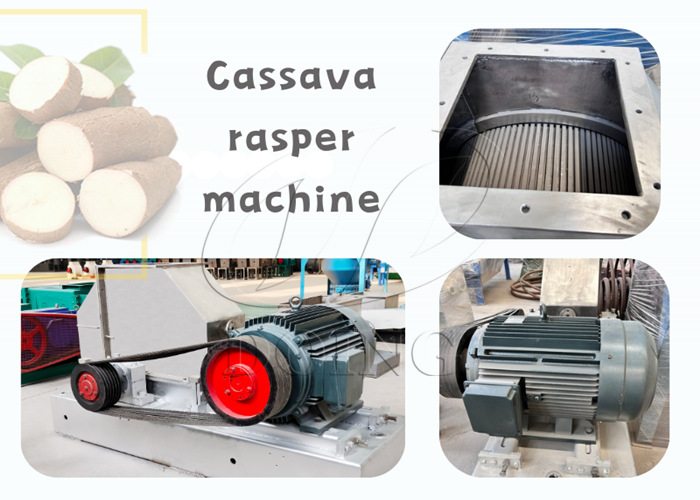 Rasper in cassava starch plant
Centrifuge Sieve: Improving Starch and Fiber Separation
After rasping, the cassava pulp must be washed and screened to recover released starch while removing fibrous material. A centrifuge sieve uses a rotating screening arrangement to separate starch-containing liquid from the pulp, supporting continuous processing and reducing dependence on manual filtration. Jinrui’s cassava starch processing equipment can incorporate centrifugal screening and additional fine-fiber separation stages according to the required slurry quality and production capacity. The objective is to recover starch effectively while limiting the transfer of fiber into subsequent refining equipment. For factories upgrading from basic filtration systems, an appropriately selected centrifuge sieve can improve screening consistency and support more effective starch recovery.
Hydrocyclone System: Producing Cleaner Starch Slurry
A hydrocyclone system refines starch milk through centrifugal separation and washing. In a multistage arrangement, starch slurry passes through a series of hydrocyclones designed to remove unwanted soluble components and other impurities while concentrating the starch. Jinrui can configure the hydrocyclone section as part of a complete cassava starch processing line according to the characteristics of the raw material and the target product requirements. Effective purification helps prepare the starch slurry for downstream dewatering and supports consistent finished-product quality. The appropriate system configuration should be based on the required separation performance rather than assuming that every factory needs the same number of stages.
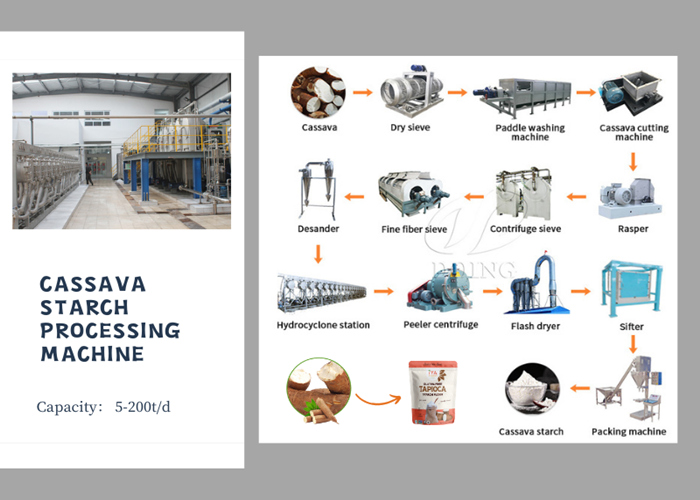 Cassava starch processing plant
Peeler Centrifuge and Flash Dryer: Improving Moisture Control
Following purification, a peeler centrifuge mechanically removes water from the starch slurry to produce wet starch suitable for drying. A flash dryer then uses heated airflow to remove additional moisture before the starch proceeds to finishing and packaging. These machines provide complementary functions: the centrifuge reduces the water that must be evaporated, while the dryer brings the product toward its specified final moisture level. In a Jinrui cassava starch processing line, the dewatering and drying stages are selected as part of the overall process configuration, taking into account production capacity, wet starch characteristics, heat supply, and finished-product requirements.
Complete Cassava Starch Processing Line Solution
Beyond individual machines, Jinrui Foodtech supplies complete cassava starch processing line solutions integrating raw material cleaning, rasping, starch extraction, fiber separation, purification, dewatering, drying, sieving, and packaging. The equipment arrangement can be developed around the customer’s planned processing capacity, cassava supply conditions, factory utilities, and finished starch specifications, allowing the different production stages to operate as a coordinated system.
For a detailed introduction to the process and equipment arrangement, explore our complete cassava starch processing line solution
4. Key Considerations for Establishing a Cassava Starch Processing Plant in Nigeria
Choosing the right machinery is important, but equipment performance alone cannot guarantee the success of a starch processing project. Investors must also evaluate whether raw material supply, factory capacity, utilities, and product requirements can support reliable commercial operation.
Fresh Cassava Supply and Factory Location
Cassava roots are highly perishable after harvesting, making transportation time and procurement arrangements important factors in factory planning. The low capacity utilization reported in studies of Nigerian processors demonstrates the potential consequences of unreliable raw material supply. Before selecting a factory site, investors should assess nearby cassava production areas, seasonal harvesting patterns, road access, transport costs, and the availability of long-term supply arrangements. Locating a factory close to suitable cassava-growing areas may help reduce logistical difficulties, but the final decision should also account for utilities, labor, and access to customers.
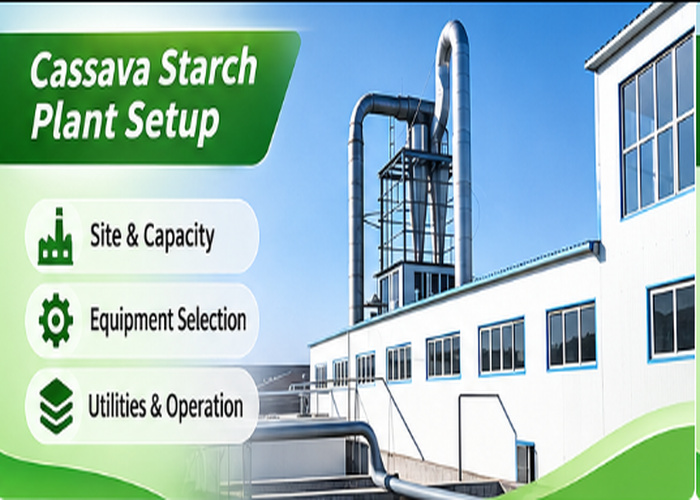 Cassava starch plant setup
Processing Capacity and Equipment Configuration
The planned capacity of a cassava starch plant should be based on the quantity of fresh cassava that can realistically be processed each day. Investors must distinguish between fresh root input and finished starch output, since starch production depends on the starch content of the roots, extraction performance, and processing losses. A line designed for a high nominal capacity may be underutilized if cassava supply is inconsistent, while poorly balanced equipment can create bottlenecks between crushing, separation, refining, and drying. For this reason, equipment suppliers should evaluate the complete process and its operating schedule before recommending a suitable production capacity.
Water, Electricity, and Factory Infrastructure
Cassava starch processing requires a dependable water supply for root washing, starch extraction, and slurry purification. Electricity is needed to operate mechanical equipment, while the drying system requires a suitable source of thermal energy. Investors should assess the availability and cost of these utilities, together with wastewater treatment arrangements, factory layout, equipment installation space, and finished-product storage. Where electricity or water supply is unreliable, the project design may need additional infrastructure or operating arrangements. Evaluating these conditions early helps avoid selecting equipment that cannot operate effectively at the proposed site.
Finished Starch Quality and Target Market
The intended buyers of cassava starch should be identified before the equipment configuration is finalized. Food processors and industrial users may have different requirements for moisture content, purity, appearance, and other product characteristics. These specifications influence the required purification, dewatering, drying, and quality-control arrangements. Investors should therefore discuss target product standards and customer acceptance requirements with their equipment supplier rather than selecting a production line based on capacity alone. A technically suitable factory should be designed to manufacture starch that meets the needs of its intended market.
5. Frequently Asked Questions About Cassava Starch Processing in Nigeria
Is There a Market for Cassava Starch in Nigeria?
Yes. Cassava starch has applications in food manufacturing and several industrial sectors, and historical market studies have identified a gap between domestic demand and local processing supply. However, older national estimates should not be treated as current guaranteed demand. Investors should verify present buyer requirements, prices, competition, and purchasing arrangements before committing to a new factory.
How Can I Reduce Starch Losses in Cassava Processing?
Starch losses can be reduced by improving rasping performance, ensuring effective washing and fiber separation, and maintaining suitable operating conditions throughout the extraction process. Monitoring the starch remaining in discharged fiber can also help identify recovery problems. The best improvement measures depend on the existing equipment, cassava characteristics, and processing arrangement.
Is a Large Cassava Starch Processing Plant Always More Profitable?
Not necessarily. A larger factory may offer greater output potential, but it also requires a larger and more reliable cassava supply, sufficient utilities, and dependable product sales. If the plant cannot operate near its planned capacity, its operating economics may be unfavorable. Capacity selection should therefore follow a realistic assessment of raw material availability and market demand.
Can an Existing Cassava Starch Factory Be Upgraded Without Replacing the Entire Production Line?
In some cases, yes. Existing factories may be able to improve performance by upgrading specific stages such as rasping, fiber separation, purification, or drying. However, the feasibility of an upgrade depends on the condition, capacity, and compatibility of the current equipment. A technical assessment is needed to determine whether replacing individual machines will improve overall line performance.
What Should Investors Confirm Before Purchasing a Cassava Starch Processing Line?
Before purchasing equipment, investors should confirm their available fresh cassava supply, intended daily processing capacity, target starch specifications, factory location, and utility conditions. They should also clarify the proposed equipment scope, installation requirements, and any plans for future expansion. These details provide a practical basis for comparing processing line proposals and discussing equipment configurations with suppliers.
6. From Cassava Resources to Commercial Starch Production
Nigeria’s cassava resources provide a foundation for starch processing, but commercial success depends on converting those resources into a consistent product through reliable raw material supply, efficient extraction, suitable equipment, and sound factory planning. The right processing arrangement should address both technical performance and the practical conditions of the local project.
Whether you are exploring a new factory or looking to improve an existing production line, Jinrui Foodtech can help assess the equipment options suited to your situation. Tell us what challenges or plans you are currently working on, and we can explore a practical processing solution together.