

How to Upgrade an Old Cassava Starch Plant: Equipment and Process Changes to Consider
A cassava starch line that has run for years can reach a point where its output, recovery, or product quality no longer meets market requirements. An old plant usually does not need to be demolished and rebuilt. Common problems are insufficient capacity, high starch loss, unstable product quality, and aging equipment, while a complete rebuild means major investment, civil work, and prolonged production downtime.
A practical cassava starch plant renovation follows four steps: diagnose where capacity is being lost, upgrade the right processing sections, integrate new equipment with the existing process, and plan the budget, installation time, and downtime. The goal is to invest where capacity, starch recovery, and product quality are actually limited—not to replace every old machine.
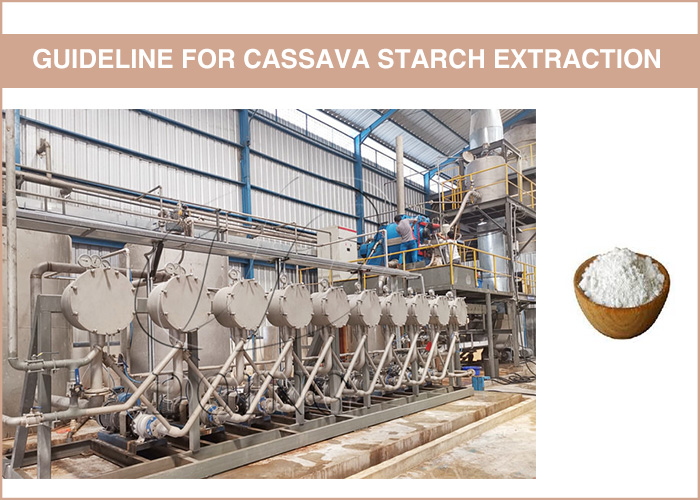 Cassava starch processing plant
Step 1: Diagnose Where Your Old Cassava Starch Plant Is Losing Capacity
Before buying new cassava starch processing equipment, measure the existing line section by section. For each section, record the nameplate capacity, actual throughput, average daily downtime, starch recovery, and final moisture.
Then compare the results with practical processing references:
A crushing rate below 90% indicates significant starch remains trapped in fiber; modern high-efficiency raspers can reach about 95% or higher.
A practical overall starch extraction reference is around 90–95%, depending on raw-material starch content and process configuration.
Final starch moisture is commonly controlled at around 12–13%, depending on the product specification.
A useful raw-material reference is roughly 4 tonnes of fresh cassava per tonne of starch, depending on raw-material starch content and actual recovery.
Three Common Types of Capacity Loss
| Capacity loss | What to check | Typical indication |
| Equipment bottleneck | Throughput of each main machine | One section consistently runs below the required flow |
| Process loss | Fiber starch, slurry concentration, extraction rate | High starch loss despite adequate machine capacity |
| Downtime loss | Stops, cleaning, maintenance and feeding interruptions | Rated capacity is much higher than actual daily output |
The largest machine is not necessarily the bottleneck. Classify the measured problem first, then decide whether it needs a single-machine upgrade, section renovation, or full-line capacity matching.
Step 2: Upgrade the Right Processing Sections, Not the Whole Line
An effective cassava starch equipment upgrade keeps equipment that still meets the required performance and replaces only sections that restrict the process.
Washing and Impurity Removal
If washed cassava still carries significant soil or sand, or the section requires frequent manual intervention, the cleaning stage is no longer keeping up. Upgrade it with a dry sieve + paddle washer with counter-current design: the dry sieve removes large dirt, stones and surface impurities first, while the paddle washer provides deeper cleaning before rasping. For a starch line, the priority is cleaning and sand removal rather than peeling, so the starch-rich outer layer is retained.
Rasping and Starch Release
If the crushing rate falls below 90%, significant starch can remain locked in the cassava fiber. Jinrui Foodtech (Henan Jinrui) high-speed rasping technology is designed for a crushing rate of at least 95%, improving starch release before extraction. Upgrading the rasper without checking downstream extraction capacity, however, can simply move the bottleneck.
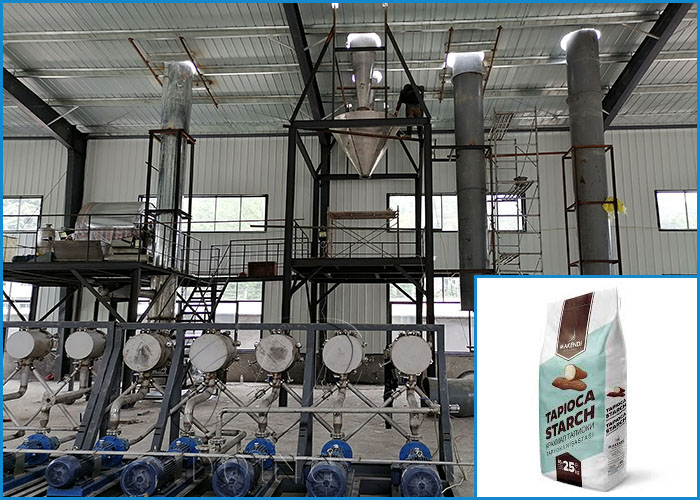 Cassava starch processing line
Starch Separation and Purification
If the old extraction section shows high starch loss or unstable slurry quality, the screening and purification stages need closer attention. Jinrui Foodtech centrifugal sieves run at 1,100+ rpm, followed by fine fiber screening, to improve starch recovery; a modern line normally uses 4–5 screening stages, while its 18-stage hydrocyclone purification system can concentrate starch milk to about 22°Bé. The centrifugal sieve and hydrocyclone systems can be configured across approximately 4–55 TPH, allowing individual sections to be matched to an existing plant rather than forcing a complete rebuild.
Dewatering and Drying
If wet starch enters drying with excessive moisture or the dryer cannot maintain stable final moisture, the dewatering and drying section becomes a capacity or quality constraint. Jinrui Foodtech scraper centrifuges can reduce wet starch moisture to about 38%, while its negative-pressure flash drying system provides rapid drying and uses a two-stage cyclone system to recover fine starch powder, with final moisturearound 12–13% depending on the project specification. A higher-capacity dewatering system also requires a dryer with matching evaporation capacity.
Equipment Upgrade Priority Checklist
| Section | Upgrade when | Main objective |
| Washing | Poor cleaning or unstable feeding | Cleaner raw material |
| Rasping | Low crushing rate or high starch in fiber | Better starch release |
| Separation | High starch loss or unstable slurry quality | Higher recovery |
| Purification | Low concentration or unstable purity | Better starch quality |
| Dewatering | High wet-starch moisture | Reduce drying load |
| Drying | Low capacity or unstable moisture | Stable final product |
Upgrading one section can push the bottleneck downstream, so every replacement should be checked against the capacity of the next process.
Step 3: Integrate New Equipment with the Existing Process
A new machine only improves an old plant when its capacity matches the rest of the process. A rasper upgraded to 5 t/h needs extraction screens sized for the resulting slurry flow, a dewatering stage that keeps pace, and a dryer with matching evaporation capacity—sizing any one of them independently moves the bottleneck rather than removing it.
This is also where cassava starch plant automation should focus on stability rather than complexity:
Automatic feeding matches raw-material flow with the actual capacity of the main equipment and reduces starvation or overfeeding.
Variable-frequency conveyor control adjusts material flow and prevents sudden surges between sections.
Level control keeps tanks and slurry transfer points within a stable operating range.
PLC monitoring tracks key parameters such as slurry concentration and drying temperature, helping operators respond before process fluctuations become product-quality problems.
The existing workshop, power supply, water system, drainage, piping routes and equipment foundations must also be checked before installation.
Step 4: Plan the Upgrade Budget, Installation Time and Downtime
Cassava starch plant upgrade cost is more than the price of replacement machines. The following items are often missed when an old plant is renovated:
| Cost item | Why it is often underestimated |
| Equipment | The main quotation may not include every auxiliary machine |
| Conveyors and piping | Existing routes may not match the new equipment |
| Workshop modification | Foundations, platforms and access may need changes |
| Electrical and PLC | New equipment may require control-panel or cable upgrades |
| Installation | Dismantling old machines adds labor and time |
| Commissioning | Trial operation and adjustment are part of the project |
| Training and spare parts | Operators need support after startup |
| Production downtime | Every shutdown day can mean lost production revenue |
Project-specific figures for equipment cost, manufacturing lead time, installation period and commissioning period must come from the supplier's quotation; there is no reliable universal number for every old plant. Request these four figures from every supplier you compare—delivery, installation, commissioning and total equipment cost—as part of the quotation.
A partial upgrade is practical when some sections can continue operating while others are replaced. A full renovation is more appropriate when several interconnected sections are already limiting each other and cannot be upgraded independently. The key question is which sections can remain operational during construction.
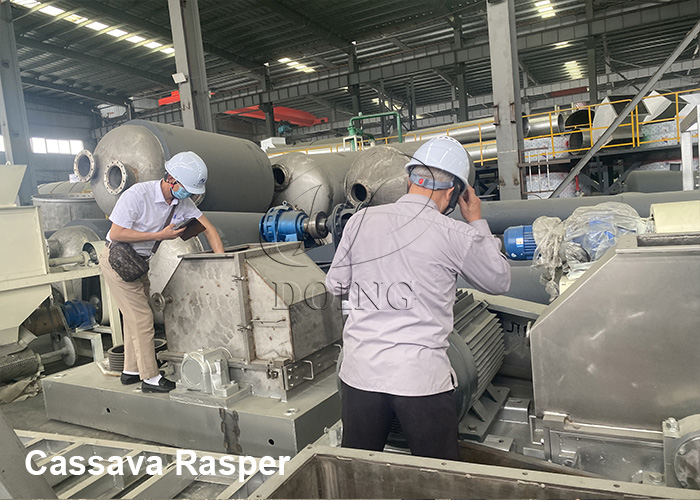 Cassava starch processing equipment for Thailand project
A Real Upgrade Example: 10-Year-Old Cassava Starch Plant in Thailand
A real Thai project shows why an old cassava starch plant upgrade should begin with equipment evaluation rather than automatic replacement. In August 2019, the chairman and a factory engineer from a Thai cassava starch plant that had operated for about 10 years visited Jinrui Foodtech to discuss renovation and capacity expansion.
Equipment evaluation: Engineers assessed the old equipment individually to determine which machines should be replaced and which could still be upgraded.
Process redesign: Based on the usable equipment, Jinrui Foodtech developed a new technical process scheme that removed outdated sections and incorporated the equipment that could still be used.
Layout integration: Using the customer's workshop drawings, engineers designed a new equipment layout so the upgraded equipment could fit the existing factory.
Reference project: Before making the final decision, the customer reviewed the previous year's Indonesian starch factory upgrade project, including before-and-after comparisons, and signed the contract the following day.
The lesson is simple: an upgrade should follow measured bottlenecks and usable equipment; targeted investment is more practical than automatically rebuilding the entire plant.
Thailand cassava starch plant upgrade project — 10-year-old line, equipment evaluation and layout redesign
FAQ: Procurement Decisions for Old Cassava Starch Plant Upgrades
What information should I prepare before asking a supplier to assess an old cassava starch plant?
Prepare the existing plant capacity, actual daily output, equipment list, current process flow, workshop layout, target capacity, and the main production problems.
What is the difference between 30 TPD cassava input and 30 TPD starch output?
30 TPD cassava input means processing 30 tonnes of fresh cassava roots per day. 30 TPD starch output means producing 30 tonnes of finished starch per day. These are very different plant sizes and require different equipment configurations.
What is the typical lifespan of cassava starch processing equipment?
There is no single useful lifespan for every machine. Actual service life depends on operating hours, material wear, maintenance, corrosion, spare-parts availability and whether the machine can still meet the required process performance.
Do I need to change my existing workshop layout when upgrading?
Not necessarily. If the existing space, foundations, material flow and utility connections are compatible, part of the layout can remain. A new layout is needed when replacement equipment cannot fit the existing process flow safely or efficiently.
Plan Your Cassava Starch Plant Upgrade with the Right Equipment
An effective upgrade follows a simple sequence: diagnose the bottleneck → replace the right equipment → integrate new and existing sections → plan cost and downtime.
If you are planning a cassava starch plant upgrade, provide:
Existing plant capacity and actual output
Target capacity
Existing equipment list
Current process flow
Workshop drawings or layout
Main production problems
Required product quality
With these details in hand, the upgrade assessment can start from your actual plant rather than a generic quotation.
Jinrui Foodtech can use these project details to assess which equipment should be retained, upgraded or replaced and develop a suitable cassava starch processing equipment configuration for the existing plant.