

Replacing an Old Cassava Grater: How Can I Upgrade My Cassava Flour Production Line?
When your cassava grater fails, you do not have to tear down and rebuild the whole production line. Replacing it with a properly sized, compatible new rasper fixes the output loss and restores throughput — the rest of the line keeps running as it is.
Before you order anything, you need to answer five questions: decide whether to repair or replace, confirm the new machine fits your existing setup, select the right specifications, swap it in with minimal downtime, then check the stages downstream before going back to full load.
1. Repair or Replace: How to Decide
Before you look at any new machine, check whether your current rasper is worth saving.
| Situation | Recommendation |
| Motor, frame, and bearings are intact; blade sharpness and screen condition are moderate | Repair — replace blades and screen |
| Blades are deeply worn or chipped; screen has holes or tears; spindle is bent or housing is cracked | Replace — repair cost will exceed replacement value within two years |
| Output dropped because the rasper was always the wrong model for your variety | Replace — new blades will not fix a fundamental mismatch |
If the machine is worth repairing, changing blades and the screen is fast and inexpensive. It will not fix a rasper whose frame is too small for your target throughput or whose motor cannot handle your variety’s fiber load.
2. Four Checks Before You Order a New Rasper
A new rasper that is the right model but the wrong fit will force changes to the rest of your line. Confirm all four before you commit.
| Check | What to verify | If it does not match |
| Motor power and speed | Nameplate kW and rpm; new rasper must be at or below current motor rating | Upgrade the motor at the same time |
| Feed and discharge port dimensions | Hopper height and width; outlet size for the next stage | Fabricate adapters or modify chutes |
| Belt and pulley setup | Number of belts, pulley diameters, center distance | Change pulley ratio or belts at the same time |
| Target daily throughput | Tonnes per day ÷ operating hours = required t/h rate | Order the correct capacity — not larger |
3. How to Choose the Right New Rasper
Three factors determine whether the machine will work in your line. Everything else is secondary to these.
Throughput match. Divide your daily tonnage target by your operating hours to get the required hourly rate. Order a rasper rated at or slightly above that figure — not significantly above. An oversized rasper runs poorly at low load and costs more than you need.
Blade and screen for your variety and product. High-fiber tropical cassava varieties quickly wear out mild steel blades — specify harder alloys or tungsten tips. For a finer cassava flour product, use a finer screen aperture; for coarser product, a coarser screen reduces power draw and extends blade life.
Physical and drive compatibility. Frame width, hopper opening, shaft height, and pulley configuration must fit your existing infrastructure. Get the dimensional drawing from the supplier before ordering and check it against your floor plan.
Jinrui Foodtech supplies rasping equipment for cassava flour lines in a range of capacities and can confirm match against your existing frame and motor specs before you order.
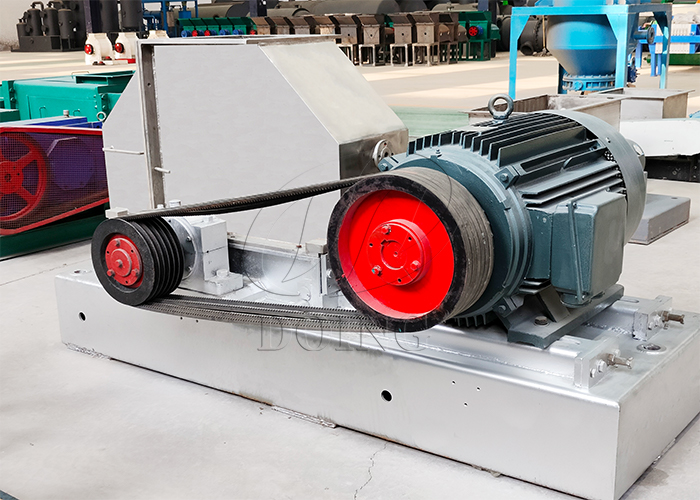 The new rasper from Jinrui Foodtech
4. How to Replace Without Rebuilding the Whole Line
Once the new rasper is selected and confirmed to fit, follow these steps in order.
Step 1 — Isolate power and prepare the site. Lock out and tag out the electrical supply. Photograph the existing installation from multiple angles — belt routing, wiring, and bolt positions — before removing anything.
Step 2 — Remove the old rasper. Unbolt the frame from the mounting plate. Disconnect motor leads and belt drive. Lift the machine out whole to keep the mounting footprint undisturbed.
Step 3 — Prepare the mounting surface. Clean the base plate. Check that the bolt hole pattern matches the new machine — if it does not, you will need minor welding or new anchor bolts, which adds at least a day.
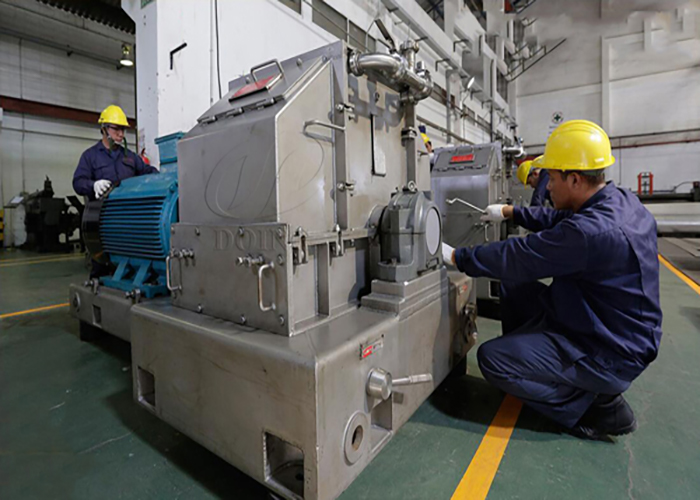 The installation of the cassava grating machine
Step 4 — Install and connect the new rasper. Set the machine in place and torque anchor bolts to spec. Route and tension the drive belts. Connect motor leads and verify the phase rotation matches the arrow on the housing.
Step 5 — Run no-load tests. Energize and run the drum at full speed with no feed for five minutes. Listen for abnormal noise, check for vibration, and verify direction of rotation. Stop immediately if you hear grinding.
Step 6 — Load test and commission. Feed at half the target rate for thirty to sixty minutes. Monitor motor current, temperature, and output consistency. Adjust blade clearance and feed rate before going to full load.
Jinrui Foodtech can also provide installation guidance and commissioning support if your team has not handled this type of swap before.
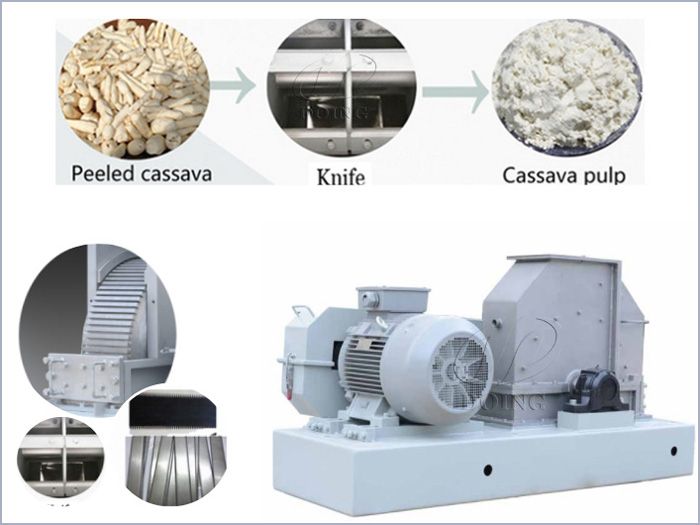 The details of the cassava grater
5. After the Rasper Is In, What Else to Check
A new rasper changes the conditions for every stage downstream. Check three areas in the first few runs.
| Stage | What to watch | What to do if you see a problem |
| Dewatering and drying | Finer pulp from a sharper rasper holds more surface moisture; the dryer may need adjustment | Reduce throughput slightly or raise dryer temperature or residence time |
| Belts, bearings, and drive | The new machine has a different weight and dynamic balance; belt tension and bearing loads change | Retension belts; relubricate bearings; check motor foundation stability |
Motor protection settings | A new rasper can draw a different starting current | Adjust overload relay or VFD settings to match the new nameplate current |
6. Frequently Asked Questions
What should I confirm with the supplier before I sign, to avoid a mismatch?
Get three items in writing before you commit: the motor nameplate kW and rpm — confirm it is at or below your existing motor rating. The frame dimensional drawing — compare bolt hole pattern and shaft height against your current mounting plate. The drive pulley ratio — confirm it works with your existing motor speed and belt setup. If any of these is missing from the supplier’s quote, that is the signal to push back before signing.
How do I tell whether the new rasper is performing better than the old one?
Weigh the output mash at the rasper outlet over a fixed time period — same cassava variety, same batch size. Compare against a baseline you recorded before the swap. A finer, heavier starch-rich fraction and cleaner fiber at the outlet are the two signs the new rasper is performing better.
How long does installation and commissioning take?
A targeted rasper swap with no structural changes typically takes one to three days from shutdown to first full load run. Adding motor upgrades or custom adapters extends that window.
What are the most common rasper failures after start-up?
Watch for four failure patterns: bearing overheating, blade chipping or premature dulling, belt slippage, and screen blockage. Catching these in the first shifts prevents unplanned downtime.
Do I need to replace the motor at the same time?
Not necessarily. If the existing motor’s power and speed match the new rasper’s requirements, keep it. If the new rasper demands more power than the motor can deliver, replace or upgrade the motor at the same time — otherwise the motor will limit the rasper’s performance or fail prematurely.
What should I confirm with the supplier before I sign, to avoid a mismatch?
Get three items in writing before you commit: the motor nameplate kW and rpm — confirm it is at or below your existing motor rating. The frame dimensional drawing — compare bolt hole pattern and shaft height against your current mounting plate. The drive pulley ratio — confirm it works with your existing motor speed and belt setup. If any of these is missing from the supplier’s quote, that is the signal to push back before signing.
How do I tell whether the new rasper is performing better than the old one?
Weigh the output mash at the rasper outlet over a fixed time period — same cassava variety, same batch size. Compare against a baseline you recorded before the swap. A finer, heavier starch-rich fraction and cleaner fiber at the outlet are the two signs the new rasper is performing better.
How long does installation and commissioning take?
A targeted rasper swap with no structural changes typically takes one to three days from shutdown to first full load run. Adding motor upgrades or custom adapters extends that window.
What are the most common rasper failures after start-up?
Watch for four failure patterns: bearing overheating, blade chipping or premature dulling, belt slippage, and screen blockage. Catching these in the first shifts prevents unplanned downtime.
Do I need to replace the motor at the same time?
Not necessarily. If the existing motor’s power and speed match the new rasper’s requirements, keep it. If the new rasper demands more power than the motor can deliver, replace or upgrade the motor at the same time — otherwise the motor will limit the rasper’s performance or fail prematurely.
7. Get a Rasper Replacement Assessment
A rasper change that is not planned correctly costs you in downtime, rework, and parts that do not fit. Send Jinrui Foodtech your current rasper model, daily throughput target, and product specifications — we will provide a match assessment and a replacement plan built around your existing line.