

How to Reduce Water Use and Wastewater in Potato Starch Extraction: A Complete Equipment Guide
Potato starch extraction is one of the most water-intensive processes in the food processing industry. A traditional line can consume 2 to 3 tons of fresh water per ton of raw potatoes, generating large volumes of wastewater with high organic load (COD/BOD) that must be treated before discharge. For plant owners facing increasingly strict environmental regulations, the challenge is not just how to treat wastewater at the end of the pipe, but how to reduce water consumption at every stage of the production process.
The solution lies in a smarter equipment configuration that follows three core principles: dry cleaning first, countercurrent washing, and closed-loop water recycling. By redesigning the flow from raw material intake to starch dewatering, you can cut fresh water consumption by 25–50% while simultaneously lowering the organic load of your wastewater, making end-of-pipe treatment far more manageable. The sections below walk through each stage of the potato starch extraction process, explaining the equipment choices and operational strategies that deliver the greatest water savings without compromising starch quality or extraction efficiency.
1. Raw Material Cleaning: Choose the Right Feeding Method
The cleaning stage is where the largest volume of water is consumed in a potato starch line. Choosing the correct feeding and cleaning method based on your raw material condition and production scale is the first step toward water savings.
| Feeding Method | Equipment Configuration | Best For | Water Consumption |
|---|---|---|---|
| Dry Feeding | Dry sieve → Drum washer | Small to medium capacity; potatoes with low soil content; dry season harvesting | Lower |
| Wet Feeding | High-pressure water flushing → Destoner | Large-capacity plants; potatoes with heavy clay/mud; rainy season harvesting | Higher |
Dry feeding is the more water-efficient option and is particularly well-suited for small to medium-capacity processing lines. Raw potatoes first pass through a dry sieve that removes stones, soil clumps, and vine residues without using any water. The pre-cleaned potatoes then enter a drum washer for secondary washing, where rotating action and a controlled amount of water remove remaining surface dirt. This two-stage approach (dry + wet) significantly reduces total water demand compared to traditional full-immersion washing.
Wet feeding is typically used in large-capacity potato starch processing plants where automation and throughput are prioritized. It is also necessary when potatoes are harvested during the rainy season or come from clay-heavy regions where mud sticks tightly to the skin. In this configuration, potatoes are flushed with high-pressure water in a collection yard and transported via hydraulic trough to a destoner that removes heavy impurities. While this method uses more water upfront, it ensures thorough cleaning of heavily soiled raw material at high processing speeds.
Jinrui Foodtech (Henan Jinrui) helps clients evaluate their raw material sourcing patterns, production capacity requirements, and local climate conditions to recommend the most suitable feeding method, balancing cleaning effectiveness with water conservation.
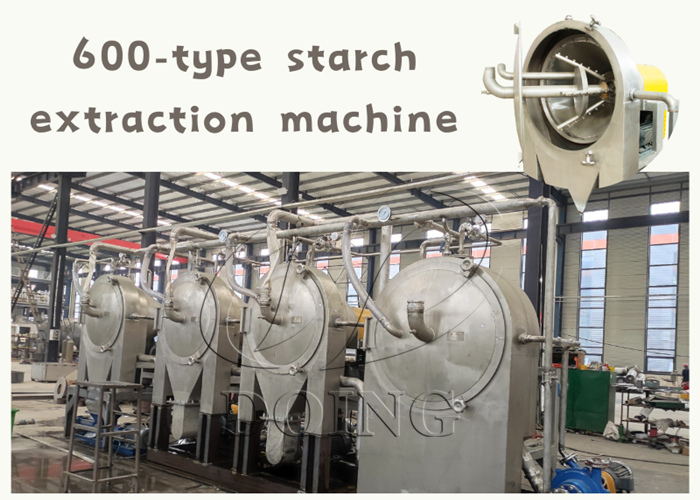 Potato starch extraction machine
2. Grinding and Fiber Washing: Countercurrent Washing Saves Water
After cleaning, potatoes are fed into a rasper (grinder) that crushes the cells to release starch granules. The rasper’s grinding efficiency directly affects the overall starch extraction rate — a well-maintained rasper can achieve a grinding rate above 94%, ensuring maximum starch release from the potato cells.
The key to water savings at this stage is how you handle the washing water during fiber (pulp) separation. Instead of using fresh water at every washing step, a water-saving line employs multi-stage centrifugal sieves (typically 4 stages) with a countercurrent washing process:
Clean process water is introduced only at the final sieve stage.
The overflow water from each stage flows backward to the previous stage, washing the fiber multiple times before being discharged.
This cascading reuse means the same volume of water does multiple jobs, dramatically reducing the total fresh water required.
The result is that fiber leaves the system with minimal residual starch, while the volume of wastewater generated is concentrated into a smaller flow with higher organic content — which is actually easier and cheaper to treat downstream.
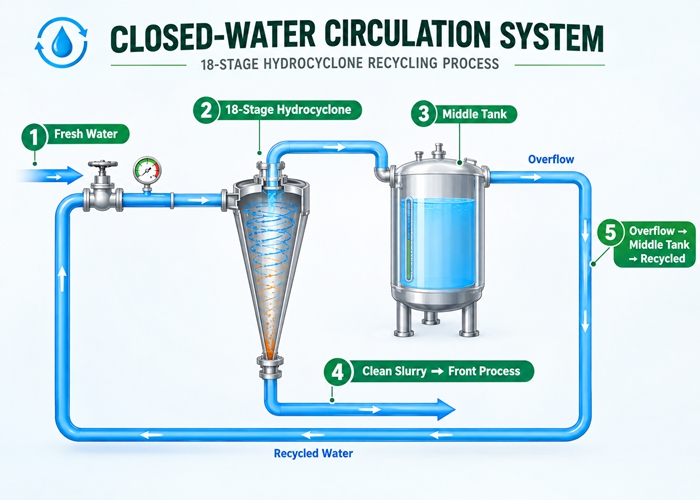 Hydrocyclone stations
3. Starch Refining: Multi-Stage Hydrocyclone Refining with Closed-Loop Recycling
The hydrocyclone station is the heart of any water-saving potato starch line. This is where the closed-loop water recycling concept becomes operational.
The number of hydrocyclone stages is a trade-off between purification quality and capital/operating cost. Too few stages mean insufficient washing — soluble proteins and fine fibers remain in the starch milk, lowering purity. Too many stages increase equipment cost, floor space, and pumping energy without proportional gains in quality. Based on this balance, Jinrui Foodtech’s standard configuration is 18 stages, which delivers starch purity up to 99.5% while keeping water consumption and energy use within an efficient range. The working principle is as follows:
Fresh clean water is introduced only at the final (18th) stage to wash the purified starch milk to food-grade quality.
The overflow from each stage — containing residual starch, soluble proteins, and fine fibers — flows backward to the previous stage for reuse.
All overflow water from the hydrocyclone station, along with filtrate from the vacuum dewatering machine and condensate from the airflow dryer, is collected in a centralized intermediate tank (sump).
This recycled process water is then pumped back to the front end of the line for fiber washing and, in some configurations, even for initial potato cleaning.
This closed-loop design means that a significant portion of the water used in the line never leaves the system. In Jinrui Foodtech’s delivered projects, fresh water consumption is typically reduced from the traditional 2–3 tons per ton of raw potatoes to approximately 1.3 tons per ton after recycling.
4. Dewatering: Minimize Wastewater from Solid By-Products
The final step in reducing wastewater discharge is ensuring that solid by-products — both starch and potato pulp — leave the processing line with minimal moisture content, so they do not continuously leak polluted juice into the drainage system.
Vacuum Dewatering Machine: For the refined starch milk, a vacuum dewatering machine reduces the moisture content of wet starch to approximately 36.5%–38%. The filtrate from this process is clear and free of large particles, allowing it to be fully recycled back into the hydrocyclone system — resulting in zero wastewater discharge from this specific stage.
Pulp Dewatering: The separated potato pulp (fiber) should also be dewatered using a screen or press. Dry pulp is easier to transport and can be sold as animal feed or biomass compost, turning a potential pollution source into a revenue stream.
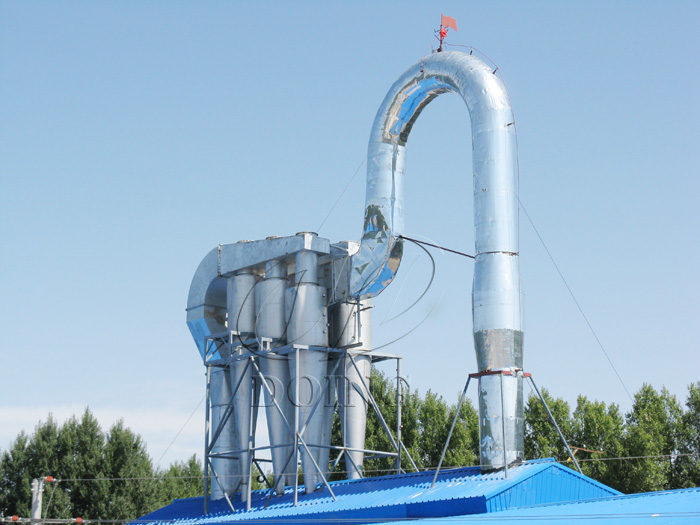 Potato starch drying machine
5. Factory Layout: Design for Water Circulation from Day One
A water-saving equipment setup is only as effective as its integration into the overall factory layout. When designing a potato starch plant, it is critical to reserve space for intermediate tanks (sumps) and piping systems that allow process water to flow naturally between stages.
Key layout considerations include:
Centralized collection: All overflow water from centrifugal sieves, hydrocyclones, and dewatering machines should be piped into a central collection tank.
Recycling pump system: A dedicated pump system sends this recycled water back to the front-end cleaning and washing stages.
Sedimentation tank: For factories that cannot achieve full closed-loop recycling, a sedimentation tank provides a cost-effective way to recover and reuse process water, especially for smaller-scale operations.
Jinrui Foodtech provides complete layout design services, ensuring that the water circulation system is optimized for both operational efficiency and ease of maintenance.
Traditional vs. Water-Saving Configuration: A Comparison
| Aspect | Traditional Configuration | Water-Saving Configuration |
|---|---|---|
| Cleaning Method | Full-immersion washing | Dry sieve + drum washer (dry feeding) |
| Fiber Washing | Fresh water at each stage | 4-stage countercurrent washing |
| Starch Refining | Simple sedimentation or low-stage cyclones | 18-stage hydrocyclone with closed-loop recycling |
| Water Consumption | 2–3 tons per ton of raw potatoes | ~1.3 tons per ton after recycling |
| Wastewater Volume | High volume, dilute organic load | Lower volume, concentrated organic load (easier to treat) |
| Starch Purity | Variable, depends on operator skill | Up to 99.5% with 18-stage hydrocyclone |
| By-Product Value | Pulp often discarded as waste | Dewatered pulp sold as feed/compost |
FAQ: Water-Saving Potato Starch Extraction
What is the biggest source of wastewater in a potato starch line?
The largest source of wastewater is the raw material cleaning stage, where traditional full-immersion washing consumes the most fresh water. The second major source is the fiber washing stage if countercurrent washing is not implemented. By switching to dry feeding and installing multi-stage centrifugal sieves with countercurrent washing, you can address both of these high-volume wastewater sources at once.
Does reducing water use affect the quality or purity of the starch?
No. In fact, the 18-stage hydrocyclone configuration achieves a starch purity of up to 99.5% by effectively removing soluble proteins, fine fibers, and other impurities through efficient countercurrent washing. The closed-loop system ensures consistent washing quality across all production batches.
What happens to the wastewater that is still produced?
Even with water-saving measures, some wastewater with high organic content (COD) will be generated, primarily from the initial cleaning and protein separation stages. This wastewater should be directed to a sedimentation tank or a biological treatment system (such as a UASB anaerobic reactor) before discharge. By reducing the total volume of wastewater through recycling, you significantly lower the load and cost of your end-of-pipe treatment.
Can this water-saving setup be retrofitted into an existing old factory?
Yes, but it requires careful engineering. The key upgrades are installing multi-stage centrifugal sieves and an 18-stage hydrocyclone station to support countercurrent washing, and building the necessary intermediate tanks and piping for water recycling. Jinrui Foodtech can assess your existing line and provide a retrofit plan to maximize water savings with minimal production disruption.
Reduce Your Water Costs and Meet Environmental Standards
A water-efficient potato starch extraction line is no longer optional — it is a necessity for any processor who wants to remain compliant with environmental regulations while keeping production costs under control. By choosing the right cleaning method, implementing countercurrent washing, installing an 18-stage hydrocyclone system, and designing your factory layout for water circulation from the start, you can cut fresh water consumption by up to 50% and significantly reduce your wastewater treatment burden.
Whether you are building a new factory or retrofitting an existing line, the right equipment configuration makes all the difference. Jinrui Foodtech provides customized potato starch processing solutions tailored to your raw material characteristics, production capacity, and local environmental requirements.
Contact us today to request a free consultation and a customized equipment proposal for your potato starch extraction line.