

Cassava Starch vs. Flour Processing Line in West Africa: Which Fits Your Market?
Choosing between a cassava starch line and a cassava flour line is not about which product is better. For a project in Nigeria, Ghana, or another West African market, the right choice starts with three things: who will buy the product and what specifications they require, whether fresh roots or dried cassava chips are reliably available, and whether the site can support the selected processing route.
Confirm your buyer before you choose a line. Then check your raw material supply and site conditions. The sections below first explain how starch and flour processing lines differ, then use these three factors to show which line fits your market.
The Difference Between Cassava Starch and Cassava Flour Production Lines
Cassava starch and cassava flour are different products, so their processing lines are designed around different processing principles and buyer requirements.
| Item | Cassava Starch Processing Line | Cassava Flour Processing Line |
| Main raw material | Fresh cassava roots | Fresh cassava roots or dried cassava chips |
| Main processing principle | Wet extraction, separation, purification and drying | Drying and milling, or direct milling of dried chips |
| Typical product | Food-grade or industrial cassava starch | Cassava flour / HQCF |
| Main quality factors | Purity, whiteness, viscosity, moisture, ash | Particle size, moisture, cyanide, microbiological quality |
| Water requirement | High | Lower for dried-chip route |
| Main buyer groups | Food ingredient manufacturers, textile, paper, adhesives and other industrial users | Flour blenders, food processors, wholesalers and regional food markets |
The key distinction is the processing route. Cassava starch requires fresh roots and a wet extraction process, while cassava flour can be produced from either fresh roots or dried cassava chips. This difference affects raw-material logistics, water demand, equipment configuration and the type of buyer the project can serve.
Which Is Better for West Africa?
Buyer Demand and Specifications: Who Will Buy Your Product?
The first question is not which product is easier to process, but who will buy it and what specifications they require. Different buyer groups create different product requirements, which directly affects whether a starch or flour line makes commercial sense.
| Buyer type | What they purchase | Key specifications they check | Product direction |
| Industrial users (textile, paper, adhesives, etc.) | Industrial-grade starch | Purity, viscosity, whiteness, ash | Starch |
| Food ingredient manufacturers | Food-grade starch | Whiteness, microbiological quality, moisture, heavy metals | Starch |
| Flour blenders / food processors | Cassava flour / HQCF | Particle size (60 mesh), moisture, cyanide | Flour |
| Wholesalers and regional food markets | General cassava flour | Moisture, packaging, price | Flour |
| Breweries and other downstream factories, where applicable | Starch or flour raw materials | Contract volume and delivered specifications | Depends on specification |
For flour buyers, demand may come from both established food markets and broader food-processing applications. In Nigeria, cassava-flour demand also has a policy dimension: the Senate advanced a bill in late 2024 to mandate 20% high-quality cassava flour inclusion in wheat flour produced in or imported into Nigeria, (Note: this remains a proposed policy/legislation, not yet fully enacted and enforced) — a potential demand driver for food-grade cassava flour beyond traditional markets.
Stable industrial or food-ingredient buyers support a cassava starch project; when demand comes mainly from food processors, wholesalers, and regional food markets, cassava flour is the more realistic product choice.
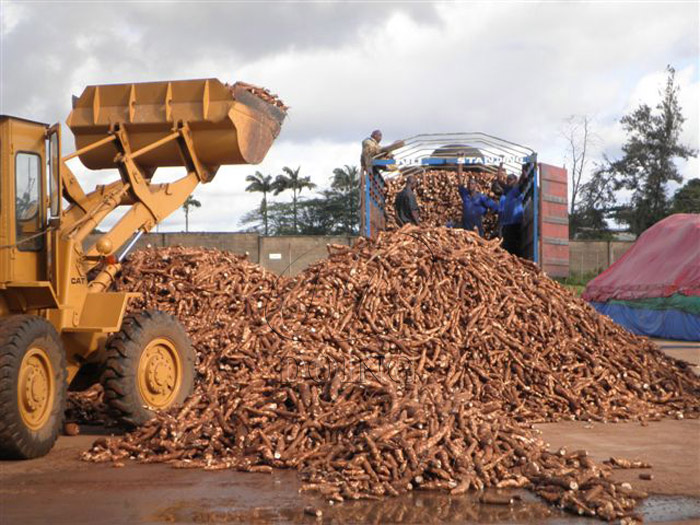 Cassava processing plant
Raw Material Supply: Fresh Roots or Dried Cassava Chips?
Once the product is selected, check which raw material you can secure consistently, because it determines the available processing route.
Starch requires fresh cassava roots. Flour gives you two options: fresh roots or dried cassava chips. A fresh-root flour line typically includes washing, peeling, grating, dewatering, drying, and milling, while a dried-chip route can start with cleaning and milling before sieving and packing.
Fresh-root logistics need tight control. IITA guidance indicates that high-quality cassava flour made from fresh roots should generally be processed within one or two days after harvest, with some HQCF guidance specifying completion within 24 hours. In West Africa, the rainy season can add another constraint: poor rural road conditions can make it harder to move fresh roots quickly, effectively reducing the practical collection radius.
Dried chips offer more flexibility for storageand transport. Ghana provides a documented example of commercial cassava-chip supply, including chip production for domestic and export markets, although market structures and trade opportunities vary by location.
Stable fresh-root supply with a controllable transport radius keeps both starch and fresh-root flour routes open; when only dried chips are reliably available, the dried-chip flour route is the practical choice and starch is ruled out.
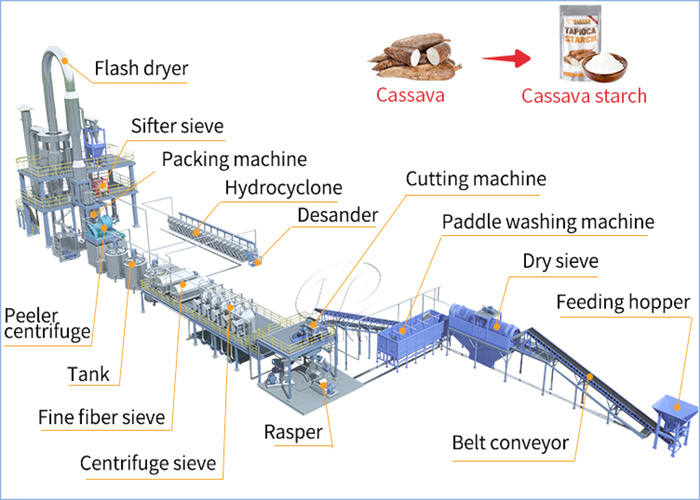 Cassava starch processing line
Water, Power and Site: Can Your Site Support the Line?
After choosing the raw-material route, verify that the site can support its utility requirements—because site conditions can rule out an otherwise suitable route.
Fresh-root processing needs water for cleaning, while starch requires substantially more because extraction, separation, and purification are wet operations. FAO data from different cassava-processing regions report starch-processing water consumption of roughly 5.5–18 m³ per tonne of fresh roots, depending on the process and location. A dried-chip flour route largely avoids these wet-processing stages.
For the site itself, check water availability, wastewater treatment, available installation area, raw-material receiving and storage space, finished-product storage, truck access, and the location of power connections. These factors should be confirmed before finalizing the equipment configuration.
A site with sufficient water and wastewater treatment can support a wet-process starch line; water shortages favor a dried-chip flour route, while an unstable grid makes backup power for drying a hard requirement.
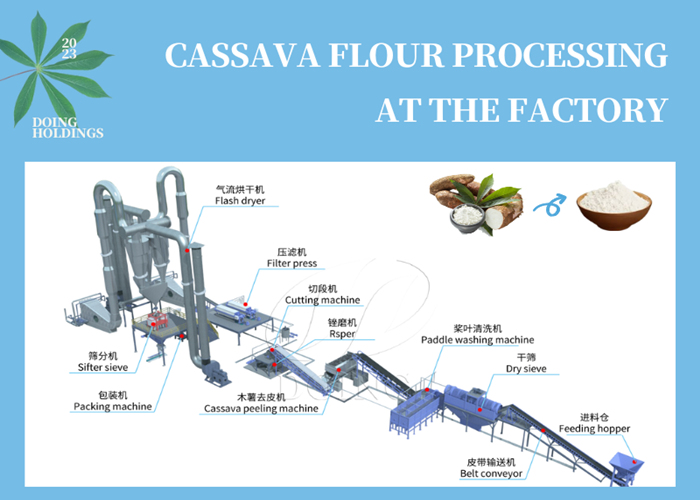 Cassava flour processing plant
Starch or Flour: Which West African Scenario Fits Each Line?
Three common project patterns can help narrow the choice:
1. Stable fresh-root supply + industrial or food-ingredient buyers + suitable water treatment conditions → cassava starch line.
2. Reliable dried-chip supply + direct demand for cassava flour → dried-chip flour line.
3. Stable fresh-root supply + limited industrial starch buyers + strong food-market demand → fresh-root flour line.
These scenarios show how the three conditions work together: the buyer selects the product, the available raw material selects the practical route, and the site determines whether that route can operate reliably.
In West Africa, choose the line that matches the buyer, raw material route, and site conditions: industrial demand plus reliable fresh roots and adequate wet-processing utilities point to starch, while food-market demand or reliable dried-chip supply points to flour.
FAQ
What should I ask a cassava flour equipment supplier before choosing the processing route?
Ask the supplier to confirm which raw materials the proposed line can process, the required pretreatment and drying steps, expected product specifications, and whether the configuration can handle your planned capacity. Also request a process flow and equipment list so you can compare the proposed route with your actual raw material supply and market requirements.
Can a cassava processing line be expanded later?
Yes, but expansion should be considered during the initial layout and equipment selection. Leave sufficient space for additional processing equipment, utilities, storage and material handling. The existing drying, milling, electrical and wastewater systems should also be checked for expansion capacity. Designing only for the first phase can make later upgrades more expensive.
If I plan to sell cassava starch to industrial buyers in Nigeria, what should I verify before ordering the line?
Verify the buyer contract volume, delivered product specifications, payment terms, and the number of alternative buyers available. Do not size or order a complete starch line based on one verbal expression of interest. Confirm that the expected demand is commercially committed and technically compatible with the planned starch grade.
When is a combined starch and flour line worth considering?
A combined starch and flour line is worth considering only when both buyer groups are confirmed and each product can support an economic production scale. It requires more complex front-end equipment planning and higher investment than a single-product line. If one product has no confirmed market, a dedicated line is usually the simpler project basis.
Get a West Africa-Specific Production Line Configuration
For a West African cassava project, the choice between a starch and flour processing line ultimately depends on three factors: who will buy the product, which raw material you can secure consistently, and whether your site can support the required processing route. Confirming these conditions first helps avoid selecting a line that does not match the actual market or local operating conditions.
Jinrui Foodtech, formerly Henan Jinrui, is a cassava processing equipment manufacturer serving overseas cassava-processing projects since 2011, with a Nigeria branch and warehouse serving the West African market. Instead of providing a one-size-fits-all quotation, we can provide an initial process-route assessment and major equipment configuration based on your raw material form, target product, and planned capacity.
If you are still unsure whether a cassava flour or cassava starch line fits your market, send us these four details — country, raw material form, target product, and target capacity — and Jinrui Foodtech will provide an initial process-route assessment for your project.