

Cassava Flour Processing Machine Price: How Much Does a Production Line Cost?
Planning to invest in a cassava flour production line? The price typically ranges from $25,000 for small-scale single machines to over $800,000 for large-scale fully automatic production lines. The exact cost depends on your capacity requirement, automation level, and equipment configuration. As a professional manufacturer with years of experience supplying cassava processing equipment to Africa and Southeast Asia, Henan Jinrui breaks down the price structure to help you plan your investment wisely.
Compared to dry processing, the wet processing method produces cassava flour with significantly finer texture, higher purity, and more consistent color—making it the preferred choice for food-grade applications and export markets that require strict quality standards. Henan Jinrui wet cassava flour production line consists of three main stages:
Stage 1: Cleaning
Raw cassava roots are fed through a dry sieve to remove stones and debris, followed by a paddle washer for thorough cleaning. This step ensures that sand and impurities do not affect the final product quality.
Stage 2: Processing
Clean cassava goes through a peeler to remove the outer skin, a rasper to crush the roots into a fine slurry, and a filter press to remove excess moisture. Proper processing is critical for achieving fine, uniform flour.
Stage 3: Drying and Packaging
The pressed material is dried in a flash dryer to achieve the target moisture content, passed through a sieve for uniform fineness, and finally packed by an automatic packaging machine.
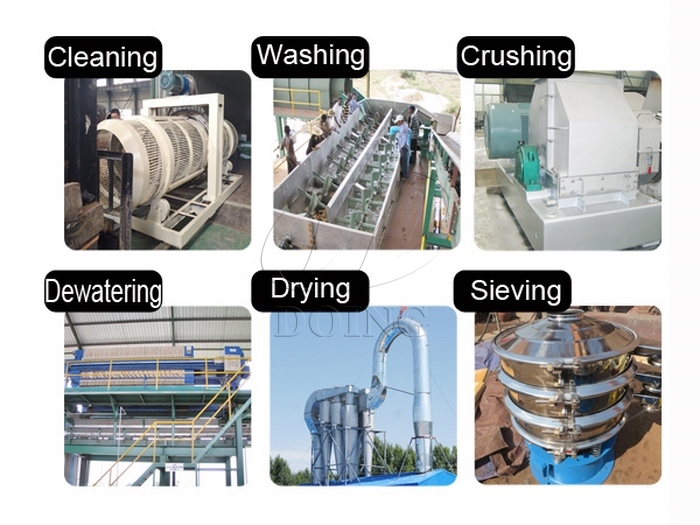 The ful process of cassava flour production
After understanding the production process, you will need to determine what capacity and automation level fits your business goals and available budget.
Selecting the right configuration depends on your production scale, budget, and target market. Use the table below to find the best fit for your project:
| Your Situation | Recommended Capacity | Recommended Automation | Why This Works for You |
| Starting small, testing the market | 1–2 tons/day | Single machines / Manual | Low initial investment, flexible operation, easy to expand later |
| Small-scale factory with stable orders | 3–5 tons/day | Semi-automatic | Balanced investment and efficiency, reduced labor compared to manual |
| Medium-scale factory targeting local or export markets | 10–20 tons/day | Semi-automatic or fully automatic | Higher output, consistent product quality, suitable for food-grade standards |
| Large-scale industrial production for export | 1–10 tons/hour | Fully automatic | Maximum efficiency, minimal labor, stable quality for international buyers |
Once you have a configuration in mind, the next question most buyers ask is: how much will it cost? Below is a general price breakdown based on common setups.
Prices below are indicative ranges based on typical configurations. Final pricing depends on equipment specifications, materials, auxiliary systems, and shipping destination.
| Capacity | Automation Level | Price Range (USD) | Suitable For |
| 1 ton/day | Single machines | $25,000–50,000 | Small workshops, startups |
| 2–5 tons/day | Semi-automatic | $60,000–150,000 | Small to medium factories |
| 10 tons/day | Semi-automatic | $150,000–300,000 | Medium-scale production |
| 1 ton/hour | Fully automatic | $300,000–500,000 | Large-scale factories |
| 5–10 tons/hour | Fully automatic | $500,000–800,000+ | Industrial-scale production |
One of the most common questions we receive is: "Does this price include shipping? Installation? Training?" The answer depends on the configuration. Below is a clear breakdown.
| Item | Small Lines (1–5 t/day) | Medium Lines (10 t/day) | Large Lines (1–10 t/h) |
|---|---|---|---|
| Core processing equipment | ✅ Included | ✅ Included | ✅ Included |
| Electrical control system | ✅ Basic | ✅ PLC-based | ✅ Fully integrated |
| Motor and drive units | ✅ Included | ✅ Included | ✅ Included |
| Operator training | ✅ Remote guidance | ✅ On-site (2–3 days) | ✅ On-site (5–7 days) |
| Spare parts starter kit | ✅ Basic set | ✅ Extended set | ✅ Comprehensive set |
| International shipping | ⚠️ Quoted separately | ⚠️ Quoted separately | ⚠️ Quoted separately |
| Local customs clearance | ❌ Not included | ❌ Not included | ❌ Not included |
| On-site civil works | ❌ Not included | ❌ Not included | ❌ Not included |
| Local installation labor | ⚠️ Available on request | ⚠️ Available on request | ⚠️ Available on request |
| Extended warranty (beyond standard) | ⚠️ Available on request | ⚠️ Available on request | ❌ N/A |
Key clarification: The prices listed are FOB (factory gate / departure port). We provide a CIF quotation (Cost, Insurance, Freight) to your destination port — such as Lagos, Tema, Mombasa, or Jakarta — when you send us your capacity and delivery address.
What Affects the Final Price Beyond Capacity?
Two lines with the same capacity can differ in price by 30–50% depending on:
Material quality — 304 stainless steel vs carbon steel for food-contact parts
Control system — Manual switches vs PLC touch-screen with data logging
Brand of key components — Siemens vs domestic motors, Schneider vs basic electricals
Drying technology — Flash dryer vs belt dryer vs rotary dryer
Auxiliary equipment — Water recycling system, waste treatment, automatic feeding conveyors
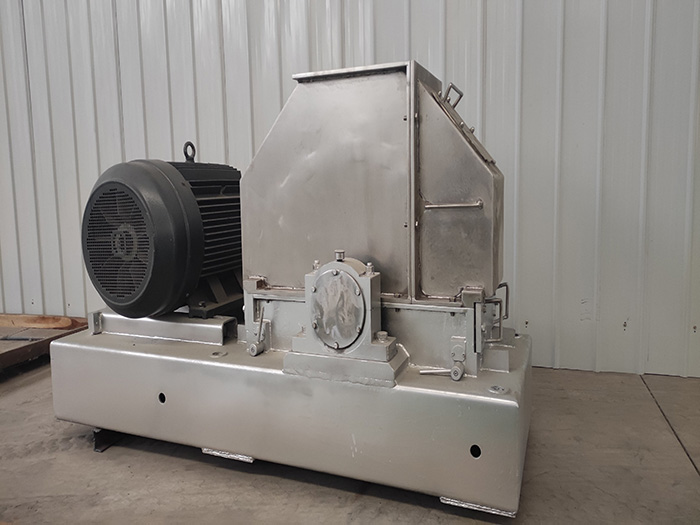 304 stainless steel cassava rasper
Investing in the right cassava flour processing line is critical to your business success. At Henan Jinrui, we offer end-to-end solutions—from process design and equipment manufacturing to installation, training, and after-sales support—with successful projects across Nigeria, Ghana, Indonesia, Thailand, and beyond. Our equipment meets CE and ISO standards, with food-contact parts made of stainless steel for guaranteed hygiene. Welcome to contact us today. We will provide you with a free customized quotation based on your capacity requirements, automation preferences, and budget.
Q1: Can the same line process both fresh and dried cassava?
A: Our wet processing line is designed specifically for fresh cassava roots. Dried cassava requires a different dry processing setup (cleaning → peeling→chipping/cutting → drying → milling → sieving). If you plan to process both fresh and dried cassava, we can discuss a flexible or combined configuration during the quotation stage — for example, a shared cleaning and milling section with separate drying paths for each material type.
Q2: How much floor space is needed to install the line?
A: A small 1–2 ton/day setup requires approximately 100–200 m². A 5–10 ton/day semi-automatic line needs 300–500 m². A large 5–10 ton/hour fully automatic line may require 1,000–3,000 m² depending on the layout and whether you include raw material storage, finished product storage, and auxiliary systems. We provide a plant layout diagram with your quotation based on your available space.
Q3: Do you have existing installation cases I can visit or see?
A: We have supplied cassava flour processing lines to customers in Nigeria, Ghana, Indonesia, Thailand, and several other countries. Depending on your location, we can arrange a visit to a reference plant or provide video walkthroughs of our installations. Contact us with your region and we will share the most relevant references.
Q4: What is the shipping cost to Nigeria / Ghana / Kenya?
A: Shipping costs depend on the total volume and weight of the equipment, the destination port, and current freight rates. As a reference, a 1–5 ton/day line (one 20ft container) to Lagos typically costs $2,000–$4,000 for sea freight. A 10+ ton/day line (one 40ft container or more) ranges from $4,000–$10,000. We include a CIF quotation with your proposal so you know the total landed cost before making a decision.