

Jinrui Foodtech Signs 3 TPD Modular Garri Processing Line Order in Cameroon
On October 30, 2026, Jinrui Foodtech (Henan Jinrui) successfully signed a contract for a 3 TPD modular garri processing line with a customer in Cameroon, receiving full payment on the same day. The order followed more than three months of communication, during which we worked with the customer to discuss equipment configurations, manufacturing quality, and future production expansion.
One of the customer's main concerns was whether the garri processing line could start with a relatively small capacity and expand as the business developed. Our modular garri processing solution, particularly the option to add more garri fryers in the future, matched this requirement and became an important factor in the customer's purchasing decision.
Cameroon Garri Project Background
We first received the customer's inquiry through our website on July 17, 2026. The customer, Marcell Food, operates a farm and a business in Cameroon and was purchasing a garri processing line on behalf of an end customer. Their plan was to begin with a daily output of 3 tons of finished garri, allowing the business to start production at a manageable scale before considering future expansion.
| Item | Detail |
|---|---|
| Project Country | Cameroon |
| Customer | Marcell Food |
| Customer Role | Purchasing equipment for an end customer |
| Equipment Ordered | 3 TPD Modular Garri Processing Line |
| Finished Garri Output | 3 tons per day |
| Initial Inquiry | July 17, 2026 |
| Contract Signing | October 30, 2026 |
| Payment Status | Full payment received |
Throughout our discussions, the customer focused on three important considerations: the initial investment, equipment quality, and whether the production line could accommodate future business growth. These requirements guided the equipment selection and discussions leading to the final order.
3 TPD Modular Garri Processing Line
For this Cameroon project, we provided a 3 TPD modular garri processing line designed to handle the main stages of cassava preparation, processing, frying, screening, and packaging. The equipment configuration covers eight processing sections, with a finished garri output of 3 tons per day.
The ordered equipment includes:
Dry Sieve: Removes loose soil, sand, and surface impurities from cassava roots before washing.
Paddle Washing Machine: Cleans the cassava roots and prepares them for the next processing stage.
Cassava Peeling Machine: Removes the outer peel from the washed cassava roots.
Cassava Crushing Machine: Crushes peeled cassava into mash for further processing.
Hydraulic Dewatering Machine: Removes excess moisture from the processed cassava mash.
Garri Fryer: Fries the dewatered cassava mash to produce garri.
Garri Sieving Machine: Screens the processed garri to obtain a more uniform product.
Packaging Machine: Packs the finished garri for storage and distribution.
The equipment arrangement was developed around the customer's initial production target while considering the possibility of future expansion. Rather than selecting a larger production line immediately, the customer could begin with the required 3 TPD capacity and plan additional frying capacity as the business developed. This flexible layout is the core of our modular garri processing line.
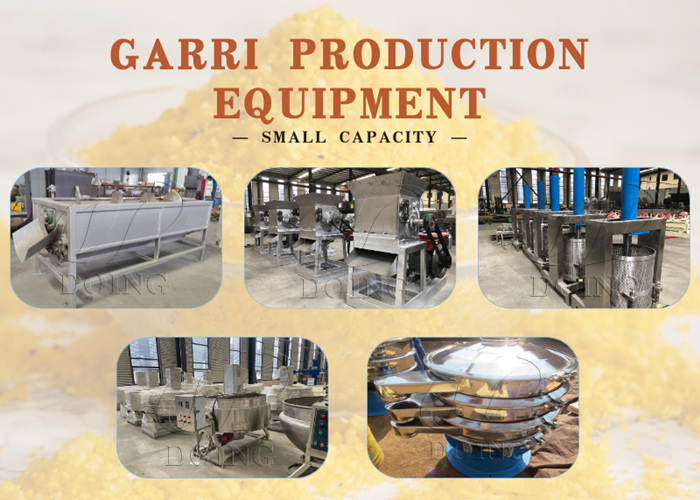 Garri processing line
Why the Customer Chose Jinrui Foodtech
During the procurement process, our customer compared equipment proposals from two other Chinese manufacturers and one local supplier in Cameroon. Besides price, the customer wanted to understand the manufacturer's actual capabilities, equipment materials, and ability to support future production expansion.
Through equipment discussions and an online factory tour, we provided the information needed for the customer to evaluate our proposed solution and manufacturing capabilities before making the final decision.
Modular Design for Future Expansion
As our discussions progressed, the customer raised an important question: Could the garri production line be expanded later without replacing the entire original system? Their end customer wanted to start with 3 tons of garri per day, gain operating experience, and increase production as the business grew.
The customer later suggested adding more garri fryers to increase output in the future. This aligned with the modular design of our garri processing line, which allows additional frying units to be considered when planning an expansion. We also discussed the importance of matching the frying capacity with the upstream processing sections, since the overall output would depend on the capacity of the complete line. With this expansion approach in mind, the customer could proceed with the initial investment while keeping future production growth in consideration.
Factory Tour and Equipment Quality
Since the customer was evaluating several equipment suppliers, we arranged an online video factory tour and equipment presentation to help them better understand our manufacturing capabilities. During the video session, we showed the factory and explained the equipment structures, processing functions, and proposed configurations, giving the customer an opportunity to assess the equipment beyond photographs and quotations.
Equipment material was another point of discussion. We introduced the SS304 stainless steel construction used in the proposed garri processing equipment, helping the customer understand the material specifications and equipment quality. Combined with our experience in overseas processing projects, the factory presentation and technical explanations provided a clearer basis for comparing the available suppliers. After evaluating the proposals, the customer decided to proceed with our equipment and completed full payment on October 30, 2026.
Project Progress and Next Steps
With the contract signed and full payment received, the Cameroon 3 TPD garri processing line project will move forward through the subsequent equipment supply stages.
This cooperation also reflects a practical consideration shared by many small and growing garri producers: choosing equipment that meets current production needs while leaving room for future development. For customers planning a similar garri production line, the initial capacity, equipment configuration, and potential expansion requirements should be evaluated together.
Planning to Start or Expand a Garri Processing Business?
Whether you are considering a small-scale garri production line or looking for a modular solution that can accommodate future expansion, contact Jinrui Foodtech with your required daily output, raw material conditions, and production plans. Our team can discuss a suitable equipment configuration for your project.