

How Much Does a Potato Starch Machine Cost in Pakistan? (2026 Investment Guide)
The cost of a potato starch machine in Pakistan is not a single number. A small automated processing line typically starts at around USD 150,000 (approximately PKR 42 million), while medium and large industrial plants can range from USD 250,000 to over USD 2 million (approximately PKR 70 million to PKR 560 million), depending on capacity, process depth, automation level and material standards.
This guide sets out current potato starch machine price ranges in Pakistan, the factors behind potato starch processing line cost, and what a full potato starch plant investment includes.
Potato Starch Machine Price Ranges by Project Scale
Potato starch processing lines are usually quoted as complete production systems, not as single machines. The final price depends on how much raw potato you plan to process each day and how complete the process chain needs to be.
| Project Scale | Typical Capacity | Price Range (USD) | Approx. Price (PKR) |
|---|---|---|---|
| Small automated line | Around 3 t/h raw potato | USD 150,000 – 200,000 | PKR 42M – 56M |
| Medium-scale line | 10–15 t/h | USD 250,000 – 800,000+ | PKR 70M – 224M+ |
| Large-scale plant | 20–30 t/h | USD 1,000,000+ | PKR 280M+ |
| Full industrial plant | 50 t/h and above | Can exceed USD 2,000,000 | Can exceed PKR 560M |
Note: PKR conversions are approximate based on a reference rate of 1 USD approx 280 PKR and should not be used for financial decisions. Please confirm current exchange rates with your bank or financial institution.
A small automated line is often suitable for regional processing or new market entry in Pakistan's potato-growing regions such as Khyber Pakhtunkhwa, Punjab or Gilgit-Baltistan. Medium-scale lines can support more stable daily production, while large-scale plants are usually designed for continuous operation, higher extraction efficiency and commercial supply to food, industrial or export markets.
For reference, Jinrui Foodtech (Henan Jinrui) has delivered a 30-ton-per-hour potato starch production line in Jiaozuo, China, representing the scale of a larger industrial plant. Such projects usually require more complete pre-treatment, refining, drying and wastewater handling systems, which is why their investment level is significantly higher than small lines. Buyers in Pakistan can use this project as a benchmark for high-specification configurations when evaluating suppliers.
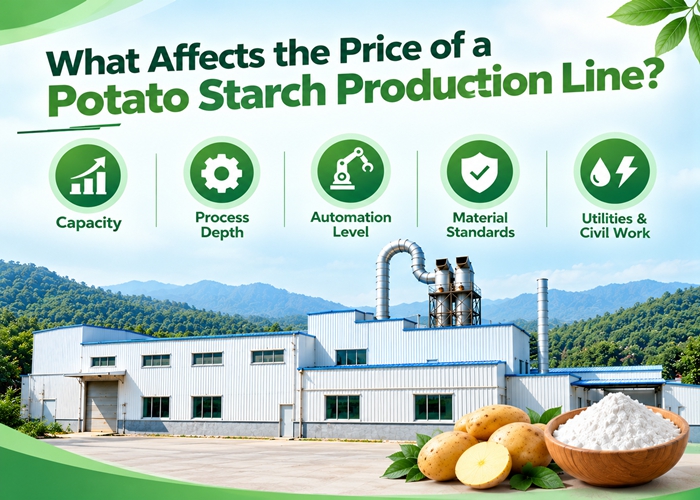 Factors driving potato starch equipment price
Five Key Factors That Drive Potato Starch Equipment Pricing
Two suppliers may give very different prices even for the same nominal capacity. That is because a potato starch processing line is made up of many subsystems, and the final configuration determines the cost.
Capacity and Throughput
Raw potato throughput is the most direct price driver. A 3 t/h line and a 30 t/h line do not differ by equipment size alone. Larger capacity requires bigger crushers, larger screening areas, more centrifuges, higher-capacity dryers and stronger utility support.
Capacity also affects civil work. For example, a 20 t/h potato starch line may require a workshop of around 54 × 18 metres, while a 30 t/h line may need roughly 72 × 18 metres. These dimensions are project-specific, but they show why larger plants cannot be priced as simple multiples of smaller ones.
Jinrui Foodtech offers potato starch processing lines across a wide capacity range – from small automated lines starting at around 3 t/h up to large-scale industrial plants exceeding 30 t/h – allowing buyers in Pakistan to select a configuration that matches their available potato supply and production targets.
Process Depth and Product Standards
The price changes depending on what the line is expected to produce. A basic line may only wash, crush, extract and dry native potato starch. A more complete system can also include:
Multi-stage washing and sieving
Fine fibre separation
Multi-stage hydrocyclone refining
Protein water recovery
Starch drying and packaging
By-product handling
Higher product standards also raise equipment requirements. When buyers need higher purity, better whiteness, lower moisture or more stable viscosity, the refining section, drying system and control parameters become more demanding.
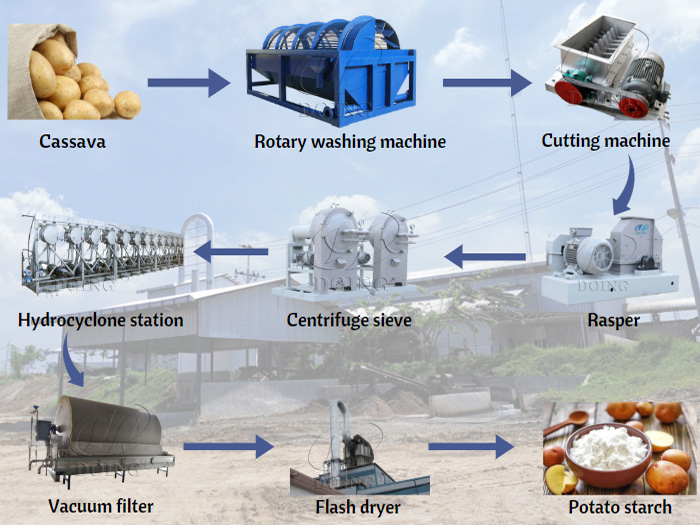 Potato starch production line
Automation Level
Semi-automatic lines may rely more on manual feeding, local control and operator judgment. Fully automatic lines usually include a PLC control system, interlock protection, fault alarms and centralised monitoring.
Higher automation increases the initial equipment cost, but it can reduce labour dependence, improve process stability and help maintain consistent starch quality. For buyers planning long-term operation in Pakistan, automation level is often more important than the lowest possible purchase price.
Material Standards and Durability
Equipment that contacts potato slurry, starch milk or process water should use food-grade materials. Jinrui Foodtech potato starch processing lines are built with food-grade stainless steel components in contact with product-facing parts, improving corrosion resistance, hygiene performance and service life compared to lines that use more carbon steel.
A lower-priced line may use more carbon steel or thinner plates. A higher-specification line usually has a higher proportion of stainless steel in critical sections such as refining, dewatering, drying and product conveyance. The right choice depends on product requirements, local maintenance conditions in Pakistan and expected service life.
Utilities and Civil Work Scope
A potato starch plant needs more than processing machines. Depending on the project, the following items may also affect the total investment:
Water supply and water treatment
Steam or heat source
Electrical power distribution
Wastewater or process water treatment
Steel platforms and piping
Packaging and storage areas
Some of these items may be included in a turnkey quotation, while others may be handled locally in Pakistan. Buyers should confirm what is included in the equipment price and what needs separate budgeting.
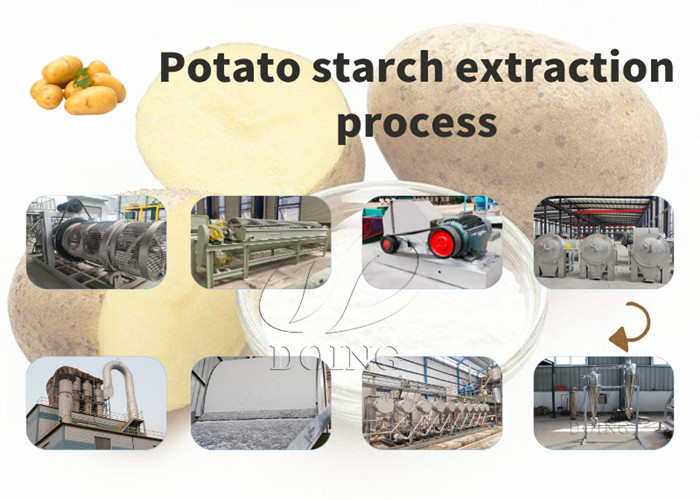 Potato starch processing plant
What Is Usually Included in a Potato Starch Processing Line
A typical potato starch processing line covers the main stages from raw potato to finished starch. The exact configuration will vary by capacity and product requirements, but most lines include:
Raw potato receiving and washing
Crushing or rasping
Sieving and fibre separation
Starch milk refining
Concentration and dewatering
Drying
Packaging
The equipment quotation usually covers the main processing machines, control cabinets, electrical components and technical documentation such as operation manuals and process drawings. Items such as factory construction, local piping, installation, commissioning, operator training, taxes and inland transport are normally quoted separately.
What the Total Project Budget Includes Beyond the Machine Price
A potato starch line usually costs 1.6 to 2 times its equipment price once duty, freight, civil work, utilities, installation and working capital are added. The machine price is the number suppliers quote. The project budget is the number your bank will ask for, and the gap between the two is where most projects in Pakistan run into trouble.
The five pricing factors discussed earlier explain why one line costs more than another. This section answers a different question: how the equipment price sits inside the total investment, and which parts of that total are normally quoted separately. The utilities and civil items listed there are the same blocks described here, only sized as shares of the budget instead of as reasons for a price difference.
The Six Cost Blocks in a Project Budget
A complete budget for a potato starch plant in Pakistan usually breaks into six blocks. The shares below are planning-level ranges for a full line from raw potato receiving to packed starch. They are not a quotation, and the split shifts with capacity, site location and how much of the scope you handle locally instead of through the supplier.
| Cost block | Typical share of total investment | What the block covers |
|---|---|---|
| Processing equipment (FOB or CIF) | 50–62% | Main machines, control cabinets, electrical components, documentation |
| Import duty, sales tax (GST) and clearance | 10–17% | Assessed on the CIF value; rate depends on the HS code |
| Civil work and steel structures | 10–15% | Workshop, foundations, platforms, drainage |
| Utilities: water, steam, power, wastewater | 8–13% | Supply connections, boiler, transformer, effluent treatment |
| Installation, commissioning and training | 3–7% | Erection, piping, trial run, operator training |
| Spare parts, first fill and contingency | 3–6% | Year-one wear parts, chemicals, contingency reserve |
In practice, the items most often quoted outside the equipment price are civil work, the incoming power connection, the boiler or heat source, effluent treatment, installation and commissioning, and inland transport. Ask each supplier to mark these six items as "included" or "excluded" on the quotation — a quotation that leaves them blank is not comparable with one that does not.
Note: the ranges overlap because the boundary between blocks depends on who supplies what. A turnkey supplier may absorb installation into the equipment price, while a local contractor may carry the civil work. Import duty and sales tax depend on the HS code and the prevailing Pakistan customs tariff, and some categories of plant machinery qualify for concessional treatment, so confirm the exact rate with a licensed customs broker before you fix the budget.
FAQ
What is the typical payback period for a potato starch plant in Pakistan?
According to Jinrui Foodtech customer feedback reports, the payback period is generally 1.5 to 3 years. The actual cycle depends on production scale, local potato prices in Pakistan, starch selling price, capacity utilisation and market access. Smaller lines may recover faster with lower overhead, while larger plants benefit from economies of scale.
Why do two suppliers quote different prices for the same capacity?
Because capacity alone does not define a production line. Differences may come from process depth, equipment material, automation level, refining accuracy, drying system design and whether utilities or wastewater treatment are included. Buyers in Pakistan should compare quotations on the same technical basis to avoid misleading price differences.
Can I start with a small line and expand later?
Expansion is possible, but it should be considered during the initial design. If future capacity increase is likely, the layout, utility capacity and process interfaces should leave room for later upgrades. Otherwise, retrofitting can become costly.
Does the equipment price include installation and training?
Not necessarily. Many quotations cover equipment manufacturing and documentation only. Installation, commissioning and training are usually quoted separately according to project location, line complexity and service scope.
What information should I provide to get an accurate quotation?
You should clarify your daily raw potato supply, target starch output, required starch quality, available factory space in Pakistan, local utilities and whether you need protein recovery, wastewater treatment or turnkey support. The more specific the requirements, the more accurate the quotation will be.
Get a Capacity-Based Quote for Your Pakistan Project
Potato starch processing lines do not have a single standard price, but they do have a standard way to be quoted. If you share your target capacity, raw material supply, factory conditions and product standards, Jinrui Foodtech can provide a configuration proposal and a corresponding price range for your project in Pakistan.