

How to Choose a Cassava Chip Slicer for Industrial Use: Thickness, Capacity and Drying Fit
Choosing an industrial cassava chip slicer comes down to three linked decisions: cut thickness, hourly throughput, and drying fit. Thickness controls how fast and evenly moisture leaves the chip; throughput must match both the available root supply and the downstream line; and drying fit determines whether finished chips reach the required moisture level without the dryer becoming a bottleneck.
Industrial cassava chips are produced for animal feed, ethanol, biofuel and other bulk applications, where buyers care more about consistent thickness, stable moisture and predictable drying behaviour than appearance. That makes the industrial cassava chip slicer more than a cutting tool: it is the point where raw roots are converted into a defined industrial specification.
Cut Thickness: How It Drives Drying and How to Set It
Cut thickness is the most influential specification because it directly affects drying behaviour. On a drum-type slicer, thickness is adjusted by changing the cutting gap between the blade assembly and the cutting surface. Jinrui Foodtech (Henan Jinrui) industrial drum-type slicers offer an adjustable range of 4–30 mm, while industrial chip production most often targets 5–8 mm depending on the end use and drying method — comfortably inside the machine’s range.
Why Thickness Carries Downstream
| Thickness choice | Drying effect | Practical risk |
|---|---|---|
| Thinner slices (5–8 mm) | Faster moisture removal; more uniform drying | Higher breakage and fines if handling is rough |
| Thicker slices (10–30 mm) | Slower drying; more moisture retained in the core | Outer layer may look dry while the core remains wet |
| Inconsistent thickness | Uneven drying across the batch | Moisture drift, storage risk and lower grade consistency |
Thinner chips dry faster because moisture has a shorter distance to travel from the centre to the surface. This matters most with mechanical drying, where uniform thickness lets the dryer hit the target moisture with less variation. Thicker chips retain moisture longer in the core and need more drying time, more heat exposure or longer residence in the dryer.
How to Choose Thickness by End Use
Ethanol or biofuel chips: thinner, more uniform slices (5–8 mm) support faster, more complete drying.
Animal feed chips: slightly thicker cuts (8–15 mm) are acceptable if the drying method and storage conditions can handle them.
Sun-dried chips: thickness should be limited by drying area, labour for turning and weather — not only by the slicer’s adjustable range.
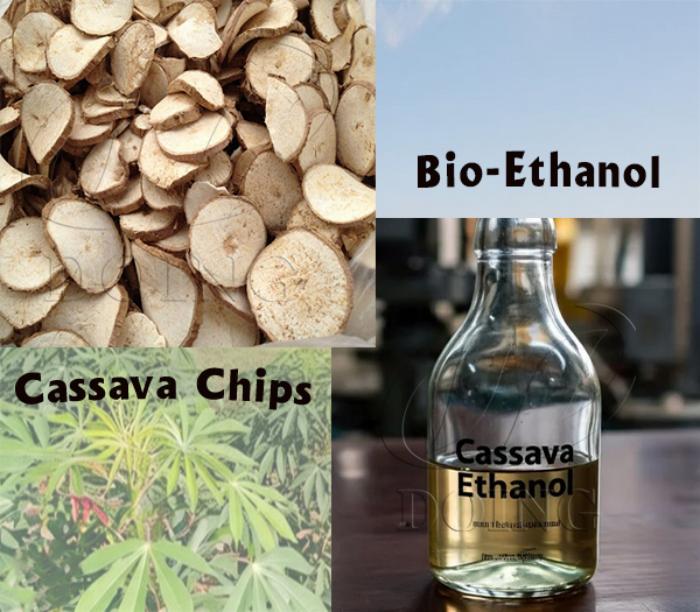 Cassava chips industrial uses
What to Check on the Machine
How the thickness is adjusted and locked during operation.
Whether the cutting gap remains stable under continuous feeding.
Whether the machine holds the chosen specification across a full production shift.
Whether blade wear or root size variation causes thickness drift.
Stability matters more than range. A slicer that claims a wide adjustable band but cannot hold a consistent cutting gap during continuous operation will create downstream problems regardless of its specification sheet.
Capacity: Matching Throughput to Your Whole Chain
Capacity should not be chosen from the slicer’s maximum rating alone. The useful capacity is the throughput that fits the entire chain, from root supply to finished dried chips. A Jinrui Foodtech industrial drum-type slicer such as the QPJ60 handles around 8–15 t/h of fresh cassava, while smaller setups may operate at 1–2 t/h and larger lines use parallel slicers to raise throughput.
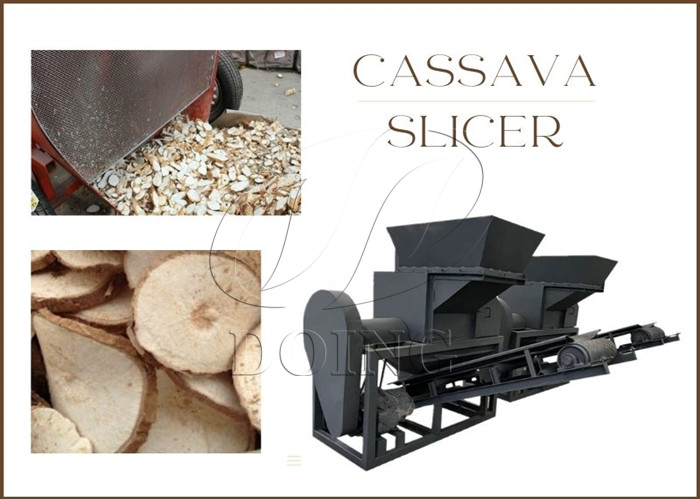 Jinrui Foodtech's cassava slicer
As a planning ratio, roughly 2.3–2.5 tonnes of fresh slices yield 1 tonne of dried chips (fresh slices enter drying at about 62–70% moisture; dried chips leave at 12–14%). Size the dryer against wet-slice throughput, not dry output.
Three factors should be checked together:
Upstream supply: how much cleaned or peeled cassava can be fed into the slicer consistently per hour?
Machine capability: what is the realistic throughput for the chosen root size, thickness and feeding method?
Downstream absorption: can washing, drying, conveying and packaging keep pace with the slicer’s output?
If root supply is limited, an oversized slicer runs underloaded and cannot create extra output. If the dryer is smaller than the slicer, wet chips accumulate and moisture control becomes difficult. For phased expansion, a slicer with slightly higher capacity than current needs can make sense — but only if the rest of the line can be upgraded later. Otherwise, oversizing creates imbalance rather than flexibility.
Drying Fit: Matching Slice Specs to Your Drying Method
Drying fit means slice thickness and throughput must be compatible with the drying method that will actually be used. Industrial cassava chips are dried by open-air sun drying, belt drying, drying rooms or other mechanical systems, and each has different limits.
| Drying method | Key constraint | Slicer matching rule |
|---|---|---|
| Sun drying | Weather, drying area, labour for turning | Limit throughput to what the drying yard can physically handle |
| Belt dryer / drying room | Temperature, residence time, airflow | Set thickness so internal moisture can be removed within the dryer’s cycle |
| Mixed or uncertain drying | Variable capacity | Choose a conservative thickness and avoid oversizing the slicer |
Mechanical drying typically runs on a two-temperature logic. Multi-zone belt dryers pass hot air through the chip bed at around 80–120 °C, keeping the material surface below about 90 °C for fast, controlled drying. Where chip colour and integrity matter more than speed — for example chips destined for flour milling — low-temperature slow drying at ≤60 °C over 14–16 hours is used instead. In both cases the target final moisture is approximately 12–14% for stable storage and industrial use.
When slices are too thick for the dryer’s residence time or temperature profile, internal moisture stays too high. When slices are too thin for a high-throughput line, breakage and fines increase during conveying and packing.
The drying system should therefore be treated as a boundary condition for slicer selection. Before fixing thickness and capacity, confirm:
What drying method will be used?
What final moisture content is required?
How much sliced material can be dried per hour or per day?
How sensitive is the end buyer to moisture variation and broken chips?
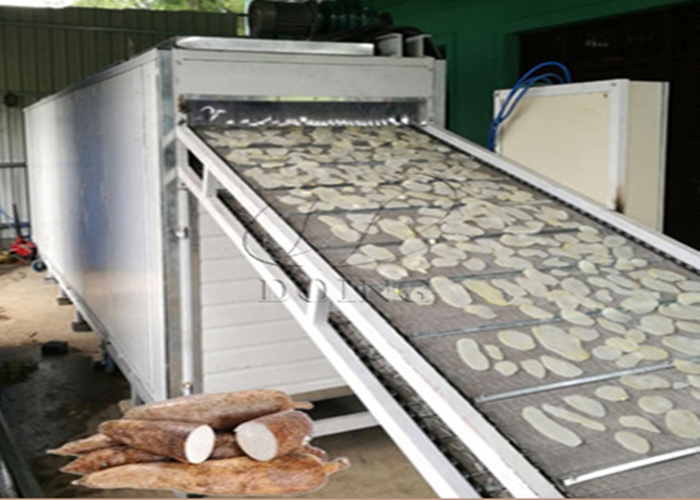 Belt dryer for cassava chips processing
Slicer Types and Build: What to Look For
Industrial cassava chip slicers fall into two types:
Drum-type automatic slicers: better suited to continuous industrial production — larger volumes and more stable feeding.
Disc-type or compact slicers: often used at farm level, in small workshops or pilot operations where throughput requirements are lower.
A reliable slicer should have:
A sturdy cutting head and stable housing.
A well-designed feeding hopper that reduces blockage.
A dependable transmission system.
An adjustable cutting gap for different chip specifications.
A drive system matched to local power conditions (electric motor or diesel-driven).
| Item | Typical Reference |
|---|---|
| Model | QPJ60 |
| Power | 5.5 kW |
| Capacity | 8–15 t/h (fresh cassava) |
| Adjustable thickness | 4–30 mm |
| Weight | About 900 kg |
| Dimensions | 2280 × 1880 × 2060 mm |
These figures represent one Jinrui Foodtech industrial drum-type automatic slicer configuration and should be confirmed against the actual machine specification before purchase.
A Practical Sizing Checklist
Define the end product. Decide whether the chips are for animal feed, ethanol, biofuel or another industrial use, then set the preferred thickness range.
Estimate root supply. Match slicer capacity to realistic daily and hourly fresh cassava availability.
Confirm drying capacity. Ensure the drying method, drying area and target moisture level can handle the chosen thickness and throughput.
Check power and drive. Choose electric motor drive for stable industrial power, or consider diesel or alternative drive where electricity is limited.
Decide on automation level. A single slicer may suit a small line; larger operations may need integrated washing, peeling, slicing and drying stages.
Plan for maintenance. Verify that blades, belts, bearings and feeding parts are easy to inspect and replace for continuous operation.
Frequently Asked Questions
What should I consider if the site does not have stable three-phase electricity?
In locations with limited or unstable grid power, a diesel-driven or alternative-drive configuration can be more practical than a standard electric motor setup. The trade-off is higher attention to fuel supply, maintenance and operating cost. Compare local electricity availability, fuel cost, expected running hours and operator experience before choosing the drive type.
Can the same slicer produce both feed chips and ethanol chips?
Yes in most cases, but treat it as a changeover, not a setting tweak. After adjusting the cutting gap, run a trial batch and measure slice thickness at the start, middle and end of an hour — the gap must hold under continuous feeding, not just on the first pass. Then confirm the dryer can absorb the thinner, faster-drying cut before committing to the new specification for a customer order.
If my dryer is the limiting step, should I still buy the bigger slicer?
Usually no — buy to the dryer. Your options, in order of cost: run the slicer in shifts matched to dryer capacity; add a second drying shift or drying yard before adding slicing capacity; or upgrade the dryer first and size the slicer to the new figure. A slicer that outruns the dryer does not add output; it adds wet stockpile.
How many tonnes of fresh chips make one tonne of dried chips?
Roughly 2.3–2.5 to 1. Fresh slices enter the dryer at about 65% moisture and leave at 12–14%, so around 60% of the intake weight is evaporated water. Use this ratio to size the dryer against the slicer: a 10 t/h slicer implies roughly 4 t/h of dried chips, and the dryer must be specified for the wet-slice throughput, not the dry output.
How often should blade sharpness and cutting gap be checked?
Check visually at every shift start and re-measure actual slice thickness hourly during the first week of operation. Fibrous or sandy roots dull blades faster than clean, peeled roots, so the interval depends on raw material quality — a fixed calendar schedule matters less than watching for the first signs of drift: more fines in the output and slower, less even drying in the same dryer.
Get the Right Cassava Chip Slicer for Your Project
The right industrial cassava chip slicer is one that matches your required chip thickness, available fresh cassava supply and drying capacity. Before choosing a model, confirm the machine’s actual operating range and rated capacity against your production requirements.
If you are planning a cassava chip processing line, contact Jinrui Foodtech to discuss your intended chip use, daily raw material supply, required thickness, available power supply and drying method. These details will help assess a suitable slicer configuration for your project.