

Horizontal vs Vertical Centrifugal Sieve: Which Is Better for Cassava Starch Processing?
A horizontal centrifugal sieve is generally a better choice than a traditional vertical centrifugal sieve for continuous cassava starch processing, particularly when high starch recovery, large processing capacity, and stable operation are priorities. Its higher operating speed and longer effective screening path can improve starch–fiber separation, while automatic cleaning systems help maintain continuous production.
However, the two designs differ in more than their installation orientation. Understanding their working principles and practical performance differences can help cassava starch producers select suitable separation equipment for a new factory or an existing production line.
How Do Horizontal and Vertical Centrifugal Sieves Work?
Both horizontal and vertical centrifugal sieves separate starch milk from cassava fibers after rasping. As explained in the FAO's technical guidance on cassava starch processing (https://www.fao.org/4/x5032e/x5032e02.htm), wet screening uses water to wash free starch from fibrous pulp. In a centrifugal sieve, cassava slurry enters a rotating screen basket, where centrifugal force helps starch-containing liquid pass through the screen while the retained fibers are discharged separately.
The main difference lies in the screen basket arrangement and the movement of slurry across its surface. In a horizontal centrifugal sieve, the basket rotates around a horizontal axis, allowing the starch–fiber mixture to travel along the screening surface before discharge. A vertical centrifugal sieve uses a vertically arranged screening basket, with the material following a different flow path.
These structural differences influence the effective screening distance, rotational speed, and separation performance, making equipment design an important consideration when comparing the two types.
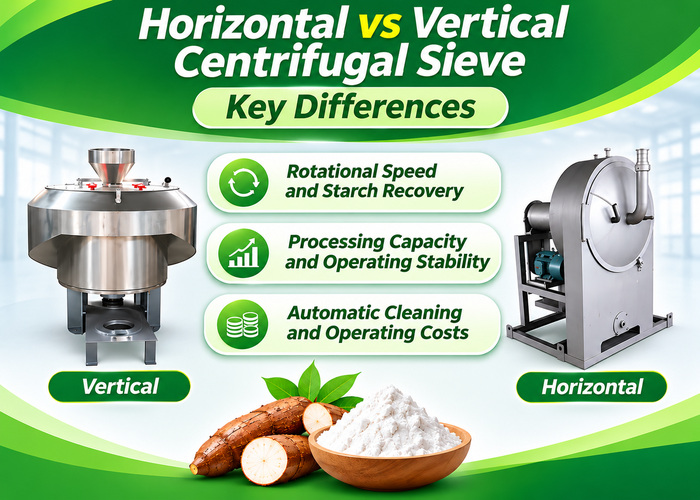 Horizontal vs Vertical centrifugal sieve: Key Differences
Horizontal vs Vertical Centrifugal Sieve: Key Differences
Rotational Speed and Starch Recovery
Horizontal centrifugal sieves offer advantages in rotational speed and effective screening distance over traditional vertical designs, helping improve starch extraction and reduce starch losses.
Traditional vertical centrifugal sieves commonly operate at approximately 600–800 rpm, while Jinrui Foodtech (Henan Jinrui)'s horizontal models operate at 1,050–1,120 rpm. The higher rotational speed contributes to the centrifugal force acting on the slurry, encouraging starch-containing liquid to pass through the screen.
The screening path is another important difference. In Jinrui's horizontal design, the starch–fiber mixture follows a spiral-like movement along the rotating basket, providing a longer effective screening distance. By comparison, traditional vertical centrifugal sieves with shorter material travel paths provide fewer opportunities for starch separation during a single pass. As a result, more recoverable starch may remain in the discharged pulp.
To further improve extraction, Jinrui commonly uses four- or five-stage centrifugal screening systems. Fibers retained by the first sieve enter subsequent stages for additional washing, while starch-containing washing liquid is returned to earlier stages. This arrangement follows the countercurrent washing principle described in FAO's cassava processing guidance, helping recover starch remaining in the pulp while making effective use of washing water.
For cassava starch producers, the practical advantage is more effective starch–fiber separation and less recoverable starch leaving with the discharged pulp. The rotational-speed and screening-path advantages described here apply to the conventional vertical designs being compared, rather than every vertical sieve available on the market.
Processing Capacity and Operating Stability
Horizontal centrifugal sieves are well suited to high-throughput, continuous cassava starch production because their screening structure supports sustained slurry movement and starch separation.
In a horizontal centrifugal sieve, cassava slurry moves along the rotating screen basket while starch milk passes through the mesh and fibers advance toward the discharge outlet. This continuous material movement helps the equipment handle substantial slurry volumes without interrupting the separation process. Jinrui's horizontal centrifugal sieve models cover rated processing capacities from 4 to 55 t/h, providing options for different production requirements.
By comparison, conventional vertical centrifugal sieves with shorter screening paths and lower operating speeds can face limitations when processing large slurry volumes. Increasing the feed rate may reduce the opportunity for starch to pass through the screen before fiber discharge. To achieve the required processing capacity and extraction performance, additional screening equipment may be necessary.
The horizontal design therefore offers a practical advantage for factories seeking higher processing throughput and consistent starch separation during continuous operation. It is particularly suitable for cassava starch lines where the screening section must keep pace with the upstream rasper without becoming a production bottleneck.
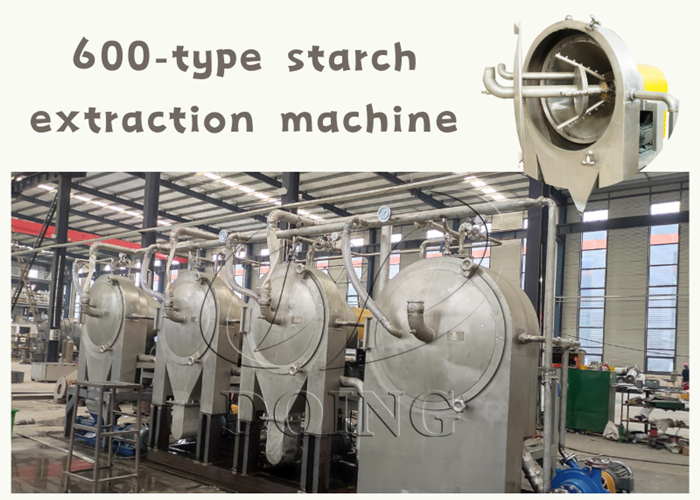 Centrifugal sieve for starch processing
Automatic Cleaning and Operating Costs
Jinrui's horizontal centrifugal sieves incorporate automatic front- and back-flushing systems, helping prevent screen blockage and reduce interruptions during continuous operation.
During cassava starch separation, fine fibers and other suspended materials can accumulate on the screen surface, restricting starch milk flow. The flushing system removes deposited material from the screen during operation, helping maintain screen permeability and stable separation performance.
Traditional vertical centrifugal sieves without comparable automatic cleaning systems may require more frequent manual cleaning when their screens become blocked. This increases maintenance work and can interrupt production, especially in factories operating continuously.
Operating costs are also influenced by the number of machines required to achieve the target processing capacity and starch recovery. Where a conventional vertical system needs additional sieves and supporting pumps, the installation involves more motors, maintenance points, and equipment connections. A horizontal system capable of achieving the required performance with fewer machines can therefore offer a simpler and more economical operating arrangement.
For cassava starch factories, the main benefits are fewer screen-cleaning interruptions, more stable production, and reduced maintenance demands. Actual electricity and water savings depend on the complete screening system rather than the orientation of an individual machine.
Which Centrifugal Sieve Should You Choose for Cassava Starch Processing?
For a new continuous cassava starch processing line, a horizontal centrifugal sieve is generally the preferred option, particularly when starch recovery, processing capacity, and operating stability are important. Its longer effective screening path, high-speed operation, and automatic flushing system provide practical advantages over conventional vertical designs.
For an existing factory, the decision depends on the performance of the installed screening equipment.
| Purchasing Situation | Recommended Approach |
|---|---|
| New cassava starch processing plant | Choose a horizontal centrifugal sieve system designed for continuous operation and efficient starch extraction. |
| Existing plant with high starch losses | Evaluate whether the current vertical sieve's screening path, rotational speed, or washing performance is limiting starch recovery. |
| Existing plant considering an upgrade | Consider a horizontal centrifugal sieve replacement to improve screening performance and reduce cleaning interruptions. |
If an existing vertical sieve already meets the factory's processing and recovery requirements, immediate replacement may not be necessary. However, when starch losses, insufficient throughput, or frequent screen blockage affect production, upgrading the screening section can be a worthwhile improvement.
Frequently Asked Questions
Can a horizontal centrifugal sieve replace an existing vertical sieve without changing the entire starch line?
In many cases, the screening section can be upgraded without replacing the complete cassava starch processing line. However, the new sieve must match the existing slurry flow rate, installation space, pipe connections, pump capacity, and downstream equipment requirements. A layout review is necessary to determine whether the replacement involves only the sieve or also requires changes to pumps, piping, and controls.
What should be checked during a centrifugal sieve factory acceptance test?
Buyers should verify the equipment model, screen basket dimensions, motor specifications, screen installation, flushing-system operation, and mechanical running condition. Factory testing can confirm assembly quality, rotation, vibration, and control functions. Actual starch recovery and slurry-processing performance should be evaluated during commissioning with representative cassava slurry, since an unloaded factory test cannot establish separation efficiency under production conditions.
What screen mesh size is suitable for cassava starch separation?
Screen apertures in the 80–120 μm range can be used in cassava starch screening systems, depending on the extraction stage and slurry characteristics. The appropriate aperture should balance fiber removal, starch passage, throughput, and blockage risk. A finer screen is not automatically more effective, particularly when slurry concentration or washing conditions are unsuitable.
How can screen blockage be prevented during continuous operation?
Screen blockage can be reduced through proper feed preparation, controlled slurry concentration, effective flushing, and regular inspection. Jinrui's centrifugal sieve design incorporates front- and back-flushing systems to help remove accumulated material from the screening surface. Operators should also monitor slurry flow and inspect screens for wear or damage to maintain stable separation performance.
What information should I provide when requesting a centrifugal sieve quotation?
Provide the required cassava processing capacity, estimated slurry flow rate if available, and whether the equipment is intended for a new line or an existing plant upgrade. For replacement projects, photographs, machine dimensions, pipe connection details, and information about current separation problems are especially useful. These details help the supplier recommend a suitable sieve model and screening configuration.
Improve Cassava Starch Recovery with the Right Screening System
Horizontal centrifugal sieves provide clear advantages over conventional vertical designs in screening speed, starch separation, continuous processing, and automatic cleaning. For cassava starch producers, these improvements can mean more starch recovered from the same raw material and fewer interruptions during production.
Are you building a new cassava starch plant, or is your existing vertical sieve leaving too much starch in the discharged pulp? Jinrui Foodtech can help identify whether screening performance is limiting your production and recommend a horizontal centrifugal sieve or multi-stage extraction arrangement suited to your factory.
Send us your cassava processing capacity and details of your existing screening equipment. We can help you determine which equipment changes are most relevant to improving starch recovery and keeping your production line running efficiently.