

Philippines Cassava Starch Producer Signs Rasper Order: A Retrofit Sizing Case | Jinrui Foodtech
On September 25, 2026, Jinrui Foodtech (Henan Jinrui) signed a purchase contract with a cassava starch processor in the Philippines for one CM-8435 Rasper. The order is aimed at replacing aging rasping equipment in one of the customer’s plants, and the question that shaped every step was compatibility with the existing line – mounting footprint, connection interfaces and rated capacity.
Our customer runs two cassava starch plants in the Philippines and chose to begin with a single rasper, to verify fit and performance before scaling up. We worked the selection through with them and confirmed the exact model and specifications for this purchase.
From Inquiry to Contract: How the Sizing Unfolded
Customer requirement: a machine that fits the line it already has
Rather than commission a whole new line, this customer first needed one rasper to slot into a plant that has been running for years. In our discussions we locked the requirement down on three fronts:
Mounting footprint: matching the machine’s external dimensions against the space available on the existing line.
Connection interface: confirming the mounting and process interfaces so the unit ties into the current workflow.
Throughput capacity: checking the machine’s rated capacity against what the plant actually produces.
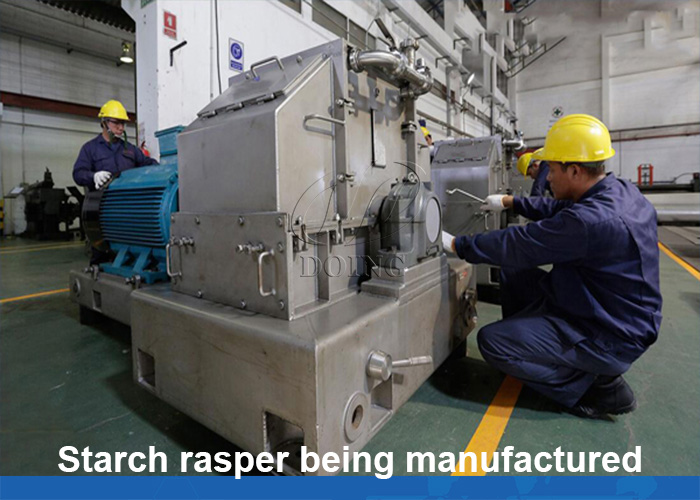 Jinrui Foodtech's rasper
Project timeline: from first contact to signature
August 6, 2026: referred by an existing customer, the buyer sent an initial inquiry through Alibaba International, asking first about the rasper itself.
September 3, 2026: our customer – the plant’s maintenance lead – came back to push the purchase forward, and we began preparing the proforma invoice (PI).
September 25, 2026: both sides signed the purchase contract for the CM-8435 Rasper.
Throughout the sizing we answered point by point on dimensions, mounting interface and capacity, so the customer could settle on the exact configuration before committing.
CM-8435 Rasper: Specifications & Build
The CM-8435 Rasper is the primary size-reduction unit at the front of a cassava starch line: it rasps washed cassava roots into a fine pulp so the maximum amount of starch is released. The higher the rasping rate, the higher the downstream starch yield – which makes this machine the first checkpoint on overall recovery. Every figure below corresponds to the CM-8435 model (Jinrui Foodtech specifications).
Key specifications (model-to-spec mapping)
| Item | CM-8435 |
|---|---|
| Model | CM-8435 |
| Capacity | 20 t/h |
| Rotor diameter | Φ840 mm |
| Rotor speed | 2100 r/min |
| Motor power | 110 kW |
| Overall dimensions | 2180 × 1310 × 1190 mm |
| Machine weight | 2800 kg |
Three performance advantages
High rasping rate, higher starch yield: a rasping rate above 94% opens the starch cells thoroughly, for roughly 4 tonnes of cassava to 1 tonne of starch – improving unit output and cost directly.
Food-grade stainless contact surfaces: parts in contact with the material are food-grade stainless, corrosion-resistant and easy to clean, meeting food-grade hygiene requirements.
SKF bearings + high-speed rotor for stable running: SKF bearings with a Φ840 mm high-speed rotor run smooth and wear-resistant, suited to long continuous duty with less downtime and maintenance.
Compatibility note
The CM-8435 ordered here measures 2180 × 1310 × 1190 mm, so it drops into the existing station of an older starch plant; its 20 t/h capacity suits a mid-size starch plant, making it well suited to a single-unit trial that proves footprint, interface and yield before any further equipment is planned.
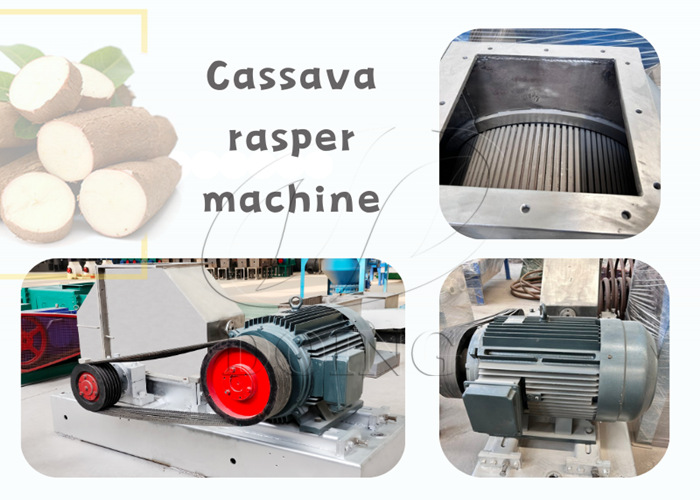 Rapser in cassava starch line
What this order means
For our customer, this was a targeted equipment replacement – confirming the rasper’s model, mounting conditions and capacity against the line they already run.
For us, it reinforced a simple principle: sizing starts from real site conditions, not from a single number. We help confirm a configuration from the duty and output the customer describes, rather than recommending a model off one specification alone.
Sizing a cassava starch line of your own?
If your cassava, sweet potato or other root-starch plant is facing aging equipment, a capacity gap, or the same footprint-and-throughput fit problem between old and new lines, talk to the Jinrui Foodtech engineering team. Working from your existing line and target capacity, we’ll put together a targeted equipment-upgrade and line-compatibility plan – prove it first, scale next – so the investment rests on a confirmed fit.