

Small Scale Cassava Starch Processing Plant: Two Equipment Designs Explained
A small scale cassava starch processing plant can be designed as either a mobile starch extraction unit or a fixed, complete starch production line. The mobile design processes fresh cassava roots into starch milk near raw material collection areas, while the fixed design integrates extraction, purification, dewatering, and drying to produce finished dry cassava starch.
The main differences are the processing scope, equipment configuration, and raw material supply arrangement. Understanding these differences helps investors select a cassava starch processing solution suited to their production conditions.
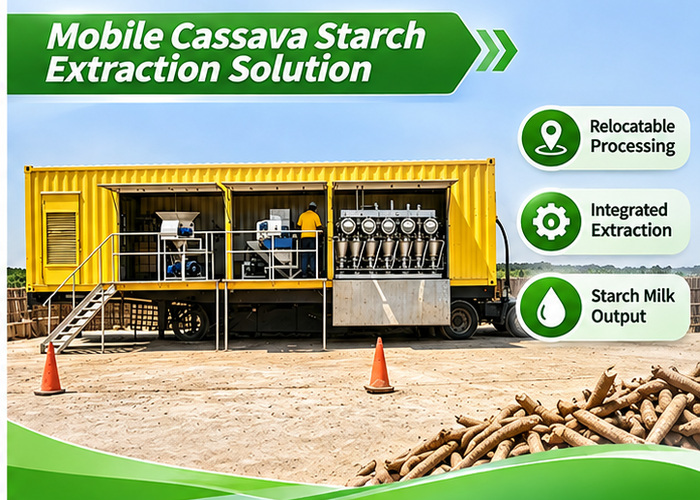 Mobile cassava starch processing plant
1. Design One: Mobile Cassava Starch Extraction Solution
A mobile cassava starch extraction solution integrates the main starch extraction operations on a transportable frame. It is designed to process fresh cassava roots into starch milk near cassava-growing or collection areas, reducing the need to transport all harvested roots to a permanent processing factory.
Mobile Cassava Starch Extraction Process
Process flow: Fresh cassava roots → Washing → Crushing → Screening → Starch refining → Starch milk collection
Washing: Fresh cassava roots are cleaned to remove soil, sand, and surface impurities before extraction.
Crushing: The cleaned roots are crushed to break down cassava tissue and release starch granules into a water-based suspension.
Screening and refining: Fibrous residue is separated from the starch-containing liquid, followed by further refining of the extracted starch suspension.
Starch milk collection: The starch milk is collected for transportation to a downstream processing facility.
The mobile unit produces starch milk rather than finished dry starch. Mechanical dewatering and drying are not included in this mobile extraction process.
Mobile Cassava Starch Processing Equipment
Jinrui Foodtech (Henan Jinrui) provides a mobile extraction arrangement that integrates the main equipment required for front-end starch processing.
| Equipment / unit | Main function |
|---|---|
| Cassava washing unit | Removes dirt and impurities from fresh cassava roots |
| Cassava crushing unit | Breaks cassava tissue to release starch |
| Starch screening unit | Separates starch-containing liquid from cassava fibers |
| Starch refining section | Further processes the extracted starch suspension |
| Starch milk collection system | Collects starch milk for downstream processing |
These processing units are arranged on a transportable frame to support relocation between suitable raw material collection locations. The exact equipment models and auxiliary systems depend on the selected mobile configuration.
Key Features of the Mobile Design
Relocatable processing: The extraction equipment can be moved closer to cassava collection areas rather than requiring all fresh roots to be transported to one factory.
Integrated extraction arrangement: Washing, crushing, screening, and refining are combined within a compact equipment system.
Intermediate starch output: The system produces starch milk that requires subsequent processing at a separate facility.
This decentralized processing approach is consistent with the operating concept described by the International Institute of Tropical Agriculture (IITA) in its Mobile Cassava Processing Plant initiative. The IITA approach addresses challenges associated with collecting and transporting fresh cassava roots from dispersed production areas.
Jinrui's mobile solution follows a similar processing-location principle, although its actual machinery and technical specifications should be evaluated independently.
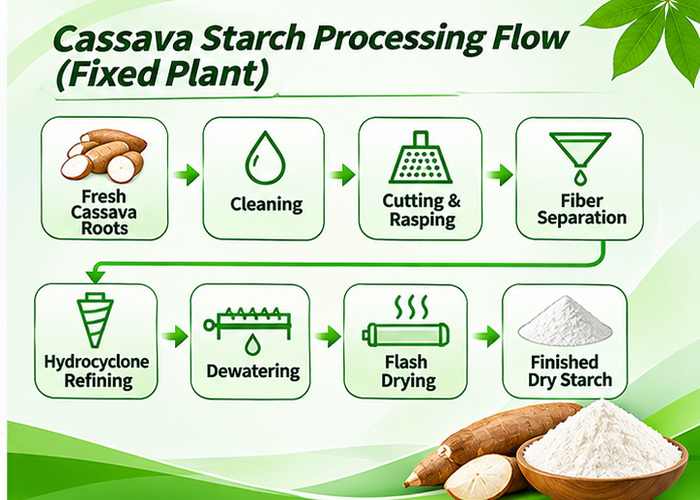 Cassava starch production process
2. Design Two: Fixed Small Scale Cassava Starch Processing Plant
A fixed small scale cassava starch processing plant is installed at a permanent factory site and covers the complete production process from fresh cassava roots to finished dry starch. It combines dedicated extraction, separation, purification, dewatering, and drying equipment in one production line.
Fixed Cassava Starch Production Process
Process flow: Fresh cassava roots → Cleaning → Cutting and rasping → Fiber separation → Hydrocyclone refining → Dewatering → Flash drying → Finished dry starch
Cleaning: Removes soil, sand, and other impurities from fresh cassava roots.
Cutting and rasping: Reduces root size and breaks down cassava tissue to release starch granules.
Fiber separation: Removes coarse and fine cassava fibers from the starch suspension.
Starch purification: Uses hydrocyclone separation and washing to reduce soluble impurities and refine the starch milk.
Dewatering and drying: Mechanically removes excess water before thermal drying produces finished dry starch.
The complete processing arrangement allows starch extraction, purification, and finishing operations to be coordinated within one factory.
Fixed Cassava Starch Processing Equipment
Jinrui's fixed production line uses dedicated machines for the main starch processing stages.
| Processing stage | Main equipment | Main function |
|---|---|---|
| Cassava cleaning | Dry sieve, paddle washing machine | Remove soil, sand, and surface impurities |
| Starch release | Cassava cutting machine, rasper | Prepare roots and release starch granules |
| Fiber separation | Centrifuge sieve, fine fiber sieve | Separate starch milk from coarse and fine fibers |
| Starch purification | Hydrocyclone station | Wash and refine the starch suspension |
| Mechanical dewatering | Peeler centrifuge | Remove excess water and produce wet starch cake |
| Thermal drying | Flash dryer | Dry starch cake to the required finished moisture |
| Product handling | Starch sieve, packaging equipment | Prepare finished starch for packing |
The rasper, centrifuge sieve, and hydrocyclone station have distinct roles in starch production. The rasper releases starch from cassava tissue, the sieves remove fibrous material, and the hydrocyclone station refines the starch suspension.
The equipment specifications and processing capacity should be matched to the required starch output and product quality.
Key Features of the Fixed Design
Complete production scope: The line processes fresh cassava roots into finished dry starch without requiring a separate downstream finishing facility.
Dedicated purification equipment: Centrifugal screening and hydrocyclone refining provide separate stages for fiber removal and starch purification.
Integrated factory operation: Extraction, refining, dewatering, and drying equipment can be arranged for coordinated production at a permanent site.
The fixed design is especially relevant to projects with sufficient, stable cassava supply and a requirement to produce finished dry starch.
3. Mobile vs. Fixed: Key Differences in Cassava Starch Plant Design
The mobile and fixed designs differ in more than equipment mobility. They have different processing boundaries, machinery arrangements, and product outputs.
| Comparison | Mobile Starch Extraction Solution | Fixed Cassava Starch Processing Plant |
|---|---|---|
| Processing scope | Fresh cassava roots to starch milk | Fresh cassava roots to finished dry starch |
| Equipment arrangement | Integrated extraction units on a transportable frame | Dedicated machines arranged in a complete production line |
| Raw material supply | Can serve dispersed cassava collection areas | Requires fresh roots to be delivered to a permanent factory |
| Main processing operations | Washing, crushing, screening, refining | Cleaning, rasping, screening, purification, dewatering, drying |
| Starch purification | Based on the mobile extraction configuration | Dedicated hydrocyclone refining section |
| Dewatering and drying | Not included in the mobile unit | Included in the complete production line |
| Product output | Starch milk | Finished dry cassava starch |
| Main operational consideration | Equipment relocation and starch milk handling | Continuous raw material delivery and complete factory operation |
The two designs do not produce the same final product. A mobile extraction unit performs the initial starch extraction stages, while a fixed production line completes the full process through drying.
Therefore, comparing equipment purchase prices alone does not provide a complete assessment. The additional processing facilities and operating arrangements must also be considered.
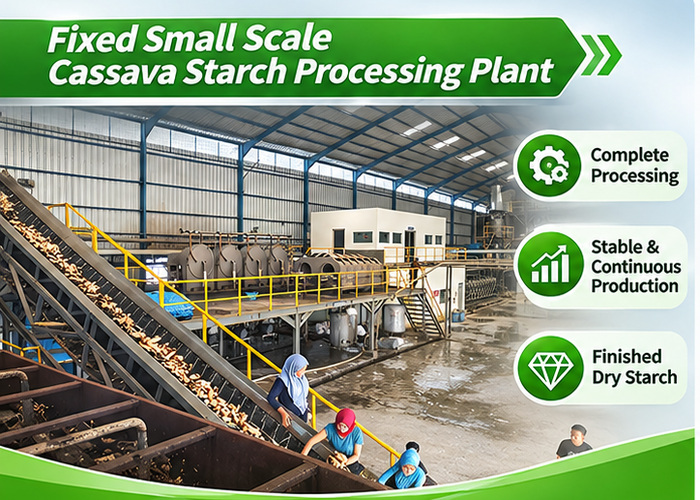 Fixed cassava starch processing plant
4. Which Small Scale Cassava Starch Plant Design Fits Your Project?
Choosing between mobile and fixed cassava starch processing equipment depends mainly on raw material availability, the required final product, and the operating conditions of the project.
Raw Material Availability and Distribution
The location and stability of fresh cassava supply can influence whether mobile or fixed processing is more practical.
Mobile solution: Worth considering when cassava roots are collected from dispersed farming areas and transporting all fresh roots to one factory is difficult or costly. Extraction equipment can be moved closer to suitable collection points.
Fixed plant: Generally more suitable when sufficient fresh cassava roots can be delivered consistently to one permanent processing site.
For example, a project collecting cassava from several distant farming communities may evaluate mobile extraction, while a project supplied by a nearby plantation or established collection network may prioritize a fixed production line.
Required Final Product
The intended product determines how much processing equipment the project needs.
Mobile solution: Produces starch milk for subsequent processing. It is suitable for consideration when the project has access to downstream starch finishing facilities.
Fixed plant: Produces finished dry starch through an integrated process that includes purification, dewatering, and drying.
If the project intends to sell dry cassava starch directly, a mobile extraction unit alone cannot replace a complete production line.
Processing Infrastructure and Operating Costs
The complete operating arrangement should be assessed rather than only the initial equipment purchase price.
Mobile solution: Requires suitable water and power supply at collection sites, equipment access, starch milk handling, and transportation to a downstream facility.
Fixed plant: Requires a permanent factory site with adequate utilities, wastewater handling, and space for the complete production line.
Mobile extraction primarily addresses the location of front-end processing, while a fixed plant provides complete dry-starch production at one site. The appropriate design depends on the project’s actual supply network and processing requirements.
5. Frequently Asked Questions
How should starch milk be handled after mobile extraction?
Starch milk should be collected in suitable tanks or containers and transferred to the receiving facility under appropriate handling conditions. The project should consider settling, hygiene, transport time, and whether agitation is required. The downstream facility must have sufficient capacity to process the incoming starch suspension.
Can a mobile cassava starch extraction unit operate without permanent factory utilities?
A transportable equipment frame does not automatically make the unit independent of water or electricity. Buyers should confirm the required power supply, process water, pumping equipment, and wastewater handling arrangements. Any generator, water storage system, or auxiliary equipment should be clearly identified in the supply scope.
What should be included when comparing the total costs of mobile and fixed designs?
A mobile extraction project should account for equipment relocation, on-site utilities, starch milk transportation, and downstream processing. A fixed plant requires consideration of the complete equipment line, factory infrastructure, installation, utilities, and raw material logistics. A meaningful comparison must include all equipment and operating requirements needed to produce the intended final product.
How can buyers verify whether a fixed starch production line meets their quality requirements?
Buyers should agree on the required starch specifications and performance evaluation conditions before equipment acceptance. Relevant checks may include the proposed purification arrangement, sampling methods, finished moisture targets, and agreed testing procedures. A particular equipment configuration alone does not guarantee a specific starch quality.
Can the extraction and drying capacities of a fixed plant be expanded independently?
Individual processing sections may be upgraded, but their capacities must remain compatible. Increasing extraction capacity can overload existing purification, dewatering, or drying equipment. Expansion plans should therefore evaluate the throughput and utility requirements of the complete line before replacing individual machines.
6. Choose a Cassava Starch Processing Solution That Fits Your Project
A mobile cassava starch extraction solution and a fixed complete starch processing plant serve different production needs. The mobile design processes fresh cassava into starch milk closer to dispersed raw material sources, while the fixed design integrates all processing stages to produce finished dry starch at one location.
Jinrui Foodtech supplies cassava starch processing equipment and customized production line solutions. To evaluate a suitable small scale cassava starch processing plant, share your raw material supply locations, expected daily cassava intake, and required final starch product. Our engineering team can help develop an equipment configuration suited to your project.