

How Mobile Cassava Processing Lines Can Solve Nigeria’s Supply Chain Bottlenecks
Nigeria produces over 60 million metric tons of cassava annually — more than any other country — yet most processing plants run well below capacity, and Nigeria captures less than 2% of the global cassava processing market. The problem is not equipment or demand; it is geography. Cassava deteriorates within 48 hours of harvest, and smallholder farmers — who produce over 80% of Nigeria's output — are scattered across rural areas with poor roads. Transporting bulky, water-heavy roots to centralized plants is expensive and slow. The result: plants sit idle while cassava rots in the field.
This is where mobile cassava processing lines come in. At Jinrui Foodtech, we've spent over a decade engineering solutions for the Nigerian market — and we've seen firsthand that fixed plants alone can't solve the supply gap. Mobile processing offers a practical way to bridge it. Below, we'll walk through how it works, where it fits, and which model makes sense for your operation.
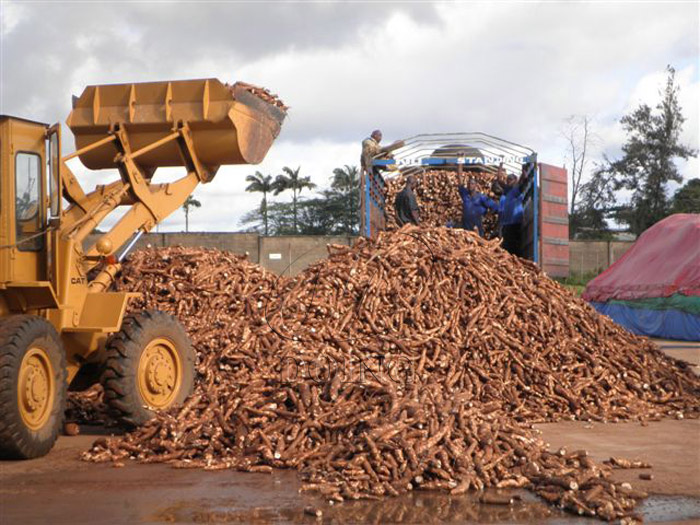 Cassava processing Bottleneck
The Cassava Processing Bottleneck: When Supply Can’t Meet Capacity
Nigeria’s fixed cassava processing plants — producing garri, flour, starch, and ethanol — have grown significantly over the past decade. On paper, the capacity exists. But most operate at 50–70% of rated capacity, not because equipment is lacking, but because raw material doesn’t arrive.
A fixed cassava plant must draw from an economic catchment area — typically within 20–50 kilometers — where it competes with other buyers for supply from hundreds of scattered smallholder farms, each harvesting at different times. For a 20-ton-per-day plant, coordinating this inflow is a logistical challenge few have fully solved, especially given cassava’s 48-hour deterioration window.
Better logistics, contract farming, and aggregation centers have helped. None has closed the gap — particularly for cassava grown in remote or highly dispersed areas that cannot economically serve a fixed plant.
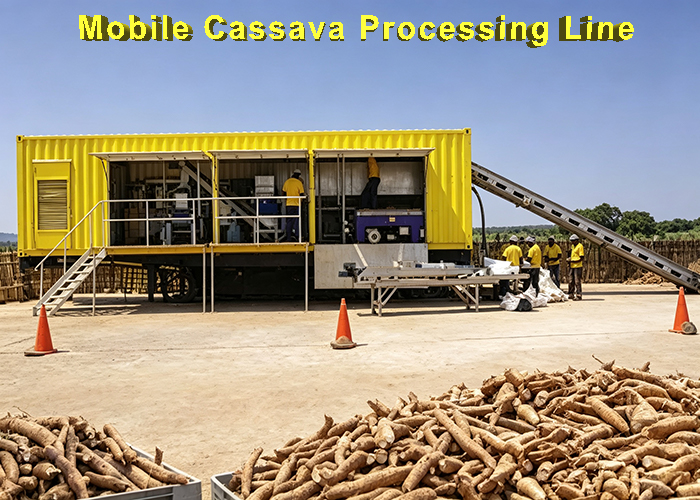 Mobile cassava processing plant
Bridging the Gap: The Mobile Cassava Processing Concept
Mobile cassava processing offers a different starting point. Instead of asking “how do we get the roots to the plant,” it asks: “what if the plant goes to the roots?”
A mobile cassava processing line from Jinrui Foodtech, is a framework-style processing plant integrated onto a truck chassis or trailer. The core processing units — washing, peeling, grating, dewatering, pressing — are mounted within a compact, road-transportable frame that can be deployed directly to harvest sites.
The concept draws from the same engineering logic as mobile rice mills and containerized food processing units already in use across South Asia and East Africa. Applied to cassava, the design follows a simple operational logic: process the root where it is harvested; transport only the finished product.
Key design considerations for mobile cassava lines include:
Compact integration: Equipment must fit within truck/trailer dimensions while maintaining throughput
Power flexibility: Units typically run on diesel generators, given the lack of grid access in rural harvest areas
Quick setup/teardown: Deployment time measured in hours, not days
Dust and moisture protection: Equipment must withstand the tropical field environment
This approach doesn’t replace the fixed-plant model. It addresses a different part of the supply chain — the part that fixed plants have always struggled to reach.
Where Mobile and Fixed Fit: A Comparison Framework
| Characteristic | Fixed Processing Plant | Mobile (Truck-Mounted) Line |
| Investment level | High — civil works, utilities, logistics infrastructure | Lower — no permanent building or utility hookup required |
| Raw material radius | Limited to economic transport distance (~20–50 km) | Travels to raw material — eliminates transport of wet roots |
| Seasonal coverage | Tied to one location; may idle during off-season | Can follow harvest seasons across different regions |
| Processing capacity | Higher — typically 10–100+ tons per day | Smaller — designed for decentralized, smaller-batch processing |
| Product consistency | High — controlled facility environment | Moderate — depends on field conditions |
| Best suited for | Established processors with stable, concentrated supply | Cooperatives, seasonal operations, pilot projects, remote areas |
To understand where mobile cassava processing line adds value, it helps to place it alongside the fixed-plant model in a direct comparison. These are not competing technologies; they are tools for different operational contexts.A large fixed cassava processing plant remains the right choice when raw material supply is reliable, concentrated, and accessible year-round. A mobile line makes sense when the supply is dispersed, seasonal, or located in areas that can’t justify a permanent facility. In many cases, the two models complement each other: a mobile line can serve as a feeder or satellite to a central fixed plant, or as a standalone solution for communities that the centralized model cannot reach.
 Jinrui Foodtech mobile cassava processing solution
Where Mobile Processing Line Makes Economic Sense
The economics of mobile cassava processing plant are driven by a simple trade-off: the cost of moving the processing equipment vs. the cost of moving the raw roots.
Consider a typical rural supply chain: A smallholder farmer in rural Benue State harvests 5 tons of cassava. Getting it to a processing plant 60 kilometers away — on roads that raise transport costs significantly — can cost tens of thousands of naira per trip. If the farmer waits for a truck to aggregate multiple loads, the roots have already been sitting for 24+ hours.
A mobile processing line changes this: the equipment arrives at the community, processes roots within hours of harvest, and the finished starch or flour — which can be stored for months — is what gets transported.
Three scenarios where mobile processing adds the most value:
Multi-season coverage. A single mobile unit can serve the Oyo harvest (March–May), then move to Benue (June–August), and later to Ondo (September–November). Instead of three underutilized fixed plants, one mobile line operates at capacity across multiple seasons.
Cooperative shared models. Groups of smallholders can collectively finance or lease a mobile line, sharing the cost and benefiting from on-site processing. This model bypasses the individual capital barrier of building even a small fixed plant.
Pilot and expansion testing. An SME processor considering expansion into a new region can deploy a mobile line to validate raw material availability and market demand before committing to a fixed investment.
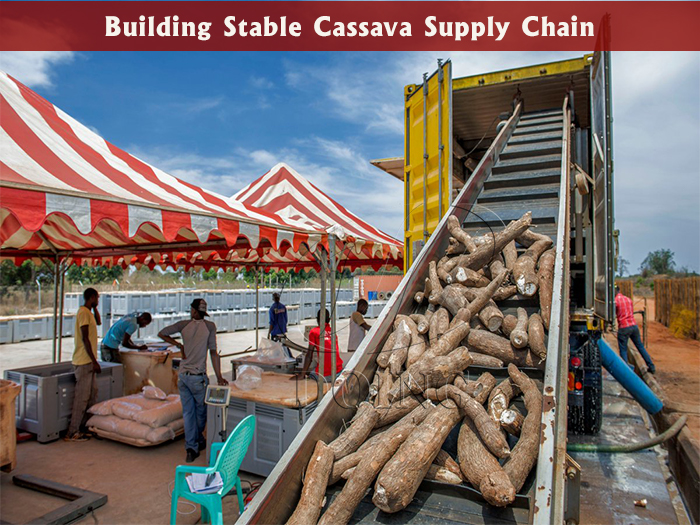 Mobile cassava processing line
Open Questions and Adoption Barriers
As with any emerging approach, several questions remain open:
Q: Can mobile cassava processing lines handle commercial-scale throughput?
A: Yes — mobile lines typically process 3–10 tons per day, sufficient for community-level processing and cooperative operations. They serve as gap-fillers, feeding semi-processed product to fixed plants for final refinement.
Q: How is equipment maintained in rural field conditions?
A: Jinrui Foodtech builds all mobile cassava processing lines with corrosion-resistant materials and modular components for easy field maintenance. Our Ogun State warehouse keeps spare parts in stock, and we provide installation guidance and after-sales support for every project.
Q: What policy conditions affect mobile processing adoption?
A: Key factors include import tariffs on equipment, access to financing, and road infrastructure. Government programs like NALDA's cassava initiatives and CBN agricultural lending are actively supporting adoption.
Q: When should I choose mobile over fixed?
A: Choose mobile when supply is dispersed, seasonal, or remote. Choose fixed when supply is reliable, concentrated, and year-round. The best strategy is often both — mobile feeds semi-processed product to a central fixed plant.
Q: Does Jinrui Foodtech provide both mobile and fixed solutions?
A: Yes. We deliver garri production lines, complete flour/starch processing systems, and frame-type mobile lines — all built for tropical conditions.
The Bottom Line
Nigeria’s cassava supply chain bottleneck is not a technology problem alone — it is a geography and logistics problem. Fixed cassava processing plants will continue to anchor the industry. Mobile processing lines offer a complementary tool: lower-cost, flexible, and capable of reaching the farmers and communities that the centralized model cannot serve.
For processors, cooperatives, and investors, the question is not “fixed or mobile.” It is “how do fixed and mobile fit together to create a resilient, year-round supply chain?”
Solutions for Every Model
With over a decade of experience engineering cassava processing equipment for the Nigerian market, Jinrui Foodtech — DOING Holdings delivers solutions across the full spectrum:
Garri production: High-efficiency single-machine lines and integrated garri processing plants
Cassava flour and starch: Complete stationary processing systems
Farm-gate processing: Frame-type mobile lines, truck-mounted for field deployment
Local support: Warehouse in Ogun State with inventory and spare parts
Whether you need a fixed plant for high-volume production or a mobile line to reach dispersed farms, we provide the equipment, engineering support, and local presence to make it work.
Ready to discuss your project? Tell us your target product, desired capacity, and location — we’ll respond with preliminary sizing and a quotation within 24 hours.