

How Much Does It Cost to Import a Cassava Peeling Machine? A Full Landed-Cost Breakdown
The price you see on a quotation sheet is not the full cost of importing a cassava peeling machine. The machine price is only the first line item; ocean freight, insurance, import duty, port handling charges and inland transport all stack on top before the equipment reaches your factory floor. That is why serious buyers plan around landed cost — the total amount paid from factory gate to warehouse — rather than the machine price alone. As a planning figure, a 1 t/h peeler quoted at USD 6,500 typically lands at USD 9,000–11,000 at a West African port — plan on 20–40% on top of the machine price, with freight, clearance and duty making up almost all of the difference.
This article gives the current ex-works price range for cassava peelers by capacity, then breaks down every cost layer between the factory and your plant. The goal is to help you calculate a realistic import budget and decide whether importing is the right move for your operation.
What "Landed Cost" Means
Landed cost is the total cost of getting an imported machine into your facility. In simple terms:
Landed cost = Machine price + Ocean freight + Insurance + Import duty and taxes + Port handling / customs fees + Inland transport
The risk of ignoring this definition is practical: buyers who compare only machine prices often discover, after the vessel arrives, that the final outlay is 20%–40% higher than the quotation. The extra cost is not hidden; it is simply distributed across freight, taxes and handling. The sections below follow this exact sequence so you can build your own landed-cost figure line by line.
The Machine Price Itself (By Capacity)
The machine price is the anchor of the calculation. For cassava peelers supplied by Jinrui Foodtech (Henan Jinrui), the current ex-works price ranges are:
| Capacity | Price (USD) |
|---|---|
| 0.5 t/h | 3,000 – 3,500 |
| 1 t/h | 6,500 |
| 2 t/h | 9,500 |
| 5 t/h | 15,500 |
These figures are ex-works / FOB level prices and do not include ocean freight, duty or destination charges. The final machine price can vary with configuration: brush-roller type (stainless-steel brush roller or emery roller), whether a spray-washing system is included, motor specification and material finish. The peeling rate for this equipment is 95%.
The exact trade term — EXW or FOB, and which Chinese port if FOB — should be confirmed with Jinrui Foodtech when you request a quotation, because it determines where your cost responsibility begins.
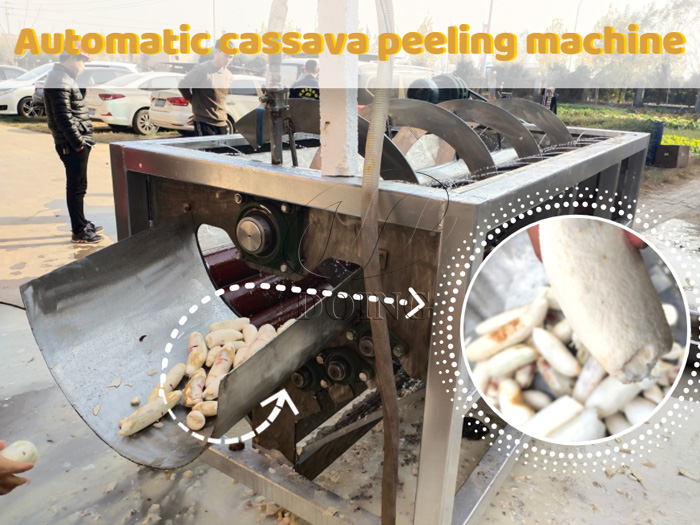 Cassava peeling equipment
Costs Between the Factory Gate and Your Warehouse
Ocean Freight and Container Packing
Ocean freight depends on three things: how big and heavy the machine is, how many units you are shipping, and which port you are delivering to.
The figures below are typical specifications for Jinrui Foodtech cassava peelers and can be used as a reference when estimating packing and container loading:
1–2 t/h model: 3 + 1.1 kW; 2,980 × 1,100 × 1,230 mm; about 850 kg.
2–3 t/h model: 4 + 1.1 kW; 3,490 × 1,380 × 1,700 mm; about 1,200 kg.
A single small-capacity peeler may be suitable for LCL (less than container load) shipment, while multiple units or larger models are usually more economical in a 20’GP or 40’GP container. Packaging is normally wooden case or steel-frame packaging suitable for ocean transport.
Ocean freight itself should be confirmed with your freight forwarder or with Jinrui Foodtech at the time of quotation, because rates change with season, port congestion and fuel surcharges. A practical way to plan is to request a freight quote for your destination port — for example Lagos/Apapa, Tema, Dar es Salaam, Jakarta or Manila — based on the confirmed packing size and container type.
Import Duty and Taxes
Import duty and taxes are usually the largest variable after the machine price. They depend on:
the HS code applied to cassava peeling machinery in your country;
the import duty rate;
VAT or GST;
any levies, surcharges or duty exemptions for agricultural or food-processing equipment.
Before budgeting, check the current HS code and duty rate with your local customs authority or clearing agent. Do not rely on a rate used in another country, even if the equipment is identical. If your country offers duty relief for agro-processing machinery, confirm the documentation required — such as an end-user certificate, investment approval or tax exemption letter — before shipment.
Insurance and Handling Fees
These items are smaller individually but easy to overlook.
Marine insurance: typically calculated as a small percentage of the insured value, often around 0.3%–0.5% of cargo value, depending on coverage and route. Confirm with your insurer or forwarder.
Customs clearance fee: paid to your clearing agent for preparing documents, filing declarations and releasing the cargo.
Port handling / THC: terminal handling charges, documentation fees and port service fees at the destination port.
Inspection or compliance fees: some countries require pre-shipment inspection, SONCAP, PVOC or similar conformity certificates.
Inland transport: trucking from the port to your factory, including any offloading or crane cost if the machine is delivered in a heavy wooden case.
Ask your clearing agent for a destination charge estimate before the vessel arrives. That single step prevents most "surprise" costs at discharge.
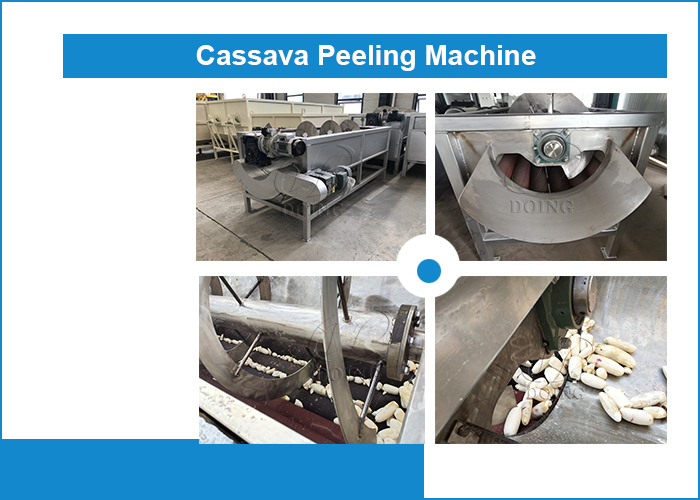 Cassava peeling equipment
Landed-Cost Calculation Template
Use the 1 t/h peeler at USD 6,500 as a working example. Replace each [to be confirmed] item with your actual quotation.
| Cost Item | Example Basis | Amount (USD) |
|---|---|---|
| Machine price | 1 t/h peeler | 6,500 |
| Ocean freight | To your destination port | [to be confirmed] |
| Marine insurance | ~0.3%–0.5% of insured value | [to be confirmed] |
| Import duty | Based on HS code and duty rate | [to be confirmed] |
| VAT / GST | If applicable at import | [to be confirmed] |
| Customs clearance | Agent fee | [to be confirmed] |
| Port handling / THC | Destination port charges | [to be confirmed] |
| Inland transport | Port to factory | [to be confirmed] |
| Estimated landed cost | [calculate] |
A useful rule of thumb: once freight, duty, taxes and handling are added, the landed cost will usually be materially higher than the machine price alone. That is normal. The question is not whether extra costs exist, but whether they are known, budgeted and competitive compared with local alternatives.
Import vs Buying Locally: When Importing Pays Off
Importing a cassava peeling machine makes more sense when:
the price difference between an imported unit and a locally sourced unit is significant;
you need a specific capacity or configuration, such as a defined brush-roller type or spray-washing system;
you plan to expand later into a fuller cassava processing line, and want equipment that shares the same design logic;
your local market has limited supply of industrial-grade peelers.
Buying locally may be preferable when:
you need the machine urgently and cannot wait for production and ocean freight;
your country has strong local fabrication with reliable after-sales support;
import duty, taxes and clearance costs remove most of the price advantage;
you are buying only one very small unit and would pay disproportionately high LCL and handling charges.
For buyers in Africa, Southeast Asia or South America, it is also worth asking whether the supplier has local service support or spare-parts availability in your region. That can reduce downtime risk without changing the landed-cost calculation.
FAQ
How do payment terms and exchange rates affect the final cost?
If your quotation is in USD but your revenue is in local currency, exchange-rate movement can change the effective cost between quotation and payment. For larger orders, ask your bank about forward contracts or USD settlement timing. Payment terms such as T/T or L/C also affect cash flow, though they do not change the landed-cost formula itself.
Is it cheaper to import a used cassava peeling machine?
A used machine may have a lower purchase price, but it can carry higher risk: uncertain wear on brush rollers, missing spare parts, non-standard electrical configuration, and limited warranty. For most small and medium processors, a new machine with confirmed specifications and spare-parts support gives a more predictable total cost.
Should I buy only a peeler or a complete cassava processing line?
If you only need peeling, a standalone peeler is sufficient. If you are producing garri, cassava flour, high-quality cassava flour or starch, a line that includes washing, peeling, rasping, pressing, drying and sieving may give better unit economics. The peeler then becomes one cost item inside a larger project budget.
What documents are normally required for importing a cassava peeling machine?
Typical documents include the commercial invoice, packing list, bill of lading, certificate of origin, insurance certificate, and any destination-country conformity or inspection certificate. Your clearing agent should confirm the exact list before shipment, because missing documents can delay release and add storage charges.
Get a Landed-Cost Quote for Your Capacity
Importing a cassava peeling machine is not difficult once every cost layer is clear. The machine price gives you the baseline; freight, insurance, duty and handling fees complete the picture. With those numbers in place, you can compare an imported unit against local options on a like-for-like basis.
If you are planning to import a cassava peeling machine, share your required capacity, destination port, preferred trade term and any configuration preference with Jinrui Foodtech. We will provide a landed-cost breakdown that covers the machine price, packing details, freight estimate and the cost items you need to confirm locally, so you can plan your budget with confidence.