

How to Choose a Fufu Flour Production Line Manufacturer That Exports to Africa
Finding a reliable fufu flour production line manufacturer that actually exports to Africa is less about browsing supplier directories and more about verifying four concrete capabilities: a production line built specifically for fufu processing, documented turnkey delivery experience on the continent, verifiable project references with real outcomes, and after-sales infrastructure that can respond before a production halt becomes a crisis. The framework below shows you exactly how to evaluate each criterion — and what red flags to watch for before you request a quotation.
Rather than repeating generic supplier claims, this guide walks through specific evaluation questions, real project evidence from Africa, and a practical comparison checklist you can use when requesting quotes. By focusing on verifiable capabilities instead of marketing language, you can objectively shortlist manufacturers that genuinely understand fufu flour production — and avoid the costly mistake of investing in equipment designed for a different process.
Production Line Capability and Process Fit
Fufu flour requires a specialized processing chain that differs significantly from standard cassava starch or garri production. A reliable fufu flour production line must follow a precise sequence: washing → peeling → crushing → fermenting → dewatering → drying → and packaging. Each stage requires dedicated equipment, including paddle washers, peelers, crushers, fermentation tanks, hydraulic or plate-frame dewatering machines, flash dryers, and automatic packing systems. When evaluating a fufu machine supplier, ensure they can demonstrate this complete workflow rather than offering generic cassava processing equipment.
Capacity is another critical factor, with fufu flour production lines typically configured in the 1–15 t/h range — the same capacity band as cassava flour plants. Key technical parameters to verify include fermentation temperature control, dewatering moisture content (typically below 40%), and drying efficiency. Jinrui Foodtech (Henan Jinrui) has delivered complete fufu flour production lines across Africa, including paddle washers and peelers through crushers, fermentation tanks, plate-frame filter presses, and flash dryers — demonstrating end-to-end line configuration rather than piecemeal equipment supply. The company’s production lines are configured specifically for fufu processing workflows, not adapted from unrelated starch or garri lines.
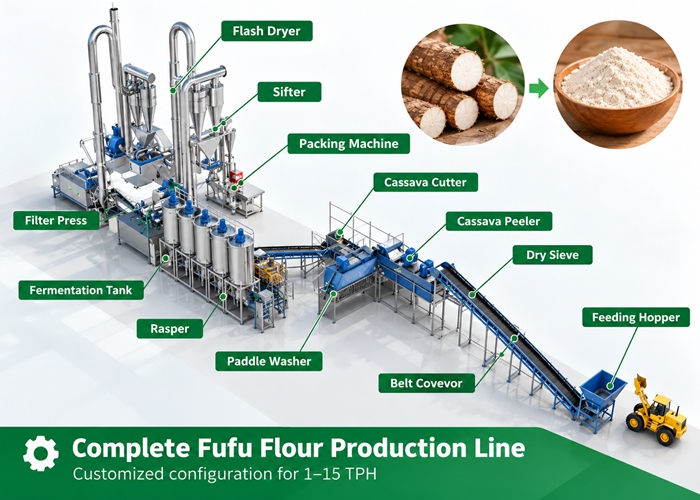 Fufu flour processing plant
Turnkey Project Delivery and Scope of Supply
A true turnkey delivery extends far beyond shipping individual machines. You must clearly understand the supply boundary: does the manufacturer provide only standalone equipment, or do they deliver an integrated system with verified interconnections? Equipment compatibility and process matching must be validated before shipment to prevent bottlenecks during installation. A comprehensive scope should also include transportation logistics, on-site installation, commissioning, and operator training.
Typical manufacturer-client division of labor involves the manufacturer handling equipment design, fabrication, and technical supervision, while the client manages civil works, local labor, and utilities. Jinrui Foodtech exemplifies this turnkey approach by managing the entire lifecycle from CAD layout design and equipment manufacturing to overseas shipping, on-site installation, commissioning, and hands-on training. This integrated delivery model eliminates the common pitfalls of coordinating multiple vendors and ensures that the fufu flour production line operates as a cohesive system from day one.
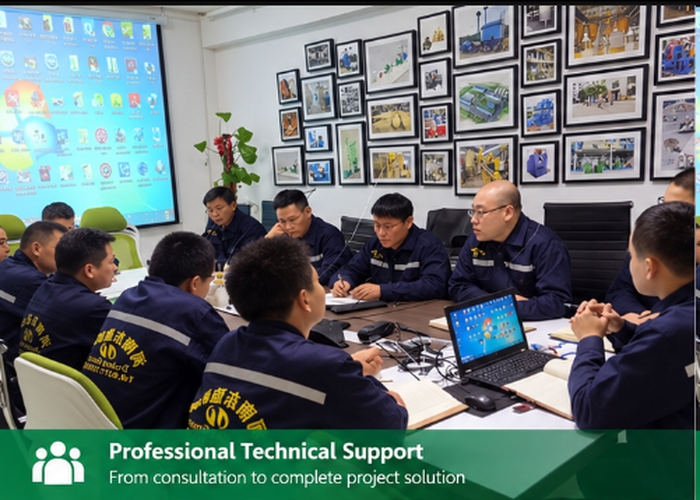 Technical support from Jinrui Foodtech
Proven Export Experience and Projects in Africa
Verifiable export performance is the strongest indicator of a manufacturer’s ability to deliver a complete fufu flour production line. Rather than relying on website case studies alone, request specific project details: what equipment was supplied, what services were included, and what outcomes were achieved. One such example is Jinrui Foodtech’s 8TPH cassava/fufu flour processing plant in Congo, Central Africa — which illustrates exactly what to look for when evaluating a manufacturer’s turnkey capability.
| Aspect | Details |
|---|---|
| Project Overview | 8TPH cassava/fufu flour processing plant in Congo, Central Africa |
| Production Method | Wet production method |
| Equipment Supplied | Paddle washers, peelers, crushers, fermentation tanks, plate-frame filter presses, flash dryers, packaging equipment |
| Services Provided | Full turnkey delivery: factory visit & technical briefing → contract signing → equipment manufacturing & quality inspection → shipping → remote installation guidance (video) → commissioning support |
| Turnkey Proof | End-to-end equipment supply + installation support demonstrates ability to deliver complete production lines, not just individual machines |
This project demonstrates how a single manufacturer can manage end-to-end delivery — from initial factory visits and technical briefings through equipment manufacturing, quality inspection, shipping, and remote installation guidance — proving that verified export experience in Africa means providing complete turnkey solutions with the technical support infrastructure to ensure successful commissioning and operation.
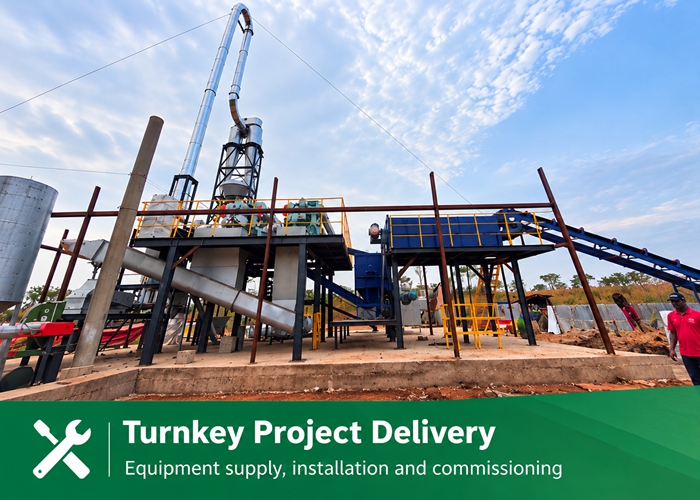 Fufu flour processing plant in Congo
After-Sales Support and Spare Parts Availability
After-sales support in Africa must be proactive, not reactive. Installation guidance can be delivered through on-site engineers or remote support, but the latter requires proven video guidance capabilities and comprehensive manuals. Spare parts availability is equally critical: local warehousing dramatically reduces downtime compared to shipping from China. Verify the manufacturer’s warranty terms, response time commitments, and remote diagnostic capabilities before signing any contract.
Jinrui Foodtech addresses these needs through the following after-sales infrastructure:
One-year warranty covering main equipment
Dedicated Nigeria office in Ogun State for local coordination and rapid response
1,000-square-meter overseas warehouse stocking spare parts for peeling, crushing, dewatering, sieving, and packaging equipment
Technical engineer team available for overseas on-site installation guidance
24/7 online remote video support for troubleshooting and operational guidance
Compare Manufacturers Before Requesting a Quotation
Before requesting quotations, use this comparison framework to objectively evaluate potential fufu flour production line manufacturers:
| Evaluation Dimension | Key Questions to Ask |
|---|---|
| Technical Configuration | Does the line include dedicated fufu fermentation and dewatering? What is the verified capacity range? |
| Project Evidence | Can you provide verifiable African project references with timelines and outcomes? |
| Scope of Delivery | Is installation, commissioning, and training included? What is the client’s responsibility? |
| After-Sales Conditions | What is the warranty period? Is there local spare parts storage in Africa? |
| Investment Range | What factors influence the final price? Are there hidden costs for installation or training? |
Request that candidates provide detailed process flow diagrams, equipment specifications, project case studies, and after-sales service agreements. Red flags include vague process descriptions, inability to provide verifiable African project references, no local support infrastructure, and pressure to sign without technical clarification. A reliable manufacturer will welcome thorough evaluation and provide transparent documentation.
Frequently Asked Questions
How can I verify that a manufacturer’s equipment meets food-grade material standards?
Request material certificates (e.g., SS304/SS316L test reports) for all food-contact surfaces and ask for third-party inspection reports. Reputable manufacturers will provide ISO 9001 certification and allow factory audits or video inspections of material storage and fabrication processes. Verify that welding meets food-grade standards and that surface finishes are smooth to prevent bacterial harborage.
What should I do if my site has unstable electricity supply?
Discuss power stability during the initial consultation. Manufacturers can integrate voltage stabilizers, backup generators, or motor soft-starters into the production line design. Specify your local voltage and frequency requirements upfront so that motors and control panels are configured correctly. Some manufacturers also offer low-voltage equipment options or hybrid power solutions for regions with unreliable grids.
How long does it take from equipment installation to full production?
Timeline varies by project complexity and site readiness, but typical commissioning takes 2–4 weeks after equipment arrival. This includes mechanical assembly, electrical connections, dry runs, wet testing, and operator training. Factors that accelerate this timeline include pre-fabricated modular designs, comprehensive installation manuals, and experienced on-site or remote technical supervision. Client preparedness (civil works, utilities, raw material availability) is often the biggest variable.
What is the typical starting investment for a fufu flour production line?
Entry-level fufu flour production lines typically start around $50,000 USD, but the final investment depends on multiple factors including capacity scale, equipment configuration (manual vs. automatic), automation level, transportation costs, installation fees, and site-specific customization. Always request itemized quotations that clearly separate equipment costs from services to enable accurate comparison and budget planning.
Discuss Your Fufu Flour Production Line Requirements with Jinrui Foodtech
Selecting the right fufu flour production line manufacturer requires rigorous evaluation of process capability, turnkey delivery experience, proven African project evidence, and after-sales support infrastructure. By systematically applying these four criteria, you can identify a partner who understands fufu flour production realities and can deliver reliable, long-term operational success in Africa.
If you are planning a fufu flour processing project and want to evaluate a manufacturer with verified African delivery experience, dedicated fufu process expertise, and localized after-sales support, share your project requirements with our team. Our team will provide a tailored technical proposal and transparent scope of supply to help you make an informed investment decision.