

How to Process Cassava Without Stable Electricity: A Practical Guide
Unstable electricity does not mean you have to give up mechanized cassava processing. In many parts of West and Central Africa, power supply is irregular — yet profitable cassava flour, starch, and garri operations run there every day. The difference is in how the operation is set up.
There are four practical ways to keep processing going when the grid cannot be trusted: use an alternative power source, choose equipment that tolerates unstable supply, adjust how and when you process, and design your plant layout around the power constraint. The sections below explain each one, and then show how to pick the combination that fits your situation.
Four Ways to Process Cassava Without Stable Electricity
Alternative Power Sources
The most direct fix is to stop depending on the grid. Diesel or gasoline generators are the common choice — they are widely available, quick to install, and can run the whole line. The trade-off is fuel cost — a typical diesel generator running a 30 kW cassava processing line costs approximately $2,000–$3,500 per month in fuel (based on 8 hours/day runtime at $1.00–$1.50/liter diesel in West Africa) — so many operations use generators only when the grid is down rather than as the primary supply.
Gas-powered generation is another route worth considering. LPG or natural gas generators run cleaner and can be cheaper to fuel than diesel where gas supply is reliable, and they avoid the storage and spoilage problems that come with keeping diesel on hand. In areas with steady organic waste, biogas is especially interesting: the peels and fiber left over from cassava processing can be digested to produce gas that runs a generator — turning plant waste into power — approximately 25–40 kg of fresh cassava peels can produce enough biogas to run a 5 kW generator for 1 hour under favorable digestion conditions — and lowering operating cost at the same time.
Solar systems are gaining ground, especially in remote areas far from reliable grid connection. A properly sized solar array with battery storage can power a processing line independently, and while the upfront cost is higher, the running cost is close to zero, with a payback period of approximately 4–7 years. Hybrid systems combine grid, generator, solar, and gas, switching between them automatically to keep production continuous.
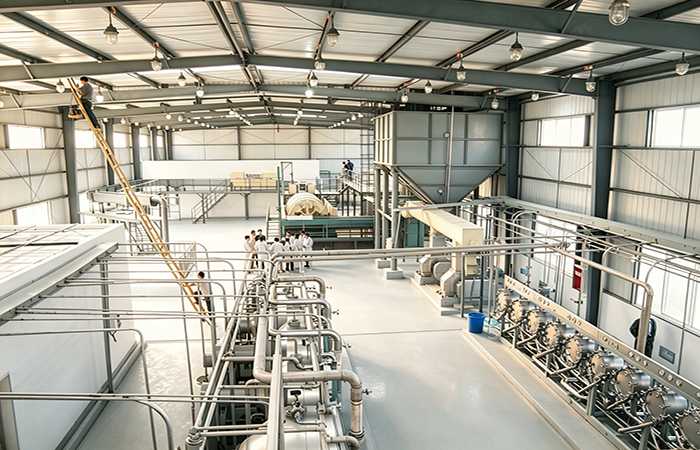 Cassava processing plant powered by gas generator
Choosing Equipment That Works with Unstable Electricity
Not all equipment responds to power problems the same way. Lower-power machines are generally more forgiving — they can run on a smaller generator or a modest solar setup, and they are less likely to trip when voltage dips. For reference, a typical small-scale cassava line (processing 200–500 kg/day) requires approximately 10–20 kW total, while a commercial-scale line (1,000 kg/day) may need 25–50 kW.
Equipment with built-in protection also matters. Features like overload protection, voltage stabilization, and automatic shutdown on fault prevent damage when the power surges or cuts out mid-cycle. Modular designs let you run one stage at a time instead of starting the entire line at once, which reduces the load spike that unstable supply struggles with.
Adjusting Your Production Strategy
Many areas have predictable windows when grid supply is steadier — often at night or off-peak hours (e.g., 22:00–06:00 in some regions) . Shifting your heaviest processing to those windows keeps the line moving without extra equipment.
Batch processing spreads the load: instead of processing a full day’s harvest in one continuous run, you process in smaller batches as power allows, keeping raw material moving through the line before it spoils. Simple pre-processing steps — washing and a short controlled storage — can also buy time, stretching the narrow freshness window cassava gives you.
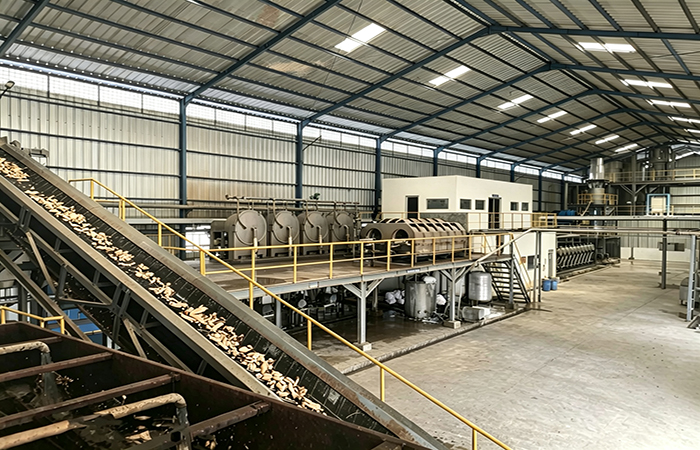 Cassava processing plant layout
Factory Layout and Workflow Design
How you arrange the plant affects how much you lose when power drops. Keep the stages that must run on electricity close to your alternative power source, and place fuel storage or gas connections where they are safe and accessible. Manual or low-power steps — washing, peeling, initial sorting — should sit where they can continue even during an outage.
Zoning the workflow this way means a blackout slows you down rather than stopping you completely. An emergency routine also helps: when power returns, know which batch to handle first so nothing sits too long. A layout built around the power reality of your location is often cheaper to implement than fighting that reality with bigger equipment.
How to Choose the Right Approach for Your Situation
These four options are not either/or — most plants use two or three of them together. To find the right mix, work through four steps rather than guessing.
Step 1 — Measure your outage profile. How many hours per day is power unavailable, and in what blocks? Under 2 hours spread through the day is very different from 8-hour daily cuts or no usable grid at all.
Step 2 — Calculate your line’s power demand. Add the rated kW of the machines you run together, plus 30% margin. For example, a typical garri line with washer (4 kW), peeler (4 kW), grater (5.5 kW), press (3 kW), and fryer (1.5 kW) totals approximately 18 kW power demand for the listed electric drives, requiring a minimum 24 kW power source.
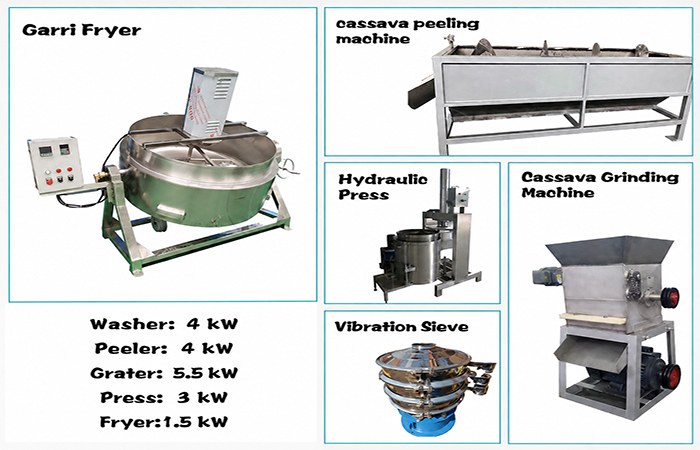 Power requirements for a garri production line
Step 3 — Match to a setup:
Scenario 1 — Short, infrequent outages (under ~2 h/day): Generator or gas unit as backup + equipment with voltage protection and soft starts. Estimated investment: $5,000–$10,000. Best for operations processing under 500 kg/day.
Scenario 2 — Regular multi-hour daily cuts (3–8 h/day): Scheduled batch processing + solar-plus-battery or hybrid system + modular staging. Estimated investment: $25,000–$50,000. Run during available power windows; modular design lets you prioritize high-energy stages.
Scenario 3 — No usable grid: Solar, gas, or hybrid as primary power, sized to full daily energy need of approximately 100–300 kWh/day (depending on line capacity of 500–2,000 kg/day). Estimated investment: $40,000–$100,000.
Scenario 4 — Very tight budget: Start with strategy and layout changes (near-zero cost) + a small used low-power machine (5–10 kW) on a generator. Initial investment: under $5,000. Scale up to solar or hybrid as revenue grows.
Step 4 — Combine methods. Most stable operations use two or three together: solar or gas primary plus modular equipment plus scheduled batching, because no single method covers every failure. Match the weakest link — fix power if power is the problem, fix workflow if budget is.
Unreliable electricity is a design challenge, not a reason to stay manual. Cassava processing continues in power-volatile regions because operators plan around the constraint instead of waiting for it to disappear. Companies like Henan Jinrui specialize in cassava processing equipment designed for various power conditions — consider consulting an equipment supplier once you’ve mapped your power profile using the steps above.
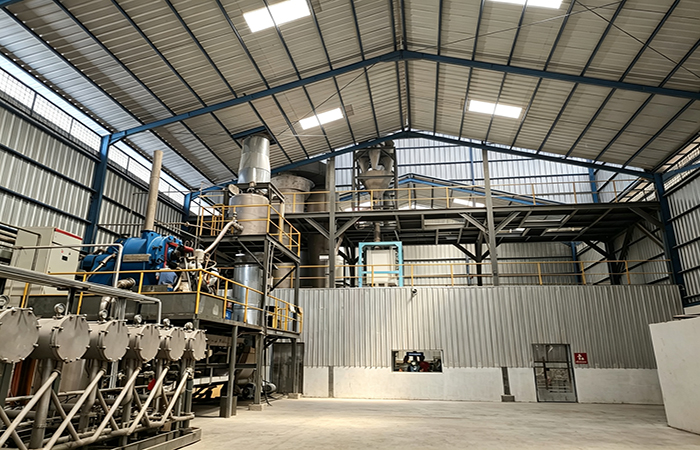 Cassava flour processing facility
Frequently Asked Questions
Q1: How much does it cost to set up solar versus a generator or gas system for a cassava plant?
For a small-scale setup (200–500 kg/day), typical costs are: diesel generator $3,000–$7,000 upfront + $300–$1,200/month fuel; gas generator $4,000–$8,000 upfront + $250–$900/month fuel; solar+battery $15,000–$30,000 upfront + near-zero running cost. Hybrid systems combine two or more sources and typically cost $20,000–$40,000 total. These ranges vary by region and line configuration — request a quote based on your specific setup for accurate figures.
Q2: What processing capacity can these solutions support?
All of them apply across scales. A small operation (200–500 kg/day) may run a single machine on a 5–15 kW generator or gas unit; a medium plant (500–2,000 kg/day) typically uses a hybrid system; a large plant (2,000+ kg/day) uses a modular hybrid line with dedicated power zones. The main limit is matching power capacity to total equipment load — which is why modular design helps, since you size power to the stages you actually run, not the whole plant at once.
Q3: Does unstable electricity affect the quality of the final product, or just output volume?
A3: Mostly it affects throughput — outages stop production and risk spoilage. Quality is hit indirectly: if cassava sits too long before processing, fermentation and spoilage change the final result. Stable processing protects both volume and consistency.
Q4: How do I start if my budget is very limited?
A4: Begin with what costs nothing: process during off-peak hours, run in batches, and rearrange the layout so manual steps continue during outages. A lower-power used machine on a small generator or gas unit can be the next step before committing to solar.
Q5: Is solar reliable during the rainy season or cloudy periods?
A5: Solar output drops in cloudy or rainy weather. Battery storage covers short gaps, and gas or hybrid systems switch in when solar falls. For areas with long cloudy seasons, solar alone is risky without a weather-independent backup source.