

Upgrading a Manual Cassava Dewatering Press: What Are Your Automation Options?
A manual cassava dewatering press can become a production bottleneck as processing volume increases. Manual loading, pressing, unloading, and material handling add labor and extend each batch cycle, while differences in operating pressure and pressing time can affect dewatering consistency.
Upgrading a manual cassava dewatering press usually involves three main automation options: Hydraulic Cassava Press for semi-automatic operation, Plate and Frame Filter Press for highly automated batch dewatering, and Screw Press Dewatering Machine for fully automatic continuous processing. The right option depends on your current equipment, target capacity, budget, and how much manual work you want to eliminate.
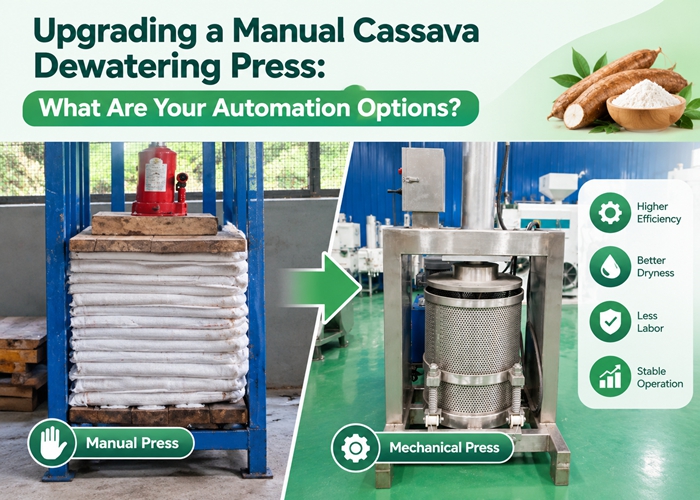 Cassava pressing machine
1. When Should You Upgrade a Manual Cassava Dewatering Press?
Three signs usually indicate that a manual press is becoming a production constraint:
Labor Costs Are Too High: Manual loading, pressing, unloading, and material handling require operators to stay at the press throughout repeated cycles. As daily processing volume increases, labor requirements can increase with it.
Processing Efficiency Is Too Low: Batch loading and unloading add non-pressing time to every cycle. If your target output is higher than the current press can handle within available working hours, dewatering can become a bottleneck.
Dewatering Quality Is Inconsistent: Manual control of loading volume, pressing time, and operating pressure can cause differences between batches. Uneven dewatering can affect the material entering the next processing stage.
2. What Are Your Automation Options for Upgrading a Manual Cassava Dewatering Press?
There are three practical equipment paths, ranging from semi-automatic batch pressing to fully automatic continuous dewatering.
| Option | Automation Level | Main Feature | Typical Application |
| Hydraulic Press | Semi-Automatic | Automatic hydraulic pressing | 1–5 TPD production, limited investment |
| Plate Frame Filter Press | Highly Automated | Automated filtration and cake discharge | Stable batch dewatering |
| Screw Press Dewatering Machine | Fully Automatic | Continuous feeding, pressing and discharge | Production lines over 10 TPD |
Option 1: Hydraulic Press
A hydraulic press is a practical upgrade when you want to automate the pressing operation without moving directly to a continuous system.
The typical operating sequence is straightforward:
Operators load the cassava mash.
The hydraulic system performs the pressing cycle automatically.
Operators remove the dewatered material after pressing.
Jinrui Foodtech (Henan Jinrui) offers hydraulic systems with pressing forces from 5–150 tonnes, adaptable to different production scales. The target dewatered material moisture content can be below 40%, depending on the cassava material and process conditions.
For a project targeting 1–5 TPD, the hydraulic press can reduce manual pressing work while keeping feeding and unloading relatively simple. The equipment is suitable when the plant needs higher pressing efficiency without the investment and process requirements of a fully continuous dewatering system.
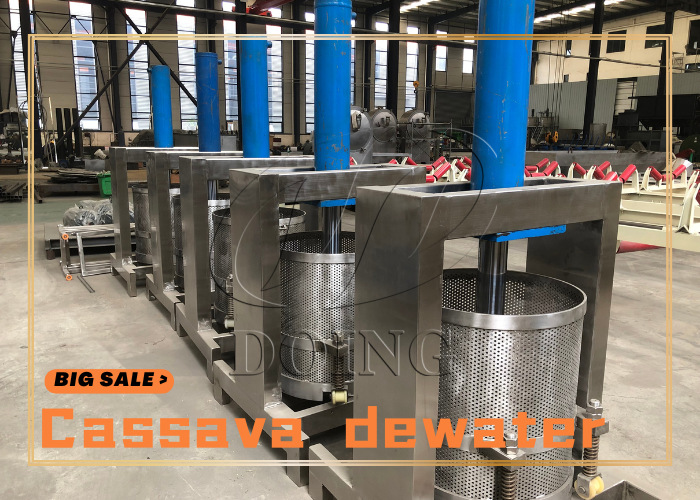 Hydraulic press
Option 2: Plate Frame Filter Press
A plate frame filter press is suitable when the priority is highly automated batch dewatering with limited operator intervention.
Jinrui Foodtech's plate and frame filter press can include a PLC automatic control system, allowing automated operation of the filtration and plate pulling process. This reduces the need for operators to manually control each filtration stage and unload the filter cake after every cycle.
Depending on the model and production requirement, the system can use 30–70 m² of filtration area and 498–1109 L of chamber volume per cycle.
However, a plate frame filter press remains a batch dewatering system. Its practical throughput depends on filtration area, chamber volume, cycle time, and the characteristics of the cassava material. It is therefore suitable when automated batch operation and stable dewatering are priorities.
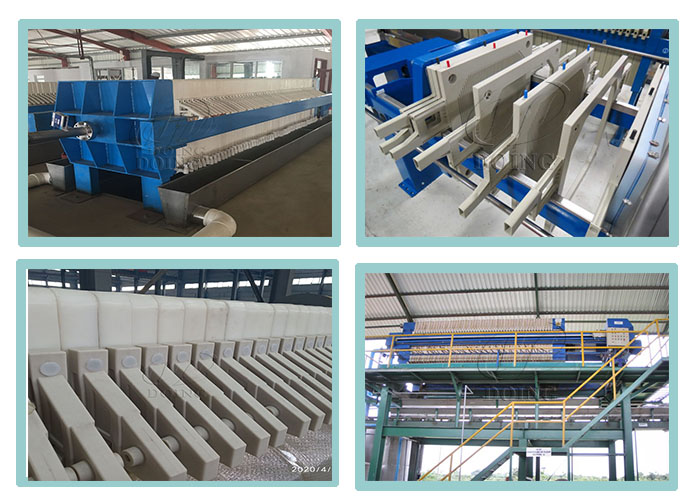 Automatic cassava pressing machine
Option 3: Screw Press Dewatering Machine
A screw press dewatering machine is designed for continuous operation. Cassava material enters the machine continuously, is mechanically compressed as it moves through the screw chamber, and exits without repeated manual loading and unloading.
Jinrui Foodtech's screw press is designed for large-scale continuous production, typically suitable for processing lines with a capacity of over 10 TPD.
The main automation advantages include:
Continuous material feeding
Continuous mechanical pressing
Continuous discharge
Low direct operator involvement
This makes the screw press particularly suitable for larger cassava processing plants where continuous production, higher throughput, and reduced manual labor are important requirements.
3. Semi-Automatic vs. Fully Automatic Dewatering: Which Fits Your Plant?
The three options differ not only in automation level, but also in processing mode, investment, and operator requirements.
| Factor | Hydraulic Press | Plate Frame Filter Press | Screw Press |
| Automation Level | Semi-Automatic | Highly Automated | Fully Automatic |
| Manual Involvement | Feeding and unloading | Limited | Low |
| Investment Level | Lower | Medium to Higher | Higher |
| Processing Mode | Batch | Batch | Continuous |
| Processing Capacity | Medium | Limited by filter area and cycle | Higher continuous throughput |
| Operation Requirements | Relatively simple | More process control | Continuous feed and machine control |
| Typical Application | Medium production, limited budget | Stable batch dewatering | Higher-capacity continuous production |
4. How to Choose the Right Upgrade Path for Your Cassava Processing Line
Use your actual production requirements rather than the automation level alone when selecting the equipment.
| Project Requirement | Suitable Upgrade Path |
| Limited investment + medium capacity + manual feeding and unloading acceptable | Hydraulic Press |
| High automation requirement + stable batch dewatering + capacity within equipment range | Plate Frame Filter Press |
| Continuous operation + higher processing requirement + low manual involvement | Screw Press Dewatering Machine |
Before making the final selection, confirm these key project conditions:
Cassava input: fresh roots, mash, or another processed material
Target capacity: required TPD or TPH output
Working hours: planned operating hours per day
Dewatering requirement: target moisture level after pressing
Existing equipment: current press model, capacity, and configuration
Automation requirement: how much manual feeding, unloading, and process control you want to eliminate
The equipment should be sized around the actual production requirement rather than selected only by its automation label.
Frequently Asked Questions
What is the difference between a hydraulic cassava press and a screw press?
A hydraulic cassava press normally works in batches, with operators loading and unloading the material, while the hydraulic system performs the pressing cycle. A screw press works continuously, with automatic feeding, mechanical compression, and continuous discharge. The choice depends mainly on production capacity, labor requirements, investment level, and whether continuous operation is required.
Can a plate and frame filter press handle large-scale cassava processing?
A plate and frame filter press can be used for higher-volume cassava processing, but its practical throughput depends on filtration area, chamber volume, cycle time, and material characteristics. For larger plants, the required throughput should be calculated first. Multiple filter presses or a continuous dewatering system may be considered when the required capacity exceeds the practical range of a single unit.
How much does it cost to upgrade a manual cassava dewatering press?
There is no fixed upgrade cost because the investment depends on the equipment type, processing capacity, automation level, and supporting configuration. The existing press, target capacity, product, and required degree of automation should be evaluated first. A project using a hydraulic press will have different equipment requirements from one using an automated plate and frame or screw press.
Can a hydraulic cassava press be used for both gari and cassava flour processing?
A hydraulic cassava press can be used in both gari and cassava flour processing, depending on the material condition and downstream process requirements. The required pressing force, batch volume, cycle time, and target moisture level should be checked for the specific process. Equipment selection should therefore be based on the actual cassava material and required output rather than product name alone.
What information is needed to select an automatic cassava dewatering machine?
The key information includes cassava material condition, target processing capacity, current dewatering equipment, desired automation level, daily working hours, and required dewatering level. Photos, equipment specifications, and the current production process are also useful. With these details, the dewatering equipment can be selected and sized according to the actual production requirement.
Upgrade Your Cassava Dewatering Equipment
Upgrading from manual to automatic dewatering does not require the same equipment approach for every plant. A hydraulic cassava press can reduce manual pressing work for 1–5 TPD projects, a plate and frame filter press can provide highly automated batch dewatering, while a screw press is designed for continuous production lines over 10 TPD.
Jinrui Foodtech can evaluate your existing dewatering equipment and production requirements to determine a suitable upgrade configuration. Send us your required capacity, current equipment photos or specifications, and target automation level. Our engineers can assess the existing process and recommend an appropriate dewatering equipment configuration for your project.