2026-03-04
The global cassava market is poised for significant growth, with projections indicating an increase from USD 178.46 Billion in 2025 to USD 260.67 Billion by 2034, representing a CAGR of 4.3%.
For investors considering entry into this sector, understanding the complete financial landscape—from investment cost requirements to business planning—is essential for building a profitable and sustainable venture.
Understanding Your Investment Cost Breakdown
Establishing a cassava processing plant involves several interconnected cost components that vary based on capacity, technology level, and location.
Capital Costs
Machinery Costs: Represent the largest portion of capital expenditure, typically accounting for 40-50% of total investment. Essential cassava processing equipment includes washing systems, mechanical peelers, raspers or graters, hydraulic presses, drying units (flash dryers or belt dryers), milling machines, and packaging systems
Land and Site Development: Includes land acquisition, registration, boundary development, and site preparation
Civil Works: Construction of processing halls, raw material storage, finished goods warehouses, quality control laboratories, and administrative buildings.
For a medium-scale cassava processing plant processing 30-50 tons of fresh cassava daily, the complete investment typically ranges from $400,000 to $800,000, while smaller starter lines (5-10 tons/day) can be established for $80,000 to $200,000.
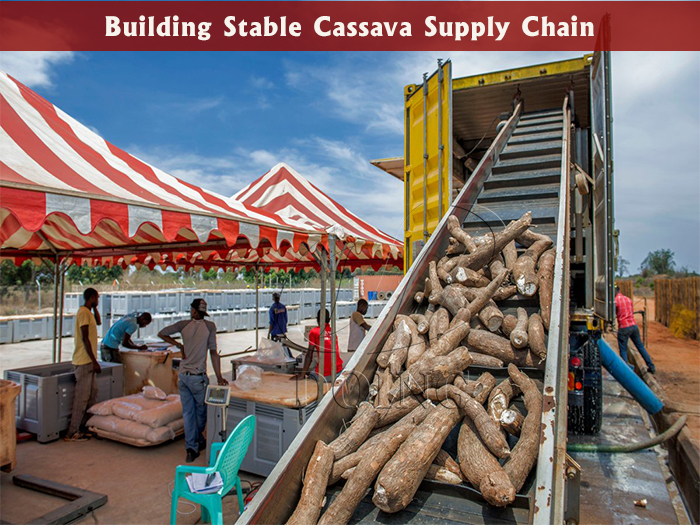 cassava processing chain
Operational Cost
Ongoing costs determine your profitability and require careful planning:
Raw Materials: Fresh cassava accounts for 60-70% of total operating expenses. Securing reliable suppliers and negotiating long-term contracts is essential for price stability.
Utilities: Electricity, water, and fuel represent 15-20% of OpEx. Energy-efficient equipment and alternative power options (diesel coupling, biogas from waste) can significantly reduce these costs
Labor: Workforce requirements vary with automation level. A medium-scale plant typically employs 5-12 workers for operations, maintenance, quality control, and administration.
Packaging and Transportation: These costs vary based on target markets—local versus export.
Profitability Expectations
Well-designed cassava processing plants demonstrate healthy returns:
Gross Profit Margins: Typically range between 25-35%
Net Profit Margins: Average 10-15% under normal operating conditions
Payback Period: Well-planned operations typically recover investment within 3-5 years
Strategic Business Planning Suggestions
Product Focus on Market
The cassava market divides into two primary segments, each with distinct requirements
Food-Grade Products: Fufu flour, garri, cassava flour for baking—these serve the growing demand for gluten-free and ethnic foods. The global gluten-free food market is expanding rapidly, with cassava flour as a preferred wheat alternative.
Industrial Derivatives: Starch, modified starch, ethanol—these serve paper, textile, pharmaceutical, and biofuel industries. The paper packaging market alone is projected to reach USD 28.3 Billion by 2033, driving starch demand.
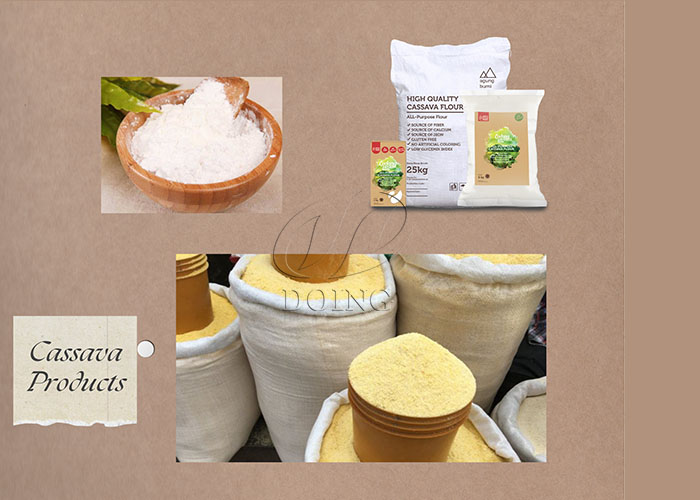 cassava products
Capacity Selection
Cassava processing plant choices should balance investment with long-term efficiency:
For Small-Scale Entry (1-5 tons/day): Semi-automatic garri processing lines with manual feeding offer affordable entry points
For Medium-Scale Production (10-30 tons/day): Fully automated cassava flour or starch making lines with PLC control ensure consistency and labor savings
For Large-Scale Industrial (50+ tons/day): Complete integrated systems with maximum efficiency and traceability.
Henan Jinrui Turnkey Project – Nigeria Cassava Flour Processing Plant
In 2023, Henan Jinrui company successfully commissioned a complete cassava flour processing plant in Congo, designed to process 8 tons of fresh cassava daily, producing 700 tons of high-quality cassava flour annually.
Project Scope
Our team provided comprehensive services including: complete plant layout and process design, supply and installation of all processing equipment, training for local operators and maintenance staff, ongoing technical support from our Nigeria branch office.
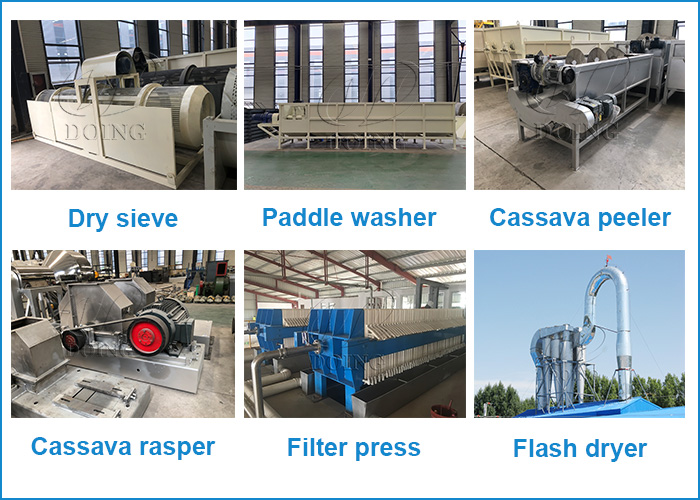 cassava flour processing line
Equipment Line Configuration
Automated Cassava Washing and Peeling System: Paddle washers and mechanical peelers ensuring 99% cleaning efficiency.
High-Efficiency Rasping Mills: Achieving over 95% starch extraction
Dewatering Presses: Reducing moisture efficiently to 40% before drying
Flash Dryer System: Precisely controlling moisture to 10-12%
Hammer Mills and Sieving Units: Producing uniform, fine flour
Automated Packaging Line: Ensuring product protection and brand presentation
If you have interests in investing in cassava processing plant, chat with us! A turnkey solution will be offered to you based on your needs!
Want to know more about our products or services? Fill out the contact form below, and we’ll to get back to you and you will get the price list. Please also feel free to contact us by email or phone.( * Denotes a required field).