2026-06-23
Cassava flour is a growing business opportunity worldwide. But turning fresh cassava into fine, market ready flour requires the right process and equipment. Next, Henan Jinrui will walk you through the complete cassava flour production process, the key machines involved, and how to choose the right solution for your business.
Cassava flour production follows a clear sequence of steps. Depending on your raw materials and final product requirements, you can choose between two main process routes: the dry cassava flour process and the wet cassava flour process. Each has its own advantages, and the right choice depends on your specific needs.
Dry Cassava Flour Process
The dry process of cassava flour is the simpler and more cost effective method. Fresh cassava is washed, peeled, and cut into chips. The chips are then dried – either under the sun or using a belt dryer – until the moisture content drops to around 12%. Once fully dried, the cassava is milled into flour and sieved to achieve uniform particle size.
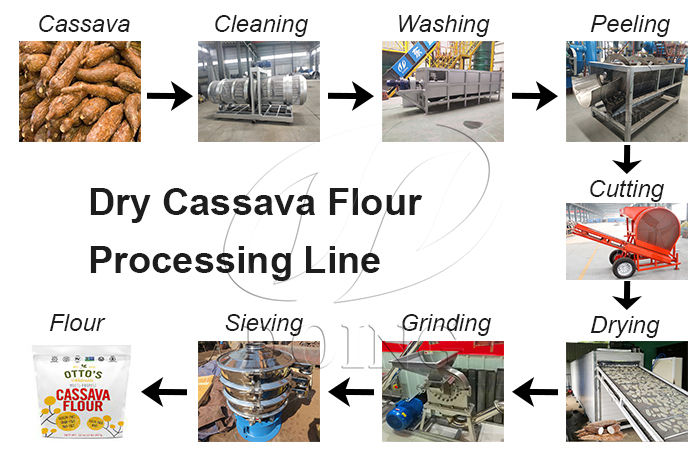 Dry cassava flour processing line
Wet Cassava Flour Process
The wet process of cassava flour involves an extra step: after peeling, the cassava is crushed into a fine pulp and then dewatered to remove excess moisture. The resulting wet cake is then dried and milled into flour. This method produces a finer, whiter flour with a more neutral taste, making it ideal for high quality food applications.
Dry vs Wet Process: Which One Should You Choose?
| Comparison Dimension | Dry Process | Wet Process |
| Equipment investment | Lower (no dewatering stage) | Higher (additional crushing and dewatering equipment) |
| Flour whiteness | Light cream to off-white | White to bright white |
| Fiber content | Higher | Lower (refining step removes more fiber) |
| Particle fineness | 40–80 mesh typical | 80–120 mesh achievable |
| Suitable markets | Local/regional, price-sensitive | Premium, export, food industry |
| Typical payback period | 6–10 months | 10–18 months |
| Recommended for | Startups, limited budget | Established processors, export-oriented |
If you are starting with limited capital and targeting local markets, the dry process is a practical entry point. If you need higher product quality for premium or export markets, the wet process justifies the additional investment.
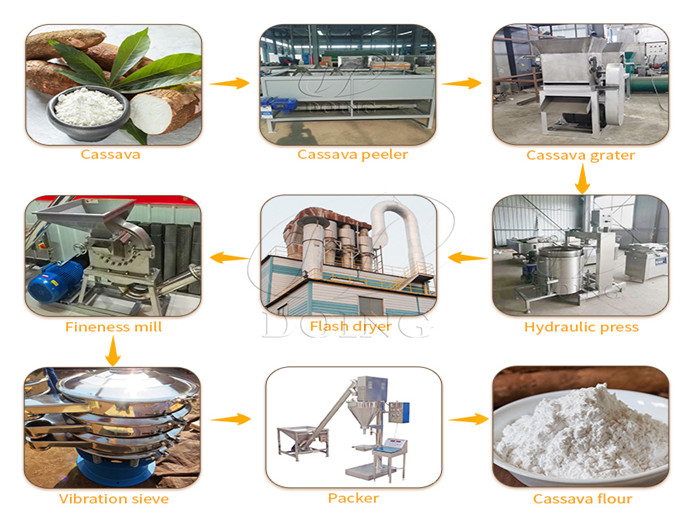 Wet cassava flour processing line
A complete cassava flour production line consists of several key machines, each playing a specific role in the process.
| Equipment | Function | Key Specification | Impact on Final Product |
| Washing machine | Removes dirt, sand, and surface impurities from fresh cassava roots | Throughput: 2 t/h – 5 t/h; stainless steel 304 | Cleaner raw material = lower microbial load and better flour color |
| Mechanical peeler | Removes cassava skin automatically | Peeling rate: >90%; labor saving: up to 80% | Consistent peeling reduces dark spots and improves flour whiteness |
| Crusher / grater | Breaks cassava into small pieces (dry process) or fine pulp (wet process) | Adjustable particle size; capacity: 1 t/h – 3 t/h | Uniform pulp/mash ensures consistent drying and milling results |
| Dewatering machine (wet process only) | Removes excess moisture from cassava pulp after crushing | Moisture after dewatering: ~40%; processing time: 10–20 min/batch | Lower moisture before drying reduces energy use and improves drying uniformity |
| Dryer | Reduces moisture content to ~12% for safe storage and milling | Belt dryer or flash dryer; capacity: 500 kg/h – 5 t/h | Even drying prevents burnt flavor and ensures stable shelf life |
| Milling machine | Grinds dried cassava into fine flour | Adjustable fineness: 40–120 mesh; capacity: 200 kg/h – 2 t/h | Most critical machine — determines final texture, mouthfeel, and market grade |
| Sieving machine | Separates coarse particles to ensure uniform flour fineness | Multi-layer screens; adjustable for different mesh sizes | Consistent particle size meets buyer specifications and prevents complaints |
| Packaging machine | Automatically packages finished flour | Semi-auto or fully auto; weighing accuracy: ±0.5% | Professional packaging extends shelf life and meets export labeling requirements |
Choosing the right equipment doesn’t have to be complicated. Just ask yourself five simple questions – and the answers will guide you to the right solution for your business.
Daily output target – Define your production scale first. Small operations (1–5 tons/day) work well with semi automatic lines, while medium to large producers (10–50+ tons/day) need fully automatic systems for higher capacity and lower labor costs.
Raw material type – Fresh cassava with high moisture suits wet processing for purer, whiter flour. Dry cassava chips or limited water supply? Dry processing is simpler and more cost effective.
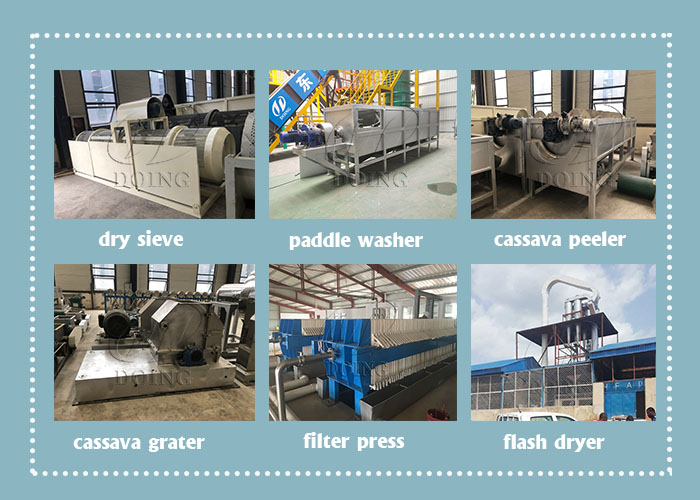 Henan Jinrui cassava flour processing equipment
Labor situation – Semi automatic lines cost less upfront but require more workers. Fully automatic lines save labor and ensure consistent quality – a smarter choice for long term operations.
Target market – Local, price sensitive markets accept standard flour (40–60 mesh). Premium or export markets require finer flour (80–120 mesh) – which means you need a fine grinding mill. This equipment is the key to higher product value.
Supplier reliability – Don’t just compare prices. Look for 304 stainless steel construction, strong after sales support (installation, training, spare parts), and proven experience with complete production lines.
Answer these five questions, and you’ll know exactly what you need – not just the cheapest option, but the right fit for your business.
Cassava flour processing can be a profitable business when you have the right equipment and support. The right machinery makes all the difference – it determines your product quality, production efficiency, and long-term profitability. Henan Jinrui offers complete cassava flour production lines with 304 stainless steel, tailored to your capacity and budget. If you have any questions or needs, please feel free to contact us.
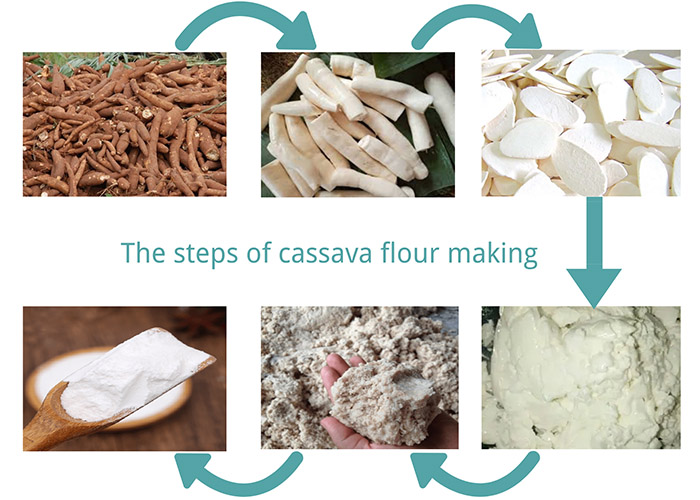 the steps of caassava flour making
Frequently Asked Questions About Cassava Flour Processing
Q1: Can I produce both cassava flour and garri with the same equipment?
A: Partially. Washing and peeling equipment can be shared between both product lines. However, garri requires fermentation and frying equipment, while cassava flour (wet process) requires dewatering and drying equipment. A flexible factory layout can accommodate both lines, but it requires careful planning at the design stage to avoid cross-contamination and process conflicts. Henan Jinrui provides integrated multi-product project planning for processors who want to diversify.
Q2: What certifications do I need for cassava flour?
A: Requirements vary by market. For domestic sales in most countries, basic food safety registration and facility certification are the baseline. For export markets, HACCP and ISO 22000 are commonly required. Specific requirements depend on your destination country — the EU, Middle East, Southeast Asia, and West Africa each have distinct food import regulations. We help customers understand the certification requirements for their target market before finalizing equipment configuration.
Q3: What is the ideal fineness for cassava flour?
A: It depends entirely on your target market. For standard local markets and general cooking, 40–60 mesh flour is sufficient and more affordable to produce. For premium food applications — snacks, gluten-free products, or export to food manufacturers — 80–120 mesh flour is recommended. Finer flour has a smoother texture, better mouthfeel, and commands a higher price. Henan Jinrui’s milling machines support adjustable fineness across the full range, so you can produce for both standard and premium markets.
Q4: How long does it take to set up a cassava flour production line?
A: Setup time depends on scale and site readiness. A semi-automatic line for 1–5 tons per day typically takes 2–4 weeks for installation and basic operator training. A fully automatic line for 10+ tons per day requires 4–8 weeks, including system integration and commissioning. An industrial-scale plant may take 2–3 months covering full civil work, equipment installation, and trial production runs. We provide on-site installation guidance and training to ensure a smooth startup regardless of scale.
Want to know more about our products or services? Fill out the contact form below, and we’ll to get back to you and you will get the price list. Please also feel free to contact us by email or phone.( * Denotes a required field).