

Hydrocyclones in Cassava Starch Processing: How They Separate, Wash and Purify Starch
A hydrocyclone station in a cassava starch line does three things in sequence: it separates starch granules from fine fibre, protein and pectin; it washes them by counter-current displacement to strip out soluble impurities; and it purifies the milk to 20–23 °Bé at roughly 99.5 % separation purity before it reaches the dewatering centrifuge. It also concentrates the milk to cut drying energy and, through a short recovery section, pulls starch back from the overflow to protect yield.
When buyers price a cassava starch line, the station is often the part they understand least and undersize most. It looks like a simple stainless frame holding a row of cones, so it gets treated as a generic filter to be bought on price alone. Every bit of purity or yield given up here is baked into every tonne the plant produces afterwards — you cannot win it back by running the centrifuge harder or the dryer hotter.
A Quick Way to Read the Station
| Job the station does | What good output looks like | What a wrong spec costs you |
|---|---|---|
| Separate | Underflow carries dense starch; overflow carries fine fibre, protein, pectin and cell liquor | Starch leaves with the waste overflow; extraction drops |
| Wash & Purify | Starch milk refined to 20–23 °Bé at up to 99.5% separation purity | Grey, off-odour starch that fails food-grade buyers |
| Concentrate & Recover | Thicker underflow feeds the dewatering centrifuge; a recovery stage pulls starch back from the liquor | Higher drying fuel; starch discharged with the effluent |
Where the Hydrocyclone Station Sits in the Cassava Starch Line
A cassava starch line moves the material through a fixed order: the rasped pulp is screened on a centrifugal sieve to release raw starch milk, a fine residue screen and a desander strip out grit and coarse particles, and only then does the slurry reach the hydrocyclone station. What leaves the station is a cleaned, concentrated starch milk, which is handed to the dewatering centrifuge for the final moisture reduction before drying.
Two points follow directly from that position. First, the station processes starch milk, not raw cassava pulp — by the time slurry reaches it, most fibre and sand are already gone, so its job is fine purification, not bulk separation. Second, the station does not dewater. Pulling free water out of the starch is the centrifuge downstream; confusing the two is one of the most common specification errors, and it leads buyers to expect a dry cake from a unit engineered to output a concentrated liquid.
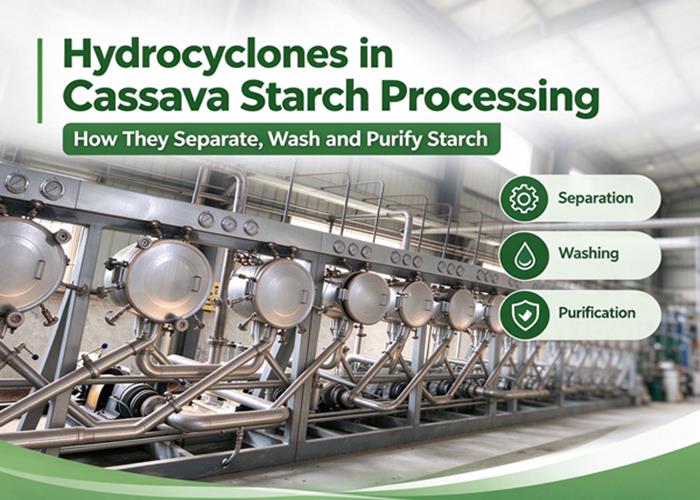 Hydrocyclones for cassava starch processing
How It Separates Starch Milk from Impurities
A hydrocyclone has no moving parts, so the easiest way to understand it is to follow one drop of starch milk through a single cone. Here is what happens, in order:
1. It enters under pressure. Starch milk is pumped in tangentially — along the wall, not straight down — which sets the whole column of liquid inside the cone spinning.
2. The spin does the sorting. That rotation builds a centrifugal field far stronger than gravity, and the only thing that decides where a particle goes is how dense it is. The flow inside the cone is turbulent and three-dimensional, so particles stay suspended long enough to settle by weight rather than simply being dumped by size.
3. Heavy starch and light waste leave by different doors. Dense starch particles are flung outward and downward and leave as the underflow at the cone’s tip; the lighter fraction — fine fibre, protein, pectin and cell liquor — drifts to the calmer centre and leaves upward as the overflow.
What to watch when you buy. Read the underflow, not the pump. A clean underflow means the cone is doing its job. If starch is showing up in the overflow, the cause is almost never the pump — it is the wrong tube size, the wrong feed pressure, or too few stages for the load.
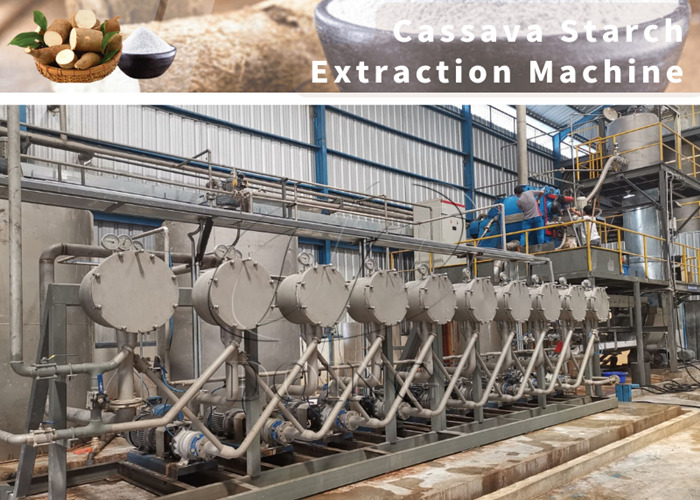 Cassava starch extraction equipment
How It Washes and Purifies the Starch Milk
Separation decides how pure the starch could be; washing is what actually gets it there. The station runs this as a counter-current displacement wash, with the water and the starch moving in opposite directions.
1. Clean water enters at the last stage, not the first. In a staged station the fresh water is added at the final, cleanest stage — it is not poured in with the feed.
2. The starch travels the opposite way. The concentrated starch moves stage by stage back toward the front, meeting water that is dirtier the closer it sits to the feed.
3. The counter-flow pushes impurities out. Meeting progressively dirtier water, the starch gives up the protein, pectin and soluble colouring still riding in the cell liquor; those leave as the overflow at the first stage, so the starch only ever meets clean water at the end.
Staged and sized properly, that wash takes the starch milk to a density of 20–23 °Bé at a separation purity of up to 99.5% — the line between a bright, low-odour starch a food buyer will pay for and a grey one that sells cheap.
Two benefits ride along with the same principle, and both carry real cost:
Thicker output, cheaper drying. The underflow leaves more concentrated than the feed, so the dewatering centrifuge and dryer downstream remove less water per tonne of starch — less fuel and power across the plant’s whole life.
Starch pulled back from the waste. Adding one to three recovery stages lets the station claw residual starch out of the cell liquor that would otherwise drain away, lifting overall extraction without touching the front end of the line.
For exactly these two reasons Jinrui Foodtech (Henan Jinrui) builds its cassava hydrocyclone station on an 18-stage configuration that includes the recovery section, rather than a minimal single-pass setup.
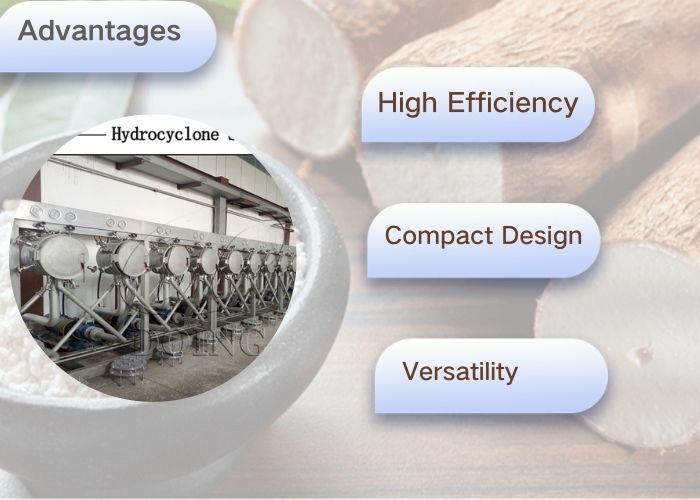 Jinrui Foodtech's hydrocyclone station
Sizing the Station to Your Output
Because a hydrocyclone is selected by throughput, not by price, the question is never "which cone is cheapest" but "which station keeps the right flow velocity at my capacity". Sizing too small overloads the tubes and sends starch to waste; sizing too large wastes floor space and pressure. The stations are built in a stepped range that maps to plant size:
| Station model | Approx. throughput |
|---|---|
| XLQ219 | around 4 t/h |
| XLQ273 | around 10 t/h |
| XLQ325 | around 20 t/h |
| XLQ377 | around 30 t/h |
| XLQ450 | around 50 t/h |
| XLQ530 | around 75 t/h |
At Jinrui Foodtech, every one of these stations is built on a stainless-steel frame with nylon-66 hydrocyclone tubes — a choice that matters more than it sounds: the tubes run full of abrasive starch and sand around the clock, and a wear-resistant liner is what keeps the underflow density stable instead of drifting as the openings enlarge. When you request a station for a specific starch output, the supplier should return the matching model from this range, not a catalogue page and a price.
Frequently Asked Questions
Is a settling pond enough, or do I really need a hydrocyclone station?
A settling pond can thicken starch, but it does so in open tanks over 24–48 hours, takes heavy floor space, and offers no washing action — protein and pectin stay in the product, and the open water is a contamination and odour risk. A hydrocyclone station runs continuously, washes as it concentrates, and delivers a closed 20–23 °Bé underflow. For any line meant to sell food-grade starch at a stable price, the station is the part worth paying for.
Are more stages always better?
More stages raise purity and whiteness, but each stage adds pumps, pressure drop and cost, so the aim is "enough stages for the purity your market demands", not the maximum. An 18-stage configuration with a recovery section is a balanced reference point; the right number for a specific plant is best settled with the supplier against your target starch quality — a decision worth its own detailed guide rather than a guess here.
Does a hydrocyclone duplicate what a disc-stack separator already does?
No — they work on different things. A disc-stack separator is mainly for removing specific-gravity impurities and clarifying, while the hydrocyclone handles the bulk fine-particle separation, washing and concentration of the starch milk across many parallel stages. In a full cassava line they are complementary, not alternatives, and a supplier who offers only one in place of the other is usually simplifying at your expense.
How long do nylon-66 hydrocyclone tubes last, and how do I know when to replace them?
Life depends on feed abrasiveness and run hours rather than a fixed calendar, so judge it by output, not by time. A reliable sign of wear is a gradual drift in underflow density or a rising starch content in the overflow, as the tube outlets enlarge and lose their calibrated geometry. Keeping a stocked set of spare tubes — and the model numbers to order them — is cheaper than losing extraction between replacements.
My starch looks grey and dull — is the hydrocyclone to blame?
Usually, yes, and it is fixable. Dull, grey starch most often means the wash and purification stages are under-sized, too few, or run at the wrong feed pressure, so protein, pectin and cell-liquor colouring are not displaced to the overflow. Before blaming the raw root, check that the station is delivering a 20–23 °Bé underflow at the design purity and that the recovery and wash stages are actually in service.
Choose the Station on Process, Not on Price
The hydrocyclone station earns its place in a cassava starch line by doing three things the machines around it cannot: separating starch from fine impurities on density, washing and purifying the starch milk to a clean 20–23 °Bé, and — with the right stages — concentrating and recovering starch that would otherwise be lost. Read it that way and the purchase stops being a price comparison between cones and becomes a decision about the purity, yield and running cost of everything downstream.
If you are configuring a cassava starch line and want the station matched to your real output, share your daily cassava throughput and your target starch quality — Jinrui Foodtech can size the station from the 4 to 75 t/h range, confirm the stage and recovery setup, and place it correctly against your centrifuge and dryer.