

How Can a Cassava Farming Cooperative Turn Fresh Roots into Starch Before They Spoil: A Setup Guide
Sizing the line to its peak daily root intake, rather than its annual tonnage, is what keeps a small cassava farming cooperative's harvest out of the spoil heap. Fresh roots begin to deteriorate within 24 hours of harvest, so the equipment has to move cassava through faster than it decays.
The sections below follow the decisions in order: processing window, capacity, equipment, site and power, then phasing.
Processing Window for Fresh Cassava Roots
Cassava spoilage begins within 24 hours of harvest — vascular streaking appears first, and microbiological rot usually follows between days five and seven. FAO guidance is to finish processing no later than day four, by which point the starch content of a root has already fallen from roughly 24% to about 20%; by day six it is near 11%. Transport time counts inside that window, so the practical rule is simple: buy for the rate you can process, not the volume you can grow.
Capacity Planning for Your Cooperative
Cassava starch plant capacity should be set by your peak daily intake during harvest, not by your annual average. Dimension it to the average and roots rot in the peak weeks; dimension it to the peak and you carry idle capacity the rest of the year — which is exactly what the phased path in the last section is designed to manage.
A simple three-step estimate is enough to open a supplier conversation:
Members × average daily supply per member → peak daily intake (t/day)
Peak daily intake ÷ 20 processing hours per day → t/h required
Check that result against the standard sizes below
| Peak daily intake (20 h) | Required capacity | Suitable configuration | Footprint reference | Labour |
|---|---|---|---|---|
| ~40 t/day | 2 t/h | Small complete set (entry level; minimum 2 t/h) | 12 × 30 m, 6 m clear height | 6–10 |
| ~100 t/day | 5 t/h | Lower end of the standard cassava starch line | 48 × 12 m, 6 m | 8–12 |
| ~200 t/day | 10 t/h | Standard line (overall range 2–40 TPH fresh root feed) | 60 × 12 m, drying on a separate upper floor | 8–12 |
A cooperative's harvest peak usually lasts only 6–10 weeks; the rest of the year is short of roots. Build the machinery for the peak anyway, and use phasing — not a smaller line — to keep the off-season affordable.
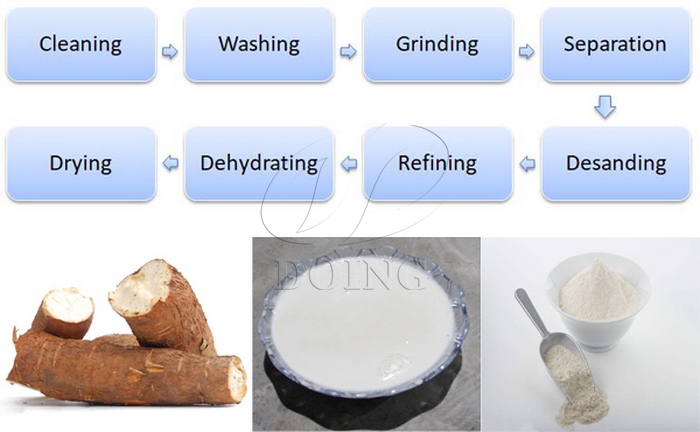 Cassava starch extraction process
Equipment List for a Small Cassava Line
The cassava starch processing equipment in a complete line is organised into seven stages: washing, breaking, extraction, refining, dewatering, drying, and sieving/packing. The smallest economical set starts at 2 t/h of fresh cassava feed, which matches the throughput floor of the individual units in the line.
| Stage | Equipment | Function | Key parameters |
|---|---|---|---|
| Washing | Dry sieve → paddle washing machine (peeling can be integrated) | Remove soil, sand and stones; de-stone | 2–30 t/h |
| Breaking | Cutting machine → cassava rasper | Open the cells and release starch | Breaking rate ≥96%; 1,800–2,950 r/min |
| Extraction | Centrifugal sieve (4–5 stages in series) | Separate fibre from starch milk | 4–55 t/h |
| Refining | Desander → hydrocyclone station (18 stages) | Remove sand and protein; purify | Starch milk concentration after refining: 20–23 °Bé |
| Dewatering | Peeler centrifuge | Reduce moisture before drying | 36.5–38% |
| Drying | Flash dryer | Reach safe storage moisture | Outlet 10–12% |
| Sieving & packing | Vibration sieve + packing machine | Grade and bag the finished starch | 10–100 mesh |
Jinrui Foodtech (Henan Jinrui) builds cassava starch production lines across a range of capacities, with delivered references including a line producing 20 t of starch per day in Ogun State, Nigeria, and a 20 t/day (fresh root feed) cassava starch line in Ghana.
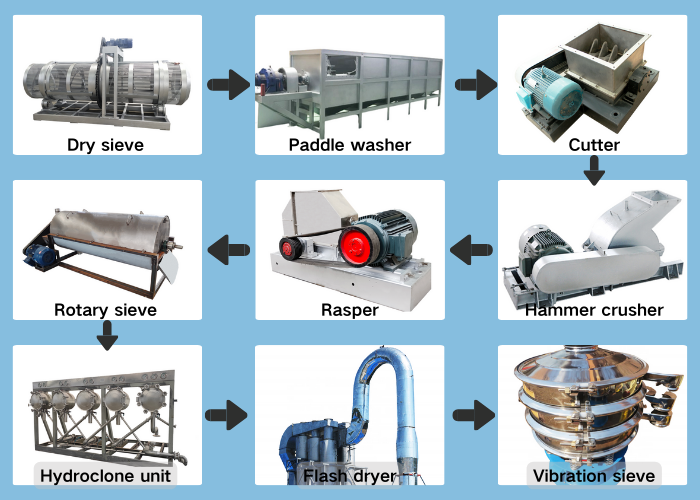 Small-scale cassava starch processing equipment
Site, Power and Water Requirements
A 2 t/h line can start in a building of roughly 12 × 30 m with 6 m clear height, but power and water decide whether it runs at all, so work those out before you commit to a building.
| Item | Reference value |
|---|---|
| Footprint | 2 t/h: 12 × 30 m, 6 m clear height; 8–12 t/h: 60 × 12 m with drying on a separate upper floor |
| Power | About 180–190 kWh per tonne of starch |
| Water | About 2 t per tonne of roots (~30% washing, ~70% cell liquid); a recirculation system can cut this by roughly 30% |
| Labour | 6–10 for a small line (feeding, washing, processing, drying, control, packing, shift lead) |
| Water tanks | Fresh-water tank sized for 10 hours of use; recirculation tank for 1 hour, with a 5%–10% slope at the bottom |
| Drying fuel | Per tonne of starch: 1 t steam, or 130 kg coal, or 70–80 m³ gas, or 55 kg LPG |
| Off-grid option | Diesel-driven key units, with power-heavy stages scheduled into windows of stable supply |
Where the grid is unreliable, a diesel-driven set on the critical units is workable — but accept that the energy cost per tonne will be higher, and factor that into your payback rather than discovering it later.
A Phased Path from Small to Full Scale
For a cooperative wondering how to start cassava starch processing, the lowest-risk approach is not to buy the whole line at once. Install it in three steps — start producing, add the profit stage, then expand — and you only spend against money you have already earned.
| Phase | What to add | Output | Why this order |
|---|---|---|---|
| Phase 1 | Washing + breaking + extraction + simple dewatering | Wet / semi-dry starch | Stop the loss first; local food processors will buy it and pay you back |
| Phase 2 | Drying + sieving + packing | Dry starch (10–12% moisture) | Opens export and long-distance markets; the profit mainstay |
| Phase 3 | Extra refining stages + automation + capacity | High-purity starch | Expand against confirmed orders, not ahead of them |
Phase one already stops the loss: it turns roots you would otherwise dump into starch that has a buyer. The drying stage in phase two is where the margin grows, because dry starch can travel.
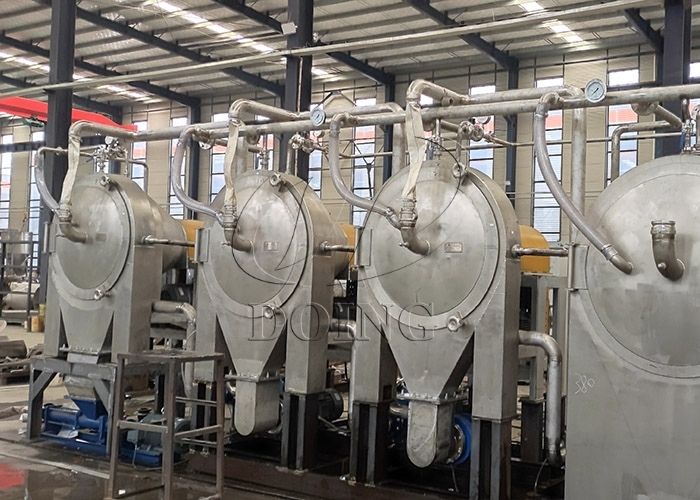 Centrifuge sieve for cassava starch extraction
Frequently Asked Questions
Does cassava need to be peeled before starch extraction?
No. A starch line does not target the peel the way a flour line does — peeling can be integrated into the paddle washer, and most starch in the peel and fibre is recovered downstream. Peeling only becomes essential when you want white cassava flour rather than starch.
How much starch does a tonne of fresh cassava yield?
About 250 kg of dry starch, a ratio of roughly 4:1 fresh roots to starch. Root starch content varies by variety, age and season, so treat it as a planning figure, not a guarantee.
Is it worth processing into starch, or is selling fresh roots better?
Fresh roots have to move within days and usually sell at harvest-time prices, when everyone is selling. Starch concentrates about four tonnes of roots into one tonne that stores and travels, so it holds value that fresh roots lose.
What do you do when roots arrive faster than the line can process?
Handle the oldest roots, and any showing vascular streaking, first. Keep the rest shaded and ventilated instead of piled, and run the longest daily shift you can sustain during the peak weeks so the backlog clears before roots pass the day-four mark.
What happens to the fibre and the wash water?
The extracted fibre can go to animal feed or compost, and recirculating the wash water cuts fresh-water use by roughly 30%. Check your local discharge limits before you build, and size the settling or treatment pit accordingly.
How should the finished starch be stored?
Keep it dry, cool and off the floor, in moisture-barrier bags. At 10–12% moisture, properly packed starch keeps for months, which is what makes long-distance and out-of-season selling possible.
Send Jinrui Foodtech your peak daily root intake, your target product (starch) and your site and power conditions, and you will get a tailored equipment list and capacity plan back — sized so your roots reach the line well before they spoil.