

Fresh Cassava vs. Dried Cassava Chips for Cassava Flour Production: What Is the Difference?
Fresh cassava roots and dried cassava chips can both be used to produce cassava flour, but they enter the production process in different conditions. Fresh cassava requires more complete processing, including cleaning, peeling, size reduction, dewatering and drying, while dried cassava chips can generally go directly to milling and sieving. This results in differences in raw material handling, equipment, investment and energy use.
Neither option is universally better. The more suitable choice depends mainly on the availability and quality of the raw material, the required production capacity, the target flour specification, and the processing line and investment required for the project.
1. Raw Material Supply, Transportation and Storage
Fresh cassava has a short post-harvest window, so a flour plant needs a sufficiently reliable supply of suitable roots and timely delivery to the factory. IITA recommends processing fresh roots within about one to two days after harvest to maintain the desired HQCF quality. Research on cassava post-harvest deterioration also shows that deterioration can begin within 24 hours after harvest.
For a fresh-cassava project, therefore, the key consideration is not simply whether cassava is grown nearby. The available quantity, root quality, supply continuity and time from harvest to processing all affect production stability.
Dried cassava chips offer more flexibility in transportation and raw material scheduling because the drying stage has already been completed. However, chip quality still needs to be controlled during purchasing and storage, particularly moisture, cleanliness, mould and storage conditions.
In practical terms:
| Raw material | Main supply consideration |
| Fresh cassava roots | Reliable supply, suitable root quality and rapid delivery/processing |
| Dried cassava chips | Consistent chip quality, suitable moisture and proper storage |
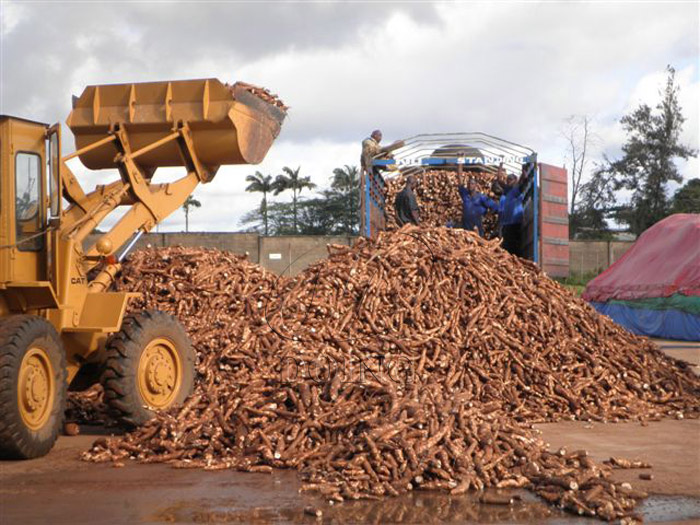 Fresh cassava for flour processing
2. Production Capacity and Processing Efficiency
Raw material form alone does not determine plant capacity. Both fresh cassava and dried cassava chips can be used for small, medium or larger-scale flour production.
The main difference is the processing configuration required to achieve the target output.
Fresh cassava is suitable for an integrated flour line when sufficient roots can be supplied and processed continuously. Dried chips are particularly practical when a reliable supply of suitable chips already exists and the project mainly requires milling and sieving capacity.
For example, Henan Jinrui supplied a 5 TPD semi-automatic fresh-cassava flour processing line for the Ministry of Agriculture of Guyana. The project processes approximately 25–30 tons of fresh cassava per day to produce 5 tons of flour, with equipment including washing, peeling, crushing, dewatering, drying and sieving.
(Project details:Guyana 5TPD Cassava Flour Processing Line Project | Henan Jinrui)
This shows why capacity should be matched with the actual raw material supply and processing route, rather than choosing plant size based only on whether the raw material is fresh or dried.
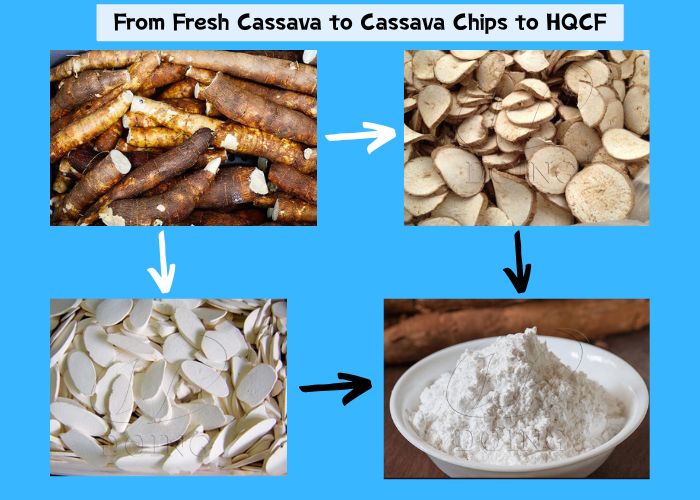 Dried cassava chips for cassava flour production
3. Product Quality and Market Application
Both fresh cassava and dried cassava chips can be used to produce cassava flour, including high-quality cassava flour (HQCF). The final quality depends on the raw material condition and how well the processing parameters are controlled.
IITA gives the following typical HQCF reference values:
| Quality parameter | Typical HQCF reference |
| Moisture | 8–10% |
| Fiber | 2% |
| Ash | 3% |
| Fine flour (<0.6 mm) | 90% |
| HCN | 10 mg/kg |
| Starch | 65–70% |
| Protein | 1.3–2.0% |
These are typical reference values rather than universal specifications. Actual requirements should follow the target market and buyer specification. IITA notes that HQCF properties are affected by cassava variety, root freshness and processing conditions.
For fresh cassava, root freshness, dry matter, starch content and processing time are important factors.
For dried cassava chips, the focus shifts to chip moisture, cleanliness, mould or insect damage, storage condition and milling performance.
HQCF can be used in food and industrial applications, including bread, soups, glucose syrups and alcohol production. Therefore, the important question is not whether fresh roots or dried chips are inherently better, but whether the selected raw material and processing line can consistently meet the required flour specification.
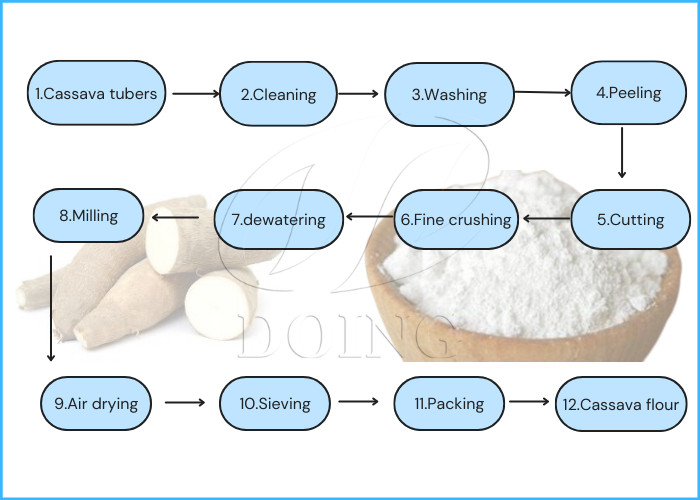 Cassava flour production line
4. Processing Method and Equipment
The main equipment difference comes from how much processing still needs to be completed after the raw material reaches the factory.
Fresh cassava roots
A typical fresh-root cassava flour line may include:
Washing → Peeling →Grating/Crushing → Dewatering → Drying → Milling → Sieving → Packaging
The line therefore needs equipment for raw-root preparation, moisture removal and drying before the flour can be milled and screened. IITA describes grating, pressing, drying, milling and screening as important stages in HQCF production, while chipping can also be used as an alternative to some wet-processing stages.
Dried cassava chips
A milling-based line is much simpler:
Cleaning/Sorting → Milling → Sieving → Packaging
The chips have already been prepared and dried before entering the flour factory. The main processing task is therefore to mill the chips to the required particle size and remove unwanted particles.
The key difference is not simply “wet processing vs. dry processing.” It is the condition of the raw material when it enters the factory and the processing stages that remain to be completed.
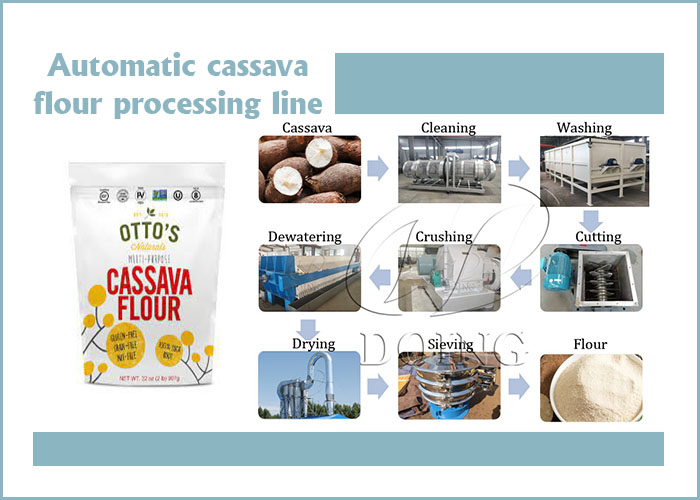 Cassava flour making equipment
5. Equipment Investment and Raw Material Cost
Because a fresh-root line includes more processing stages, its equipment investment is generally higher than a dried-chip milling line.
Based on historical Henan Jinrui project references:
| Processing route | Indicative equipment investment |
| Fresh cassava → cassava flour | USD 50,000–100,000 |
| Dried cassava chips → cassava flour | USD 10,000–20,000 |
These are historical project reference ranges, not fixed market prices. Actual investment depends on capacity, automation level, equipment configuration, material requirements and project conditions.
Raw material cost should also be compared based on the amount required to produce the finished flour rather than simply the purchase price per ton.
IITA reports an average requirement of approximately 5.5 tons of fresh cassava roots for 1 ton of HQCF, although the actual conversion depends on dry matter, starch content, variety and processing losses.
For dried chips, a Henan Jinrui project reference indicates that approximately 1.1–1.3 tons of dried cassava chips can produce 1 ton of cassava flour, depending on chip quality and processing losses. Dried chip conversion reference
Therefore, a more meaningful cost comparison is:
raw material cost required to produce 1 ton of the target cassava flour
rather than simply comparing the purchase price of one ton of fresh roots with one ton of dried chips.
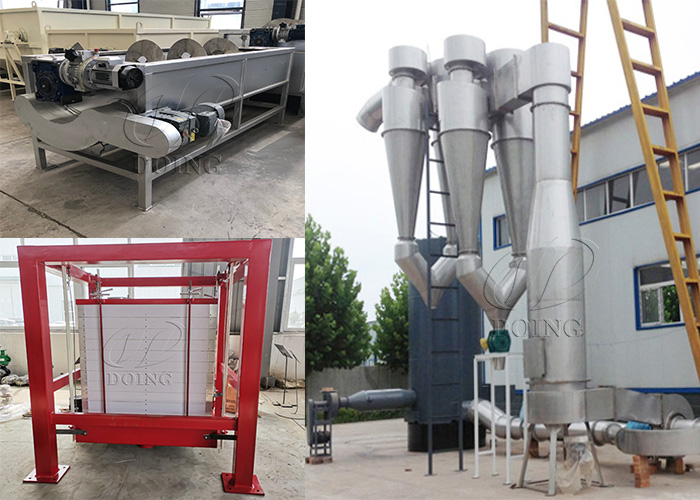 Cassava flour processing machine
6. Energy Consumption
Energy requirements differ mainly because the two routes use different key processing equipment.
For fresh cassava flour production, drying is the main energy-intensive stage inside the flour factory. Flash dryers use electrical power for blowers and also require a heat source for drying. IITA identifies electricity for blowers and fuel for heat as important components of flash-drying costs.
For dried cassava chips, the drying stage has already been completed before the chips reach the flour plant. The main energy-consuming operation inside the plant is therefore milling.
The actual power requirement varies with equipment capacity and configuration.
| Processing route | Main energy-consuming equipment | Henan Jinrui equipment reference |
| Fresh cassava → flour | Flash dryer | Electrical power: 22–260 kW |
| Dried cassava chips → flour | Fine mill | Motor power: 11–30 kW |
The main difference is therefore where the energy-intensive drying stage takes place: inside the fresh-cassava flour factory or before the dried chips reach the flour plant.
7. Which Raw Material Is More Suitable?
There is no single answer for every cassava flour project. The better choice depends on raw material supply, required capacity, target flour specification and the processing system that fits the project.
| Raw material | More suitable when |
| Fresh cassava roots | Stable and sufficient fresh-root supply is available; the project is designed for continuous or large-scale HQCF production; and roots can be delivered and processed soon after harvest. |
| Dried cassava chips | Reliable-quality chips are available; the project needs more flexibility in sourcing, transportation or storage; and a simpler milling-based flour line is preferred. |
Henan Jinrui configures cassava flour processing lines according to the raw material form, target capacity and required flour quality, rather than using one standard equipment configuration for every project.
Planning a Cassava Flour Processing Plant?
Whether you plan to process fresh cassava roots or dried cassava chips, Henan Jinrui can configure the processing line according to your raw material, target capacity and flour specification. Contact us to discuss your project and get a suitable equipment solution.
How much fresh cassava is needed to produce 1 ton of HQCF?
An IITA reference gives an average of about 5.5 tons of fresh cassava roots for 1 ton of HQCF. The actual requirement can vary depending on root dry matter, starch content, variety and processing losses.
How much dried cassava chips are needed to produce 1 ton of cassava flour?
A Henan Jinrui project reference indicates approximately 1.1–1.3 tons of dried cassava chips for 1 ton of flour. The actual ratio depends on chip quality, moisture and milling losses.
What should I check before buying dried cassava chips for flour production?
Check at least the moisture content, visible mould, foreign matter, cleanliness, storage condition and consistency of chip quality. Poor-quality chips can affect both flour yield and the ability to meet the required flour specification.
Can dried cassava chips be stored before milling?
Yes. Properly dried chips can be stored for an extended period when protected from moisture, insects and mould. Storage conditions are important because moisture uptake during storage can reduce raw-material quality and affect subsequent milling and flour stability.