

Food-Grade vs Industrial-Grade Cassava Starch Line: Equipment and Cost Differences
The main difference between a food-grade and an industrial-grade cassava starch production line is not whether the starch will be modified, but material hygiene, purity standards and refining intensity built into the line. Food-grade lines are designed for starch that may enter the human food chain, so every surface that contacts starch milk, pulp or process water must meet strict hygiene requirements. Industrial-grade lines serve applications such as papermaking, corrugated adhesive, textile sizing or chemical fillers, where purity and whiteness requirements are lower.
Choosing the wrong grade can be costly. A food-grade line is over-specified for low-end industrial starch and raises capital cost unnecessarily. An industrial-grade line cannot be easily upgraded to food-grade later, because hygiene is determined by material, weld finish, drainage design and cleaning systems from the start.
What actually sets the two lines apart
End use decides the grade
The decision begins with the final product. If the cassava starch will be sold for food processing, snack production, sauce thickening or other edible applications, the line must meet food-grade standards. If the starch will be used in paper, adhesive, textile, construction or similar non-food applications, an industrial-grade configuration is usually sufficient.
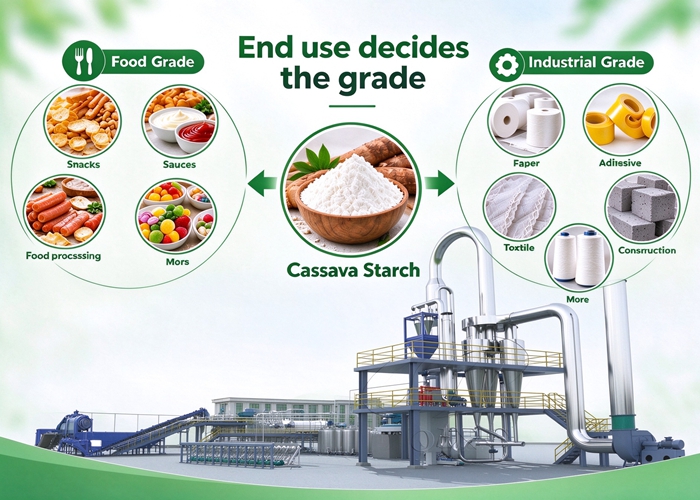 Food-grade and industrial-grade applications for production lines
Three things change between the two lines
The practical differences fall into three areas:
Contact-surface material. Food-grade lines use food-grade stainless steel on all product-contact parts. Industrial lines may use carbon steel or coated materials in non-critical zones.
Hygiene design and cleaning. Food-grade lines are built for regular sanitization and often support clean-in-place (CIP) systems. Industrial lines have lighter hygiene requirements.
Refining intensity. Food-grade lines use multi-stage separation to remove fiber, protein, cell sap, sand and fine ash. Industrial lines may use fewer stages when high whiteness and neutral taste are not required.
Chemical or physical modification, such as pregelatinization or cross-linking, is a separate question. A modified starch can be food-grade or industrial-grade. Modification equipment is an added process section, not the defining feature of an industrial-grade line.
Equipment differences that matter
Contact-surface material
In a food-grade cassava starch line, all parts that touch raw starch milk, pulp, washed starch or process water are normally made from SUS304 or SUS316 stainless steel. This includes rasping units, centrifugal sieves, hydrocyclone pipes, dewatering machines, drying feed sections and product-contact conveyors. Stainless steel reduces the risk of rust, metallic contamination and bacterial growth, and it withstands repeated washing and sanitization.
In an industrial-grade line, structural frames and some non-critical flow components may be made from carbon steel or lower-cost materials. This can reduce equipment cost, but carbon steel is more vulnerable to corrosion when exposed to acidic starch slurry or frequent washdown. Whether carbon steel is acceptable depends on the end-use specification. Some industrial applications tolerate minor iron contamination; others, such as certain adhesive or paper grades, still require rust-resistant surfaces.
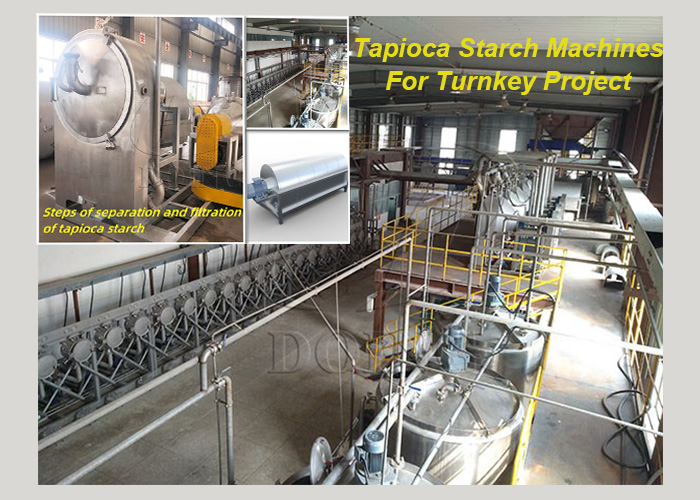 Tapioca starch machines for turnkey project
Refining and purification rigor
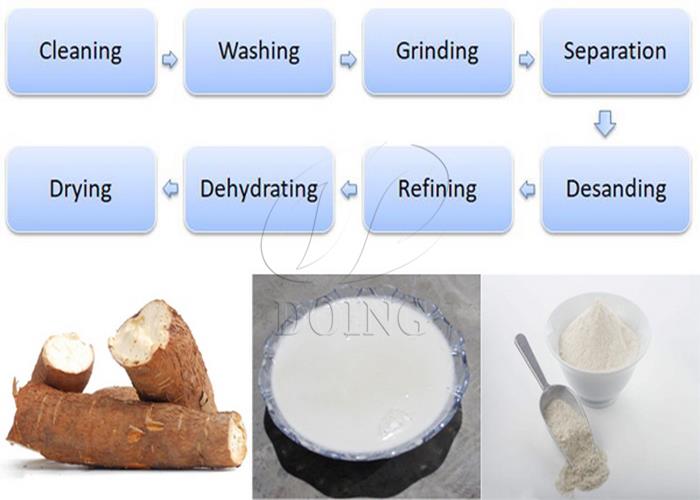
Food-grade cassava starch must meet higher standards for whiteness, purity, taste and microbial control. A typical food-grade line therefore uses a complete wet-process chain: cleaning and washing, rasping, fiber separation, desanding, multi-stage hydrocyclone refining, dewatering, drying and packing. Rasping is especially important because an efficient rasping unit releases more bound starch from cassava cells. Jinrui Foodtech (Henan Jinrui) fits its raspers with magnetic separation and premium bearings, reaching a rasping rate of 94% or higher, which improves overall starch recovery and lightens the downstream refining load.
After rasping, food-grade lines usually add centrifugal sieves or fine fiber sieves to remove residual fiber, then use multi-stage hydrocyclone stations to wash out soluble protein, cell sap and fine impurities. This multi-stage refining is what produces white, neutral-tasting starch suitable for food applications.
Industrial-grade lines can simplify this section. For papermaking, adhesive or filler-grade starch, a reduced-stage separation system may be acceptable. Some basic industrial setups use fewer hydrocyclone stages, simpler settling equipment or lighter fiber-removal sections, because the final product does not need food-level purity.
Dewatering and drying
Food-grade lines normally use enclosed, high-efficiency dewatering, and Jinrui Foodtech uses the peeler centrifuge as the standard dewatering unit here, followed by a continuous flash dryer. Rapid drying reduces moisture to below 12% and helps prevent microbial souring during storage, while the enclosed design avoids open exposure and cross-contamination.
Industrial-grade lines may accept simpler mechanical dewatering, such as filter presses, especially when the starch is used wet or processed immediately in a nearby facility. Moisture tolerance can also be wider for certain industrial applications. However, if the industrial starch must be stored, transported or sold on the open market, proper drying is still necessary.
 Cassava starch production line
How the differences translate into cost
Capital expenditure
Food-grade cassava starch lines generally require higher upfront investment. The cost increase comes from full stainless-steel fabrication, multi-stage hydrocyclone refining, enclosed dewatering and drying sections, and higher automation. An automatic food-grade line is typically priced higher than a basic industrial line of similar capacity, and the gap widens when clean-in-place systems, advanced control panels and food-grade certification documentation are included.
Industrial-grade lines can reduce capital cost by using carbon steel in non-critical areas, simplifying the refining section, or omitting certain hygiene-focused features. The saving can be significant for basic configurations, but it should be weighed against long-term durability and the intended market for the starch.
Operating and maintenance costs
Food-grade lines usually have higher sanitation costs. They consume more cleaning water, require regular sanitization and may need periodic replacement of food-grade seals and gaskets. These costs are often offset by higher product value, better market access and optimized starch recovery.
Industrial-grade lines have lower daily hygiene overhead. However, carbon-steel components exposed to acidic cassava slurry or frequent moisture may corrode or wear faster. Over time, maintenance, part replacement or unplanned downtime can reduce the initial cost advantage.
Side-by-side comparison
The table below summarises the eight points that differ most between the two lines.
| Comparison point | Food-grade cassava starch line | Industrial-grade cassava starch line |
|---|---|---|
| Typical end use | Food processing, edible starch, high-whiteness native starch | Paper, adhesive, textile sizing, chemical filler, non-food starch |
| Contact-surface material | SUS304/SUS316 stainless steel on product-contact parts | Carbon steel or coated materials may be used in non-critical zones |
| Hygiene design | Designed for regular washdown and sanitization; often supports CIP | Lighter hygiene design; cleaning depends on process needs |
| Refining intensity | Multi-stage desanding, fiber separation and hydrocyclone washing | May use fewer refining stages or simpler separation |
| Dewatering and drying | Enclosed peeler centrifuge plus continuous flash drying | Filter press or simpler dewatering may be acceptable in some cases |
| Product quality target | High whiteness, low impurity, neutral taste, food-safety compliance | Meets industrial specification; whiteness and purity requirements are lower |
| Modification section | Not required for native starch; added only if modified starch is needed | May be added if pregelatinized or chemically modified starch is required |
| Cost profile | Higher CapEx due to stainless steel, refining and hygiene systems | Lower initial cost in basic configurations; maintenance depends on material choice |
Which line fits your product
A food-grade cassava starch line is the right choice when:
The starch will be sold to food processors, retail brands or export markets that require food-safety compliance.
High whiteness, neutral taste and low impurity are important selling points.
The plant must pass buyer audits, third-party inspections or certification reviews.
You plan to build a long-term starch brand rather than supplying only internal industrial users.
You may upgrade to modified or value-added starch products in the future.
An industrial-grade configuration can be more cost-effective when:
The starch will be consumed by your own paper, adhesive, textile or chemical process.
The buyer does not require food-level purity, whiteness or taste standards.
Capital budget is limited and a simpler configuration still meets the production target.
The product will be used wet or processed immediately, so strict drying and hygiene control are less critical.
Minor iron contamination from carbon-steel surfaces is acceptable for the end application.
If the final product is edible or high-value native starch, choosing an industrial-grade line to save cost can create bigger problems later. If the starch is only for internal industrial use, a full food-grade specification may be unnecessary.
FAQ
Which certifications indicate a food-grade starch line?
A food-grade line is normally supported by food-contact material compliance, CE marking, ISO quality-management documentation and third-party inspection reports where required by the buyer market. The exact certification set depends on the destination country and the customer audit requirements.
If I start with an industrial-grade line, what would it actually cost to convert it to food-grade later?
Converting is rarely just a parts swap. You would typically have to replace all product-contact parts with stainless steel, re-finish welds and drainage, add refining and cleaning stages, and re-run hygiene validation — often at a cost approaching a new line, plus lost production during the rebuild. The cheaper decision is almost always to specify food-grade requirements before fabrication.
Which sections should I add later if I want to expand the line after installation?
Plan the growth path up front: many processors later add water-recycling and wastewater treatment, automatic control, a modified-starch (pregelatinization/cross-linking) section, or additional storage and bagging. Decide at design stage which of these will eventually be needed, so space, power and layout are reserved — retrofitting them into a finished plant is far more disruptive.
What is the rough investment range for a cassava starch line?
Investment depends mainly on capacity, automation level, material specification and whether the line is food-grade or industrial-grade. Small to medium automatic food-grade lines usually start from the low hundreds of thousands of US dollars, while larger high-capacity plants require significantly higher investment. Industrial-grade configurations can be lower in basic form, but the final price must be confirmed against the required capacity and end-use specification.
Conclusion: Match the Grade to Your End Use, Not Just the Price
Choosing between a food-grade and an industrial-grade cassava starch line is not just an equipment decision. It is a decision about market access, product quality, operating cost and long-term plant value. A food-grade line costs more at the start but opens higher-value markets and supports stricter quality control, while an industrial-grade line is a practical choice only when the starch serves non-food applications and food-level purity is genuinely not required.
If you are planning a food-grade cassava starch production line, Jinrui Foodtech can help evaluate your capacity target, raw cassava supply, utility conditions and product specification, then recommend a turnkey configuration that balances hygiene standards, refining intensity and investment cost. Reach out to our team with your capacity and end-use requirements, and get a line proposal matched to the grade your product actually needs.